

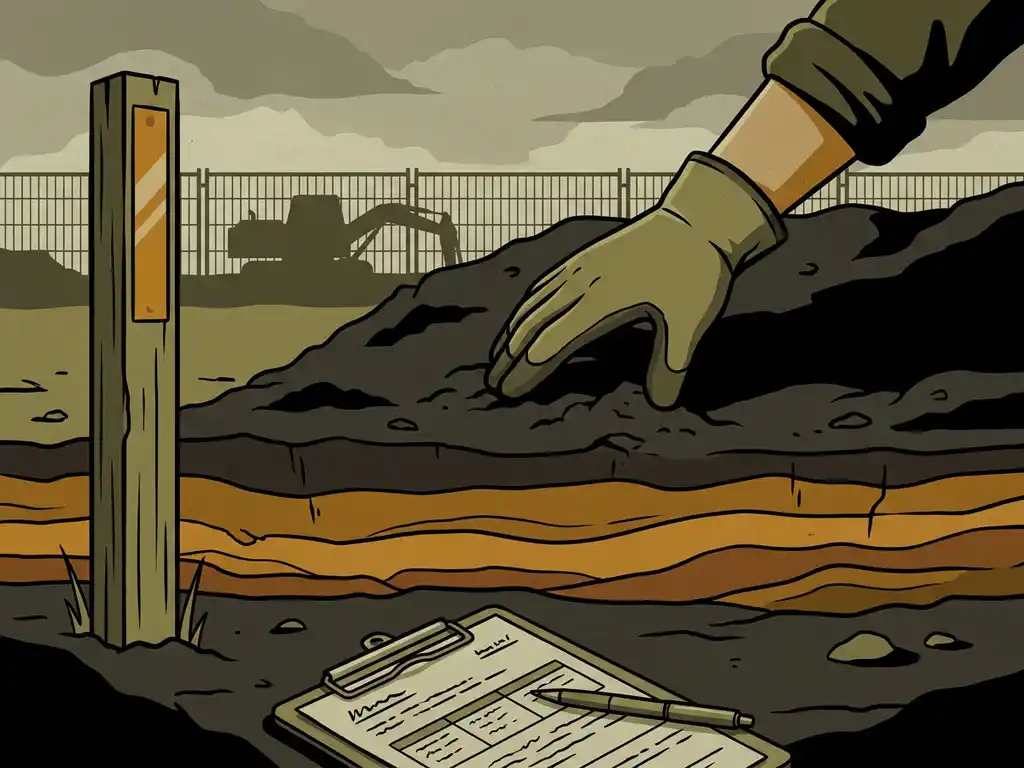
When soil contamination is found, responsibility typically falls on the party that caused the pollution. Under Belgian law and the VLAREBO decree enforced by OVAM, the polluter bears primary liability for investigation and remediation costs. However, when the polluter cannot be identified or no longer exists, the current landowner may become legally obligated to act. The questions below unpack how liability is determined, shared, and managed in practice.
Who actually pays for soil remediation?
The polluter pays. This is the foundational principle of Belgian soil remediation law. Under VLAREBO, the party responsible for introducing contamination into the soil is legally required to fund the investigation, risk assessment, and remediation work. If that party can be clearly identified and is still solvent, the financial responsibility rests with them.
In practice, however, the situation is rarely this clean. Many contaminated sites involve historical pollution from industrial activities that took place decades ago. The company that operated the facility may have changed ownership multiple times, merged, or been dissolved entirely. In those cases, OVAM will look at the chain of ownership and determine who holds current legal responsibility for the plot.
When a landowner acquires a site knowing it is contaminated, they often negotiate remediation costs into the purchase price or require the seller to fund a soil remediation project before the transaction closes. A notary is legally required to consult the OVAM soil certificate database before any real estate transaction involving land in Flanders, which means contamination status is formally disclosed at the point of sale.
Get in Touch
Let’s Talk Microbial Solutions
Book a conversation with Stijn, our CEO, or send us your request.
| Book an Appointment | Request Information |
What happens when the polluter can no longer be identified or found?
When the original polluter is untraceable or legally extinct, the obligation to remediate shifts to the current landowner. OVAM does not leave contaminated sites unaddressed simply because the responsible party has disappeared. If you own the land, you may be required to take action even if you did not cause the problem.
This is one of the most difficult situations a project manager or site owner can face. The costs of remediation can be substantial, and there is no legal mechanism to recover those costs from a party that no longer exists. In these circumstances, it becomes especially important to understand which remediation approaches are technically feasible and financially proportionate.
Some sites qualify for public funding or subsidies, particularly when the contamination poses a risk to public health or when the landowner is a municipality or public body. OVAM maintains specific procedures for so-called “orphan sites” where the polluter cannot be held accountable. Even so, the process of demonstrating that the polluter is genuinely untraceable requires documentation and often legal guidance.
Does buying contaminated land make you responsible for cleaning it up?
Yes, in most cases it does. Purchasing contaminated land in Flanders transfers a significant share of legal responsibility to the buyer, even if the contamination predates your ownership. The OVAM soil certificate issued before the transaction informs the buyer of the contamination status, and proceeding with the purchase after receiving that certificate means you are entering the transaction with full knowledge.
There are important nuances. The degree of responsibility depends on whether the contamination was disclosed, whether you are classified as an innocent owner under VLAREBO, and whether the previous owner or polluter has signed a remediation obligation. In some transactions, the seller retains responsibility for historical contamination while the buyer takes on obligations for any new pollution that occurs after the transfer.
For developers and municipalities acquiring brownfield sites, this is a central risk management question. A soil remediation assessment before finalizing a purchase gives you a clearer picture of what you are taking on, both technically and financially. Knowing whether biological treatment is feasible, for example, can significantly change the cost estimate and timeline for a project.
What are the legal obligations of a landowner under OVAM rules?
A landowner in Flanders is legally obligated to investigate and remediate soil contamination when OVAM determines that a risk exists. The VLAREBO decree defines when a descriptive soil investigation is required, when a risk assessment must follow, and under what conditions active remediation is mandatory. Non-compliance can result in enforcement measures, fines, or OVAM carrying out the work at the owner’s expense.
The key obligations break down as follows:
- Soil investigation: Required when contamination is suspected or discovered, often triggered by a change of land use, a building permit application, or a notification to OVAM.
- Risk assessment: If contamination is confirmed, you must assess whether it poses an unacceptable risk to human health, groundwater, or the surrounding environment.
- Remediation plan: When a risk is established, OVAM requires a remediation plan to be submitted and approved before work begins.
- Monitoring and reporting: During and after remediation, regular monitoring reports must be submitted to OVAM to demonstrate progress and eventual compliance.
The monitoring obligation is often underestimated in terms of cost and administrative burden. Molecular monitoring tools that quantify the activity of specific microorganisms in the soil can make this process more efficient and provide regulatorily defensible data at each reporting interval. Avecom offers this type of molecular soil analysis as part of its remediation support services, which helps project managers meet OVAM reporting requirements with concrete, measurable data rather than qualitative assessments.
How is responsibility shared when multiple parties have used the same site?
When multiple parties have operated on the same site over time, responsibility for contamination is determined by identifying which party introduced which contaminants and when. OVAM applies the polluter pays principle to each identified source, which means liability can be split between former operators, current owners, and in some cases tenants or users who conducted activities that contributed to the pollution.
In practice, establishing who caused what requires a combination of historical site investigation, chemical fingerprinting of contaminants, and sometimes legal proceedings. If one party is insolvent or untraceable, their share of the liability does not automatically disappear. It may fall to the remaining responsible parties or, in some cases, to the current landowner.
This complexity is particularly common on industrial sites that have changed function multiple times. A former dry-cleaning facility, for example, may have introduced chlorinated solvents into the groundwater, while a later tenant may have added fuel contamination from an underground storage tank. Each contamination type is assessed separately, and the remediation strategy may need to address multiple contaminant profiles simultaneously.
For sites with volatile organochlorine compounds (VOCl) such as chlorinated solvents, biological remediation is often the most practical approach when excavation is not feasible. Avecom’s biological soil remediation services include microcosm testing to determine whether in-situ biodegradation is viable for a specific soil matrix and contaminant combination, which is a critical step before committing to a full remediation strategy.
When should a project manager involve a soil remediation specialist?
A soil remediation specialist should be involved as early as possible, ideally before a site is purchased or a building permit is applied for. The most expensive mistakes in soil remediation happen when project timelines and budgets are set without a realistic understanding of what the contamination requires. Early specialist input prevents those assumptions from becoming costly surprises later in the project.
There are specific trigger points where specialist involvement is not just advisable but necessary:
- Before a real estate transaction: To assess the contamination status and estimate remediation costs before they become your liability.
- When a building permit is blocked: Contaminated soil can prevent development approval, and a specialist can advise on what remediation is required to proceed.
- When classical techniques have failed: If excavation is not feasible due to existing structures, high groundwater levels, or prohibitive cost, a specialist can evaluate whether biological or in-situ approaches are viable.
- When OVAM requires a remediation plan: Preparing a technically sound and regulatorily compliant plan requires specialist expertise.
- When monitoring obligations are ongoing: A specialist can design a monitoring program that is both cost-effective and sufficient to satisfy OVAM’s reporting requirements.
For contamination involving chlorinated solvents or other persistent compounds, the specialist you involve should have specific experience with those contaminant types. General environmental consultants may not have the microbiological expertise needed to evaluate whether enhanced biodegradation is feasible or how to design a bioaugmentation approach. The Avecom team, with its background in microbial resource management and over 30 years of experience in environmental biotechnology, provides that level of technical depth for complex contaminated sites where standard approaches have not delivered results.
If you are managing a site where contamination has been found and the path forward is unclear, the first practical step is usually a feasibility assessment. This gives you the data you need to make decisions about remediation strategy, timeline, and budget before committing to a full-scale intervention. Contact Avecom for a no-obligation screening to determine what biological remediation options may be available for your specific situation.
Related Articles
- What is anaerobic fermentation used for in industry?
- How do you turn a food processing waste stream into a valuable product?
- What is the difference between fermentation R&D and contract production?
- Why is sludge management important in industrial wastewater treatment?
- What should you do when your wastewater plant misses discharge limits?