

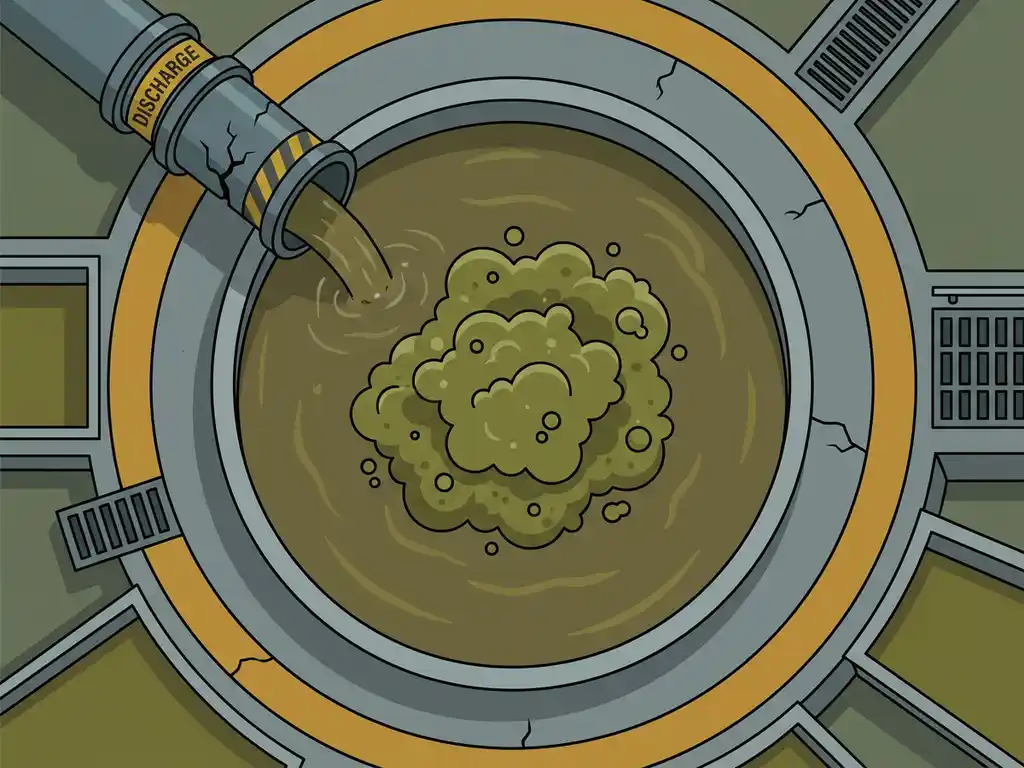
A discharge limit exceedance is rarely a single event with a single cause. For environmental and production managers in food processing, chemicals, or pharmaceuticals, the moment an inspector flags a violation, the pressure is immediate: explain what went wrong, fix it fast, and prove it will not happen again. Yet when wastewater treatment is not working as expected, the instinct to reach for a quick chemical fix often masks a deeper process problem that will resurface within weeks. Understanding what actually drives non-compliance, and what a structured response looks like, is the difference between a one-off incident and a recurring liability.
This article walks through the most common causes of industrial wastewater compliance failure, the steps to take immediately after a breach, and the longer-term process improvements that deliver lasting results, including how biological treatment can outperform chemical dosing when violations become persistent.
Common root causes of discharge limit exceedances
Most violations trace back to one of four underlying problems: hydraulic overload, organic overload, nutrient imbalance, or microbial community instability. In seasonal food production, for example, peak processing periods generate sudden spikes in COD, nitrogen, or phosphorus that a system sized for average loads simply cannot absorb. The result is a surge in effluent concentrations that breaches permit thresholds before operators can respond.
Sludge problems in wastewater treatment are another frequent culprit. Poor sludge settleability, bulking caused by filamentous bacteria, or loss of active biomass through washout all reduce the biological capacity of the system. When the microbial community is disrupted, whether by a toxic shock, a sudden temperature change, or antibiotic residue in the influent, treatment efficiency drops sharply. These are not equipment failures in the traditional sense; they are ecosystem failures that require a microbiological response, not just a mechanical one.
Get in Touch
Let’s Talk Microbial Solutions
Book a conversation with Stijn, our CEO, or send us your request.
| Book an Appointment | Request Information |
Immediate steps to take when limits are exceeded
The first priority is containment and documentation. Isolate the non-compliant stream if possible, notify the relevant authority according to your permit conditions, and begin sampling at multiple points in the process to locate where performance is breaking down. A single effluent sample tells you there is a problem; influent, intermediate, and effluent samples together tell you where it is.
Simultaneously, review recent operational data for anomalies: changes in influent composition, shifts in pH or temperature, unusual sludge volume index readings, or recent maintenance events that may have disrupted the biological community. A microbiological audit of your treatment installation at this stage provides far more actionable insight than generic troubleshooting. Understanding which microbial groups are present, which are depleted, and which are dominating gives operators a precise target for corrective action rather than a trial-and-error approach.
How biological treatment outperforms chemical dosing for persistent violations
Chemical dosing, whether for phosphorus precipitation, pH correction, or COD reduction, addresses symptoms rather than causes. It is often the fastest short-term fix, but it comes with compounding costs: reagent purchasing, increased sludge volumes, higher disposal fees, and a growing carbon footprint. When violations are seasonal or linked to load variability, chemical consumption scales with the problem, and the cost trajectory becomes unsustainable.
Biological treatment works differently. A well-managed microbial community degrades organic compounds, converts nitrogen, and removes phosphorus through natural metabolic pathways. The key word is well-managed. Systems that struggle with persistent non-compliance often have the right infrastructure but the wrong microbial balance. Steering and optimizing that balance, through targeted inoculation, process parameter adjustment, or biofilm management, is precisely where specialist expertise adds measurable value.
Avecom, a Ghent-based environmental biotechnology company with over 27 years of experience in microbial process optimization, has developed the ABIL technology specifically to accelerate the startup or recovery of biological filters without requiring a full system restart. This means facilities can correct a failing biological stage with significantly less downtime than a conventional overhaul would require, a critical consideration when production cannot simply stop.
When to consider a feasibility study or pilot test
If violations are recurring rather than isolated, or if the existing system consistently underperforms against tightening discharge standards, incremental fixes will not close the gap. This is the point at which a structured feasibility study or pilot-scale test delivers the most value. Rather than committing to a full system redesign based on assumptions, a lab or pilot test characterizes the actual wastewater, identifies the optimal microbial consortia for the specific influent composition, and quantifies achievable treatment performance under controlled conditions.
For industries facing regulatory pressure from frameworks such as VLAREM or the Water Framework Directive, this evidence base is also strategically important. Regulators respond more favorably to operators who can demonstrate a documented improvement trajectory backed by technical data than to those who simply report corrective actions taken. A pilot-scale feasibility test translates directly into a defensible compliance roadmap.
The decision point is straightforward: if the cost of repeated violations, including fines, increased discharge tariffs, and reputational risk, exceeds the cost of a structured investigation, the feasibility study pays for itself before implementation even begins.
Turning wastewater into a resource instead of a liability
The most significant shift in industrial water management thinking over the past decade is the recognition that wastewater streams carry recoverable value. Nitrogen-rich reject water, for instance, has traditionally been a disposal problem. Treated through specialized microbial processes, that same nitrogen can be recovered as a high-quality input for animal feed production, converting a compliance cost into a partial revenue stream.
This is the logic behind Avecom’s ProMic platform, which links biological wastewater treatment with microbial protein production. Nutrient-rich side streams from food processing are processed through controlled fermentation to produce single-cell protein, effectively closing a loop that previously ended at the discharge point. The business case shifts from “how do we meet limits at minimum cost” to “how do we recover value while meeting limits,” which is a fundamentally different and more sustainable framing.
For production managers already under pressure to justify environmental investment, this dual-value proposition, compliance assurance combined with resource recovery, strengthens the internal case for upgrading biological treatment infrastructure. It also positions the facility ahead of regulatory trends that are moving steadily toward circular economy requirements rather than simple end-of-pipe compliance.
If your current system is struggling to meet discharge limits reliably, the starting point is a clear-eyed diagnosis of where and why it is failing. From there, the path to durable compliance, and potentially to valorizing what was previously a waste stream, becomes considerably more concrete. Explore Avecom’s biological treatment services to understand what a tailored, science-driven approach looks like in practice.