

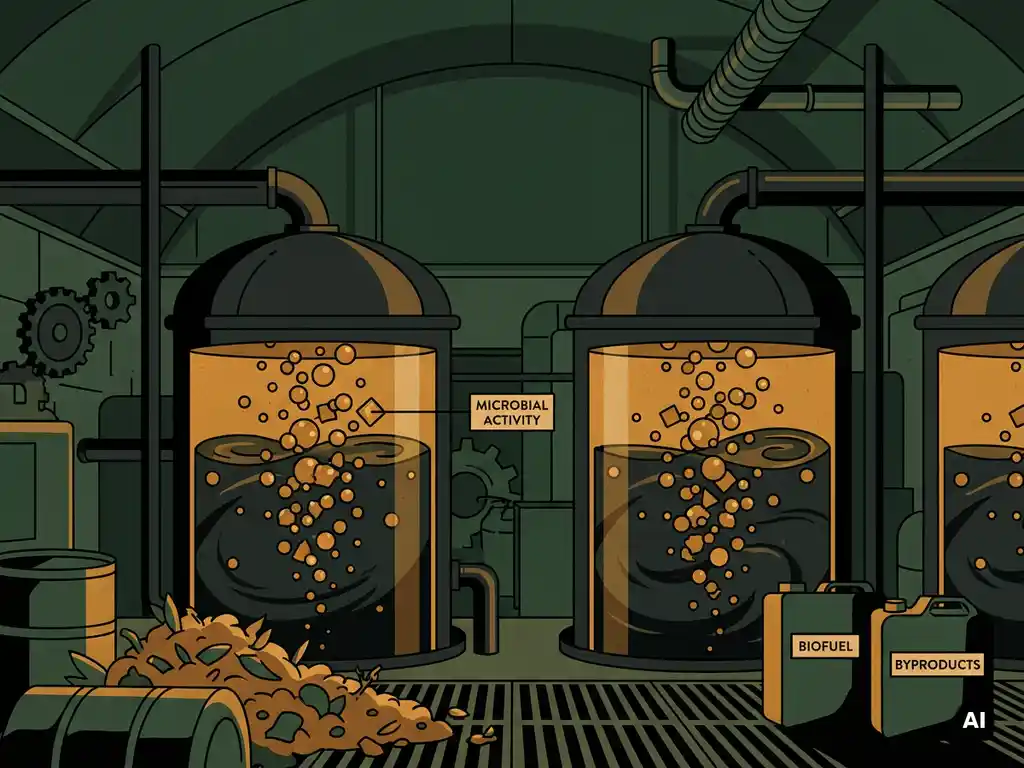
Anaerobic fermentation is used in industry to break down organic material and synthesize valuable compounds without oxygen, producing outputs such as biogas, organic acids, alcohols, and fermented food and feed ingredients. It is one of the oldest and most widely applied microbial processes in industrial biotechnology, operating across sectors from energy and chemicals to food production and waste treatment. The sections below address the most common technical questions companies face when working with anaerobic fermentation at scale.
What industries rely most on anaerobic fermentation?
The industries that rely most heavily on anaerobic fermentation are wastewater treatment, renewable energy, food and beverage production, pharmaceutical and chemical manufacturing, and agriculture. Each of these sectors uses anaerobic microbial processes either to convert waste streams into useful products or to synthesize specific compounds that aerobic conditions cannot produce efficiently.
In wastewater treatment, anaerobic digestion is the standard method for stabilizing organic sludge and recovering energy from high-strength effluents. Municipal treatment plants and industrial facilities processing food, dairy, or brewery waste routinely rely on anaerobic reactors to reduce organic load while generating biogas as a recoverable energy source.
The renewable energy sector uses anaerobic digestion at large scale to produce biogas from agricultural residues, food waste, and manure. This biogas is either burned for heat and electricity or upgraded to biomethane and injected into gas grids.
In food and beverage production, anaerobic fermentation underlies the production of beer, wine, yogurt, cheese, sourdough bread, vinegar, and fermented vegetables. Industrial food manufacturers also use it to produce flavor compounds, preservatives, and functional ingredients.
The chemical and pharmaceutical industries apply anaerobic fermentation to produce organic acids such as lactic acid, succinic acid, and butyric acid, as well as solvents like butanol and ethanol. These are platform chemicals used in bioplastics, pharmaceuticals, and specialty materials.
Finally, agriculture and animal nutrition increasingly use anaerobic fermentation to valorize processing side streams into fermented feed ingredients, reducing both waste and raw material costs.
How does anaerobic fermentation differ from aerobic fermentation in industrial settings?
The fundamental difference between anaerobic and aerobic fermentation in industrial settings is the presence or absence of oxygen as the terminal electron acceptor. In aerobic fermentation, microorganisms use oxygen to fully oxidize substrates, producing carbon dioxide, water, and biomass at high yield. In anaerobic fermentation, microorganisms use alternative electron acceptors or fermentative pathways, producing a wider range of end products such as organic acids, alcohols, and gases, but generating less biomass per unit of substrate consumed.
Energy yield and process economics
Aerobic processes generate significantly more ATP per mole of substrate, which means faster microbial growth and higher biomass yields. This makes aerobic fermentation preferable when the goal is biomass production or when rapid conversion speed is critical. Anaerobic processes are energetically less efficient for the microorganism, but this is often an advantage for the operator: less energy is wasted as heat, aeration costs are eliminated, and the product spectrum shifts toward reduced compounds that have direct industrial value.
Infrastructure and operational requirements
Aerobic fermenters require continuous oxygen supply, typically through sparging and mechanical agitation, which represents a significant operating cost at scale. Anaerobic reactors are sealed systems that must exclude oxygen, which simplifies aeration infrastructure but demands tight control over sealing, gas management, and redox conditions. Anaerobic systems also tend to operate at lower volumetric productivities, meaning longer residence times and larger reactor volumes for equivalent throughput. However, the absence of aeration costs and the potential to recover biogas as an energy product can make anaerobic processes more economically attractive for certain applications, particularly where the feedstock is a waste stream with negative or low cost.
Get in Touch
Let’s Talk Microbial Solutions
Book a conversation with Stijn, our CEO, or send us your request.
| Book an Appointment | Request Information |
What products are made through anaerobic fermentation?
Anaerobic fermentation produces biogas (primarily methane and carbon dioxide), ethanol, lactic acid, butyric acid, succinic acid, acetic acid, butanol, hydrogen, and a range of fermented food and feed products. The specific product depends on the microbial community or organism used, the substrate, and the process conditions applied.
- Biogas and biomethane: Produced by methanogenic archaea from complex organic matter in multi-stage anaerobic digestion processes. Used for heat, electricity, or grid injection as renewable natural gas.
- Ethanol: Produced by yeasts such as Saccharomyces cerevisiae fermenting sugars under anaerobic conditions. Used as biofuel and as a chemical feedstock.
- Lactic acid: Produced by lactic acid bacteria from sugars. Used in food preservation, bioplastics (polylactic acid), and pharmaceuticals.
- Butyric and succinic acids: Platform chemicals produced by anaerobic bacteria from agricultural residues or food processing streams. Used in flavoring, polymers, and specialty chemicals.
- Butanol: Produced by solventogenic clostridia in acetone-butanol-ethanol (ABE) fermentation. Used as a solvent and fuel additive.
- Fermented feed and food ingredients: Mixed anaerobic cultures applied to food processing side streams can produce fermented biomass with improved digestibility and nutritional profile.
The diversity of this product portfolio is one reason anaerobic fermentation continues to attract industrial R&D investment. Many of these products are direct replacements for petrochemical equivalents, making anaerobic microbial fermentation a central tool in the shift toward biobased manufacturing.
Why do anaerobic processes fail to scale from lab to pilot?
Anaerobic fermentation processes most commonly fail during scale-up because process parameters that appear stable at lab scale become difficult to control in larger reactors, particularly mixing homogeneity, pH gradients, temperature distribution, and gas-liquid dynamics. These factors interact in ways that are not always visible at the milliliter or liter scale but become critical at hundreds or thousands of liters.
At lab scale, a small stirred vessel can maintain near-perfect mixing with minimal energy input. At pilot scale, the same mixing intensity per unit volume is far harder to achieve, and concentration gradients develop for substrates, metabolites, and pH. Anaerobic microbial communities are particularly sensitive to these gradients because many of the organisms involved, such as methanogens or syntrophic bacteria, operate within narrow physiological windows. A local pH drop of half a unit in one zone of a large reactor can inhibit methanogenesis while acetate accumulates, leading to process imbalance and eventual failure.
A second common cause of scale-up failure is inadequate characterization of the microbial community at lab scale. When a process relies on a mixed culture, the community composition at lab scale may not be representative of what establishes itself in a larger system with different hydraulic retention times, different materials of construction, or different inoculum sources. Without molecular monitoring tools such as amplicon sequencing or qPCR, these community shifts go undetected until process performance deteriorates.
Finally, gas management becomes a distinct engineering challenge at pilot scale. In anaerobic systems producing biogas, inadequate gas removal can lead to foam formation, pressure buildup, or inhibition of microbial activity by dissolved gases such as hydrogen or carbon dioxide. These issues rarely manifest in small sealed lab vessels but require deliberate engineering solutions in pilot reactors.
What parameters must be controlled in an industrial anaerobic fermenter?
The critical parameters in an industrial anaerobic fermenter are temperature, pH, redox potential, organic loading rate, hydraulic retention time, alkalinity, and the concentration of inhibitory compounds such as ammonia, sulfide, and volatile fatty acids. Controlling these parameters in combination is what determines whether the microbial community remains stable and productive or shifts toward an undesirable state.
- Temperature: Anaerobic processes operate in mesophilic (30 to 40°C) or thermophilic (50 to 60°C) ranges. Temperature affects both microbial activity rates and community composition. Fluctuations of more than a few degrees can destabilize sensitive organisms such as methanogens.
- pH and alkalinity: Most anaerobic processes require a pH between 6.8 and 7.4. Alkalinity, primarily in the form of bicarbonate, acts as a buffer. Insufficient alkalinity allows volatile fatty acid accumulation to crash the pH, which is one of the most common causes of reactor failure.
- Redox potential: Strict anaerobes require highly reducing conditions, typically below minus 200 millivolts. Oxygen ingress, even in trace amounts, can inhibit sensitive organisms and alter the product spectrum.
- Organic loading rate: Feeding too much substrate too quickly overwhelms the microbial community’s capacity to process intermediates, leading to volatile fatty acid accumulation and inhibition.
- Inhibitor concentrations: Ammonia (from protein-rich feedstocks), sulfide (from sulfate-containing streams), and long-chain fatty acids can each inhibit methanogenesis at elevated concentrations. Monitoring and managing these requires both analytical capacity and process design choices such as dilution, co-digestion, or feedstock pre-treatment.
In practice, controlling these parameters at industrial scale requires continuous online monitoring combined with a solid understanding of the underlying microbiology. This is where microbial fermentation expertise becomes a genuine operational asset rather than an academic concern.
When should a company outsource anaerobic fermentation R&D?
A company should outsource anaerobic fermentation R&D when it lacks the specialized infrastructure, microbial expertise, or analytical capacity to de-risk the process internally within the required timeframe. This is most relevant for organizations that have a promising concept or feedstock but no access to controlled pilot-scale reactors, molecular monitoring tools, or engineers experienced in mixed-culture fermentation.
The decision to outsource is typically driven by one or more of the following situations. First, the internal lab is equipped for chemistry or standard microbiology but not for controlled anaerobic fermentation at volumes above a few liters. Second, a previous scale-up attempt has failed and the root cause is unclear, suggesting a need for deeper process characterization. Third, there is time pressure to demonstrate proof of concept for investors or customers within six to twelve months, making it faster and cheaper to use an established external facility than to build internal capability.
Outsourcing also makes sense when the process involves complex mixed microbial communities rather than a single defined organism. Mixed-culture anaerobic systems are harder to characterize and control, and they benefit disproportionately from partners with experience in microbiome engineering and molecular community analysis.
Confidentiality is a legitimate concern in this decision. Companies developing novel fermentation processes or valorizing proprietary waste streams need a partner that operates with scientific integrity and clear agreements around intellectual property. Choosing an external R&D partner with a track record in industrial biotechnology and a science-driven approach reduces both technical and commercial risk.
Avecom, as a spin-off of Ghent University with over 30 years of experience in microbial process development, works with companies at exactly this stage: from initial lab-scale feasibility through pilot validation and into small-scale contract production, using both aerobic and anaerobic systems up to 2,000 liters.
Related Articles
- What fermentation applications exist in the agrochemical industry?
- How do stricter discharge limits affect sludge management decisions?
- What are the regulations for sludge disposal in industrial wastewater?
- How do you diagnose sludge problems in biological treatment?
- What causes sludge problems in biological wastewater treatment?