

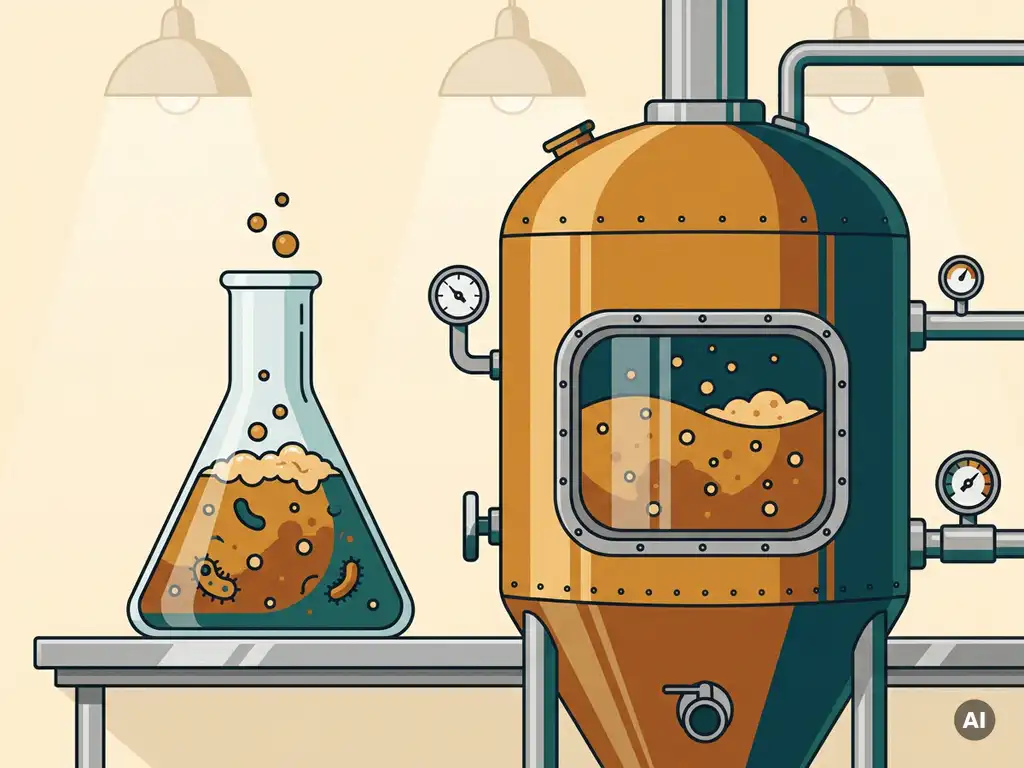
Fermentation R&D and contract production are two distinct service models that serve different stages of a project. R&D focuses on developing, testing, and optimizing a fermentation process, while contract production involves manufacturing a defined microbial product at consistent quality and quantity. The right choice depends on how well your process is understood and how ready it is for reproducible output. The sections below unpack each phase, the path between them, and the practical considerations around IP, confidentiality, and partner selection.
What does each phase actually involve?
Fermentation R&D is the investigative phase where a process is designed, tested, and refined. Contract production is the execution phase where a validated process is run repeatedly to deliver a product. The two differ fundamentally in their goals: R&D tolerates uncertainty and iteration, while contract production demands consistency and predictability.
In a fermentation R&D engagement, the work typically begins at lab scale with feasibility testing. The core questions are whether a microbial system can produce the desired output under controlled conditions, and which process parameters, such as pH, temperature, oxygen transfer rate, or substrate composition, drive performance. This phase often involves screening multiple microbial strains or consortia, running batch and continuous experiments, and applying analytical tools like amplicon sequencing or qPCR to understand what is happening inside the bioreactor at a community level.
In contract fermentation, the process is already defined. The partner operates fermenters according to a fixed protocol, delivers a product that meets agreed specifications, and documents the run for quality and traceability purposes. The focus shifts from discovery to execution: yield consistency, downstream processing, and regulatory compliance become the central concerns. For companies producing microbial biomass, enzymes, or specialty ingredients, this model allows manufacturing without owning the infrastructure.
The distinction matters because the skills, equipment, and mindset required for each phase are genuinely different. A facility optimized for contract production may not have the analytical depth to troubleshoot a novel fermentation process. Conversely, a research-oriented team may lack the quality systems needed for reproducible commercial output.
When should a company choose R&D over contract production?
A company should prioritize fermentation R&D when the process is not yet fully defined, when scale-up behavior is unknown, or when the microbial system has not been validated beyond the lab bench. Contract production is the right choice when the process is stable, reproducible, and ready to be handed off to an operator without further development work.
In practice, the trigger for choosing R&D is uncertainty. If your team has demonstrated a concept in shake flasks but has not yet run it in a controlled bioreactor, you are not ready for contract production. The same applies if you have changed a key input, such as a substrate source or growth medium, and do not know how that affects process performance at larger volumes.
Common scenarios where fermentation R&D is the appropriate starting point include:
- A novel microbial product with no established production protocol
- A known process being adapted to a new feedstock or waste stream
- A process that has failed to reproduce at pilot scale and needs troubleshooting
- A concept that requires proof-of-concept data for investor or regulatory purposes
Contract production becomes appropriate once the process has been validated at pilot scale, key parameters are locked, and the product specification is clearly defined. At that point, handing manufacturing to a contract partner is typically faster and more cost-efficient than building internal capacity.
Get in Touch
Let’s Talk Microbial Solutions
Book a conversation with Stijn, our CEO, or send us your request.
| Book an Appointment | Request Information |
Get in Touch
Let’s Talk Microbial Solutions
Book a conversation with Stijn, our CEO, or send us your request.
| Book an Appointment | Request Information |
How does the scale-up journey connect R&D to production?
Fermentation scale-up is the bridge between R&D and contract production. It is the process of transferring a lab-validated concept into a pilot-scale or production-scale bioreactor while preserving the performance characteristics established during development. Scale-up is not a single step but a structured progression that requires deliberate process engineering at each stage.
The challenge of fermentation scale-up lies in the fact that many process parameters do not behave linearly as volume increases. Mixing dynamics, oxygen transfer rates, heat dissipation, and substrate gradients all change when you move from a 2-liter bench fermenter to a 200-liter pilot vessel. A process that performs well at lab scale can fail at pilot scale not because the microbiology is wrong, but because the engineering conditions have shifted.
A structured scale-up journey typically follows this progression:
- Lab-scale feasibility: Confirm that the microbial system produces the target output under controlled conditions in small bioreactors
- Parameter optimization: Identify the critical process variables and define acceptable operating ranges
- Pilot-scale validation: Reproduce the optimized process in a larger vessel and confirm that performance is maintained
- Process lock: Document the validated protocol in sufficient detail to hand it to a contract production operator
Each transition point carries risk, and that risk is best managed by teams with direct experience running fermenters at multiple scales. For companies without their own pilot-scale fermentation infrastructure, working with a specialized external partner at this stage avoids the cost and delay of building that capacity internally while keeping the development timeline on track.
What IP and confidentiality considerations apply to each phase?
Both fermentation R&D and contract production involve sharing sensitive process knowledge with an external partner, but the IP risks differ by phase. During R&D, the process is still being invented, which means the most valuable intellectual property is often generated during the collaboration itself. During contract production, the process is defined and the key risk is protecting an already-established protocol from disclosure.
In the R&D phase, it is important to establish upfront who owns the results of the development work. This includes any novel process parameters, microbial strains, or analytical insights generated during the project. A well-structured R&D agreement should specify ownership of foreground IP, the partner’s right to publish, if any, and how background IP brought into the project by each party is protected. For companies building toward a patent, it is also worth confirming that the partner’s involvement does not create prior disclosure issues under the relevant patent jurisdiction.
In the contract production phase, the main concern shifts to process confidentiality. The manufacturing protocol, strain information, and product specifications represent the core of the company’s competitive advantage. A robust non-disclosure agreement and clearly defined data handling procedures are standard expectations for any credible contract manufacturing partner.
One practical consideration that applies to both phases: the more specialized and scientifically rigorous the partner, the more likely they are to have established confidentiality frameworks already in place. Partners with a background in academic or regulated environments tend to treat IP and data governance with greater formality than generalist contract manufacturers.
Can one partner handle both R&D and contract production?
Yes, a single partner can manage both fermentation R&D and contract production, and for many companies this is the more efficient arrangement. Working with one partner across both phases eliminates the knowledge transfer gap that occurs when R&D results are handed to a separate manufacturer that was not involved in developing the process.
The practical advantage is continuity. When the same team that optimized your process at lab and pilot scale also runs the contract production batches, they carry the institutional knowledge of how the process behaves, what the failure modes are, and how to respond when something deviates from specification. That depth of understanding is difficult to document fully and even harder to transfer to a new partner who starts from a written protocol alone.
Not every partner has both capabilities, however. The combination requires a facility with both the analytical and experimental infrastructure for genuine R&D work and the quality systems, downstream processing equipment, and production discipline required for consistent contract manufacturing. These are different organizational competencies, and a partner that excels at one does not automatically excel at the other.
Avecom operates across both phases, running microbial fermentation services from initial lab-scale feasibility testing through to pilot-scale validation and small-scale contract production. The same technical team engages across the full trajectory, which means process knowledge accumulated during R&D is carried directly into the production phase rather than being lost in a handover. For companies under time pressure to deliver proof-of-concept or early commercial batches, this integrated model reduces both timeline risk and the coordination overhead of managing multiple external partners.