

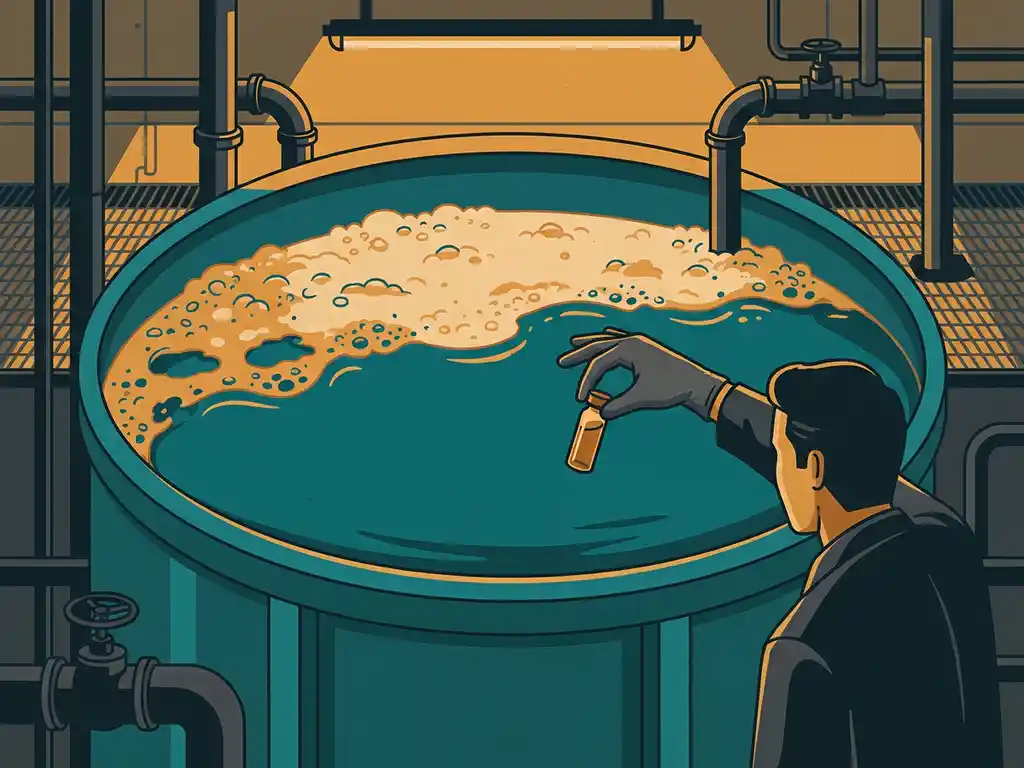
Reducing downtime when fixing sludge problems in a biological treatment plant is possible in most cases, provided you address the root cause without taking the system fully offline. The key is distinguishing between problems that require a complete restart and those that can be corrected through targeted adjustments to aeration, loading rate, or microbial community composition while the plant continues to operate. The sections below work through the most common questions plant managers face when sludge performance deteriorates.
What actually causes sludge problems in a treatment plant?
Sludge problems in wastewater treatment arise when the microbial community inside the activated sludge system is disrupted, unbalanced, or overwhelmed. The most frequent causes are sudden changes in organic loading, nutrient imbalances (particularly nitrogen and phosphorus ratios), toxic shock from industrial discharges, and fluctuating temperatures. Each of these stresses the microbial consortium in a different way, producing different failure modes.
In food and beverage production, seasonal variation is a particularly common trigger. A facility running at low capacity in winter and peak capacity during harvest season can send the biological stage into overload within days. The sludge microbiome simply cannot adapt fast enough when the feed composition or volume changes abruptly.
Excess sludge in a wastewater plant is another recurring issue. When sludge retention time (SRT) is too long, older, less active biomass accumulates and degrades overall treatment efficiency. Conversely, if sludge is wasted too aggressively, the slow-growing nitrifying bacteria responsible for ammonia removal are the first to wash out, causing nitrogen exceedances at the discharge point.
How does sludge failure lead to plant downtime?
Get in Touch
Let’s Talk Microbial Solutions
Book a conversation with Stijn, our CEO, or send us your request.
| Book an Appointment | Request Information |
Sludge failure leads to plant downtime when the biological stage can no longer meet discharge limits, forcing the operator to slow or halt influent flow to avoid regulatory violations. The most direct path from a sludge problem to downtime is through the secondary clarifier: when sludge settleability deteriorates, the clarifier fails to produce a clean effluent, and suspended solids breach the discharge threshold.
Sludge bulking in biological treatment is one of the most common mechanisms. Filamentous bacteria overgrow the floc-forming organisms, producing a low-density sludge that rises rather than settles. The clarifier fills, effluent quality collapses, and the plant either reduces throughput or stops accepting influent while operators attempt to recover the biology.
Secondary failures compound the problem. A plant that has been running with deteriorating sludge for weeks before the issue is caught will have a depleted and stressed microbial community. Recovery from that state takes longer than recovery from an early-stage imbalance, which is precisely why early detection matters so much in avoiding extended downtime.
What’s the difference between reactive and preventive sludge management?
Reactive sludge management means responding to a problem after it has already affected effluent quality or operational stability. Preventive sludge management means tracking biological performance indicators continuously and making small, timely corrections before the system reaches a critical threshold. The practical difference between the two is often measured in days of lost production.
Reactive management is the default in many industrial facilities, partly because biological treatment is often seen as a background process that runs itself. Operators intervene when alarms trigger or when discharge monitoring reveals a violation. By that point, the microbial community may have been under stress for days, and recovery requires more aggressive intervention.
Preventive management relies on a combination of routine process measurements and, increasingly, molecular monitoring of the microbial community itself. Tracking the ratio of filamentous to floc-forming bacteria, monitoring nitrification rates, or measuring sludge volume index (SVI) trends over time gives operators actionable warning before the system tips into failure. This is where biological wastewater expertise becomes operationally relevant: knowing what to measure and how to interpret it is not always straightforward without microbiological depth.
How can you fix sludge issues without stopping the plant?
Most sludge problems in biological treatment can be corrected without a full plant shutdown, provided the intervention is proportionate to the severity of the problem and implemented while the system still has functional biomass. The core principle is to stabilize conditions first, then gradually steer the microbial community back toward the desired composition.
Practical steps for in-operation recovery typically follow this sequence:
- Reduce or equalize the incoming load to relieve pressure on the stressed biology, even if only temporarily.
- Adjust aeration to correct dissolved oxygen levels — both under-aeration and over-aeration can suppress the wrong organisms.
- Review sludge wasting rates to ensure SRT is appropriate for the organisms you need to maintain, particularly nitrifiers.
- Correct nutrient ratios if carbon, nitrogen, or phosphorus are out of balance relative to the biological oxygen demand (BOD) of the influent.
- Introduce targeted biomass if the functional microbial population has been depleted below the recovery threshold.
The last point is where bioaugmentation becomes relevant. Adding a concentrated inoculum of the right microbial consortium can shorten recovery time significantly compared to waiting for the indigenous population to rebuild on its own. Avecom’s ABIL technology is specifically designed for this scenario: it allows operators to restart or resteer an existing biofilter without taking the installation fully offline.
When should you bring in external microbiome expertise?
External microbiome expertise is warranted when in-house troubleshooting has not resolved the sludge problem within a reasonable timeframe, when the failure mode is not clearly understood, or when the facility faces regulatory pressure that makes extended trial-and-error unacceptable. It is also appropriate when a plant is being modified, scaled up, or asked to handle a new influent composition for the first time.
Many industrial operators have strong process engineering knowledge but limited microbiological depth. That gap becomes critical when sludge problems involve subtle community-level shifts rather than obvious operational faults. A facility might have correct aeration, correct loading, and correct nutrient dosing, and still experience chronic underperformance because the microbial consortium has drifted toward a suboptimal composition over time.
Avecom’s team works with mixed microbial cultures in exactly these situations, combining a microbiological audit of existing installations with molecular community analysis to identify what is actually happening inside the reactor, not just what the process parameters suggest. This kind of diagnostic work is particularly valuable before committing to capital investment in new equipment, since many performance problems are biological rather than mechanical in origin.
What monitoring data helps predict sludge problems early?
The monitoring data most useful for predicting sludge problems early includes sludge volume index (SVI) trends, effluent suspended solids, dissolved oxygen profiles, ammonia and nitrate concentrations in the effluent, and, where available, molecular data on microbial community composition. No single parameter tells the full story, but together they provide a reliable early warning picture.
Process-level indicators
SVI is one of the most practical early indicators of bulking risk. A rising SVI trend over several weeks signals that sludge settleability is deteriorating before the clarifier is visibly affected. Similarly, a drop in nitrification efficiency, measured as rising effluent ammonia, is an early sign that the nitrifying population is under stress, often before total treatment performance collapses.
Microbial community monitoring
Molecular monitoring techniques, including DNA-based community profiling, allow operators to track shifts in microbial population structure over time. This is not standard practice in most industrial plants yet, but it is increasingly accessible and provides a level of predictive insight that process parameters alone cannot offer. Knowing that filamentous bacteria are increasing in relative abundance weeks before they cause visible bulking gives operators time to intervene without disrupting production.
For facilities handling variable or complex industrial effluents, combining routine process data with periodic microbiological audits is the most robust approach to avoiding unplanned downtime. Avecom offers molecular monitoring of microbial communities as part of its broader water treatment services, providing the diagnostic layer that turns raw process data into actionable decisions.
Sludge problems in wastewater treatment are rarely sudden. They develop over time, and the window between early warning and operational crisis is almost always wide enough to act, provided the right data is being collected and interpreted. The difference between a plant that manages through a difficult period with minimal disruption and one that faces weeks of downtime usually comes down to how early the problem was recognized and whether the response targeted the biological root cause rather than just the visible symptom. For facilities where biological expertise is limited internally, working with a specialist partner from the diagnostic stage is often the most cost-effective route to a stable, compliant operation. Explore Avecom’s wastewater services to understand what a structured approach to biological treatment looks like in practice.
Related Articles
- What is centrifugation used for in fermentation downstream processing?
- When is excavation not the right solution for contaminated soil?
- How do stricter discharge limits affect sludge management decisions?
- How do environmental engineers assess contamination risk?
- How do you control filamentous bacteria in activated sludge?