

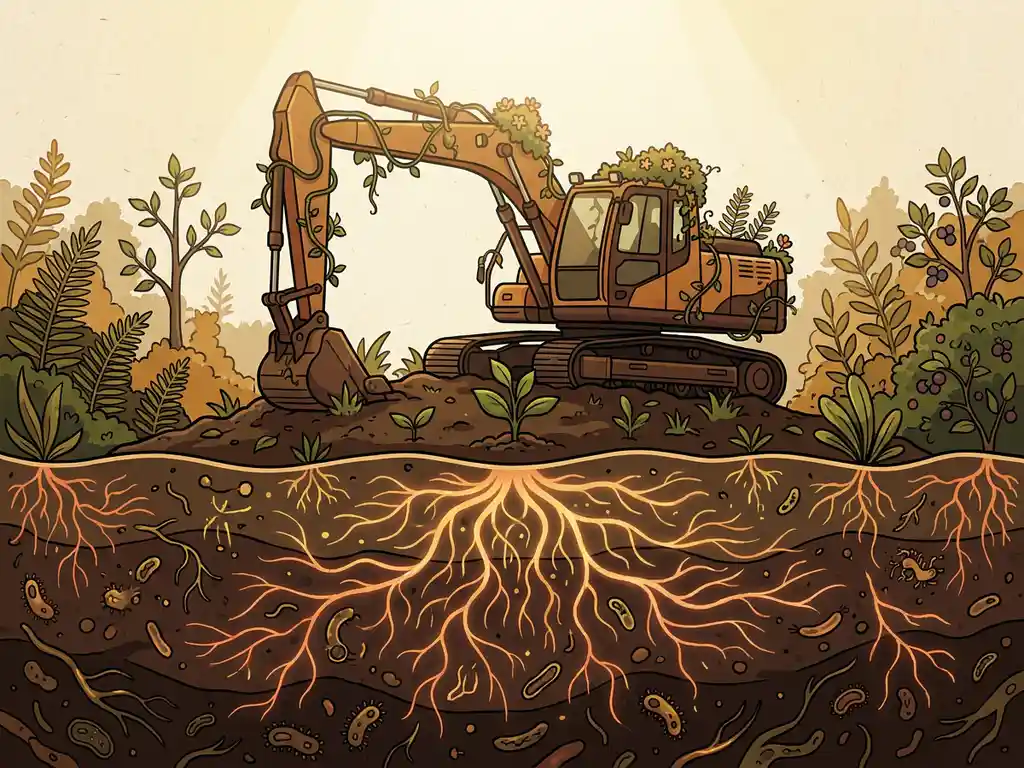
Excavation is not the right solution for contaminated soil when the contamination is too deep, too widespread, or located beneath existing structures, making physical removal technically impractical or economically prohibitive. In those situations, in-situ biological remediation is often a more appropriate and cost-effective approach. The questions below walk through the key decision points project managers face when excavation is off the table.
What are the main limitations of soil excavation?
Soil excavation fails as a remediation method when the contamination is located at depth, beneath buildings or infrastructure, or when the volume of affected soil makes removal financially unworkable. It is a high-disruption, high-cost technique that works well for shallow, localized contamination but quickly reaches its limits in complex brownfield situations.
Several practical constraints make excavation unsuitable or impossible in many real-world scenarios:
- Depth of contamination: Contaminants that have migrated into deep soil layers or the saturated zone cannot be reached by standard excavation equipment without extreme cost and risk.
- Built environment: When contamination sits beneath existing buildings, roads, or utility networks, excavation requires demolition or major infrastructure work before remediation can even begin.
- Groundwater interference: High groundwater tables make excavation technically complex and expensive, often requiring continuous dewatering throughout the works.
- Volume and spread: Large plumes of contamination distributed across a site make full excavation economically unrealistic. The cost per tonne of soil removed can make the project unfeasible before a single shovel hits the ground.
- Waste processing: Excavated contaminated soil must be transported and treated as hazardous waste. Disposal costs, logistics, and regulatory requirements add significant overhead to every project.
For project managers working under budget constraints or with sites that have complex geologies, these limitations often make excavation a non-starter from the outset. Understanding this early prevents wasted time on feasibility studies for a method that was never going to work.
Get in Touch
Let’s Talk Microbial Solutions
Book a conversation with Stijn, our CEO, or send us your request.
| Book an Appointment | Request Information |
What types of contamination are hardest to treat with excavation?
Volatile chlorinated compounds, also known as VOCl or chlorinated solvents, are among the most difficult contaminants to address through excavation. These substances sink through the soil profile into deep groundwater, spread laterally over large areas, and persist in the environment for decades. Their physical behaviour makes surface removal largely ineffective.
Chlorinated solvents such as perchloroethylene (PCE) and trichloroethylene (TCE) were widely used in dry cleaning, metal degreasing, and industrial cleaning operations. They are denser than water, which means they migrate downward through the soil until they reach an impermeable layer, forming what are known as dense non-aqueous phase liquids (DNAPLs). Once in that state, they act as a long-term source of groundwater contamination that is almost impossible to physically remove in its entirety.
Other contaminant types that are poorly suited to excavation include:
- Petroleum hydrocarbons at depth: Fuel spills that have migrated beyond the shallow soil zone are difficult to excavate completely without major site disruption.
- Diffuse contamination across large areas: When a contaminant has spread across thousands of square metres, the volume of material to be removed makes excavation economically impossible.
- Mixed contamination plumes: Sites with multiple contaminants at varying depths require tailored treatment, which excavation cannot easily provide.
VOCl contamination in particular demands a fundamentally different approach, one that works with the subsurface environment rather than trying to physically remove it.
How does biological soil remediation work as an alternative?
Biological soil remediation uses naturally occurring or introduced microorganisms to break down contaminants directly in the ground. Rather than removing contaminated soil, the process transforms harmful compounds into harmless substances through microbial metabolic activity. For chlorinated solvents, specialist bacteria can achieve reductive dechlorination, progressively breaking down VOCl into non-toxic end products.
The process works by stimulating or augmenting the microbial community already present in the soil. In many contaminated sites, the conditions for natural biodegradation exist but are limited by a lack of the right bacteria, insufficient electron donors, or suboptimal geochemical conditions. Biological remediation addresses these constraints directly.
In-situ bioaugmentation
Bioaugmentation involves injecting specialized microbial consortia into the contaminated zone. These consortia contain bacteria capable of performing reductive dechlorination of VOCl under anaerobic conditions. Once established in the subsurface, they colonize the contamination plume and progressively degrade the target compounds over time. This approach is particularly effective for sites where natural attenuation is occurring too slowly to meet regulatory timelines.
Biostimulation
Biostimulation enhances the activity of microorganisms already present by adding electron donors such as lactate or other organic substrates. This accelerates the metabolic processes that drive contaminant breakdown. Biostimulation is often used in combination with bioaugmentation to create optimal conditions for sustained microbial activity throughout the treatment zone.
Avecom’s biological soil remediation services are built around this in-situ approach, combining scientific assessment of site conditions with targeted microbial intervention. The process is guided by data at every stage, from initial feasibility screening through to field-scale application.
When is biological remediation a better choice than excavation?
Biological remediation is a better choice than excavation when the contamination is deep, widespread, or located beneath infrastructure, and when the target contaminants are biodegradable under the right conditions. It is also preferable when project budgets make large-scale excavation unworkable, or when site activity must continue during remediation.
In practical terms, biological remediation tends to outperform excavation in the following scenarios:
- Contamination has reached the saturated zone or deep soil horizons beyond the reach of excavation equipment
- The site is partially or fully built over, making physical removal impossible without demolition
- The contaminant is a chlorinated solvent that has formed a persistent groundwater plume
- Previous excavation or pump-and-treat efforts have failed to reduce contamination to target levels
- Regulatory timelines allow for a phased, monitored approach rather than immediate physical removal
- The project requires a solution with a lower carbon footprint and reduced waste generation
The key qualification is that biodegradability must be confirmed before committing to a biological approach. Not every site has the right conditions for effective microbial breakdown, which is why feasibility testing is an essential first step rather than an optional one.
How do you measure progress when excavation is not used?
When biological remediation replaces excavation, progress is measured through regular monitoring of contaminant concentrations in soil and groundwater, combined with molecular analysis of the microbial community performing the degradation. This dual approach provides both chemical evidence of contaminant reduction and biological evidence that the degradation process is active and sustained.
Monitoring typically involves:
- Chemical analysis of groundwater samples: Regular sampling from monitoring wells tracks the reduction in target contaminant concentrations over time and confirms that degradation products are forming as expected.
- Molecular microbiology tools: Techniques such as quantitative PCR (qPCR) and amplicon sequencing allow laboratories to detect and quantify the specific microorganisms responsible for degradation. This confirms whether the introduced or stimulated bacteria are active and present at sufficient concentrations.
- Geochemical parameters: Measurements of redox conditions, pH, dissolved oxygen, and electron donor availability provide context for interpreting microbial activity and identifying any process limitations.
This monitoring framework serves two purposes simultaneously. It gives the project team the data needed to adjust the remediation strategy if results are slower than expected, and it provides the documentation required for regulatory reporting to bodies such as OVAM under the VLAREBO framework. Molecular monitoring tools offered by Avecom are specifically designed to meet both of these needs, translating complex microbiological data into clear, reportable metrics.
What should a project manager ask before choosing a remediation method?
Before selecting a remediation method, a project manager should ask whether the contamination type, depth, and distribution make physical removal technically feasible, and whether biological degradation of the specific contaminants has been demonstrated to be achievable under the site’s conditions. These two questions frame every subsequent decision.
A structured set of questions to guide the decision includes:
- What is the contaminant and how has it behaved in the subsurface? Understanding whether the contaminant is volatile, dense, or mobile determines which remediation approaches are physically possible.
- Has contamination reached the groundwater? If groundwater is affected, excavation alone will not resolve the problem. A method that addresses the saturated zone is required. Knowing how groundwater contamination is assessed is essential before any method is chosen.
- Is there evidence of natural attenuation already occurring? Monitoring data or historical records may show that indigenous microorganisms are already degrading the contaminant. This is a strong indicator that biological remediation is viable.
- What are the regulatory timelines and reporting requirements? OVAM compliance obligations will influence whether a phased biological approach is acceptable or whether faster results are required.
- Has a microcosm test been conducted? A laboratory-scale feasibility test using actual soil and groundwater from the site is the most reliable way to confirm whether biological degradation will work before committing to full-scale implementation.
- What is the total cost comparison over the full project lifecycle? Excavation may appear cheaper upfront but often leaves residual contamination requiring further treatment. Biological remediation costs should be evaluated over the full treatment period, including monitoring.
For project managers who have already found contamination on an industrial site or are working through the steps after soil contamination is discovered, these questions provide a practical framework for avoiding costly decisions based on incomplete information. Avecom’s team of environmental engineers works through exactly this kind of structured assessment before recommending any course of action, ensuring that the chosen method is grounded in site-specific data rather than default assumptions.