

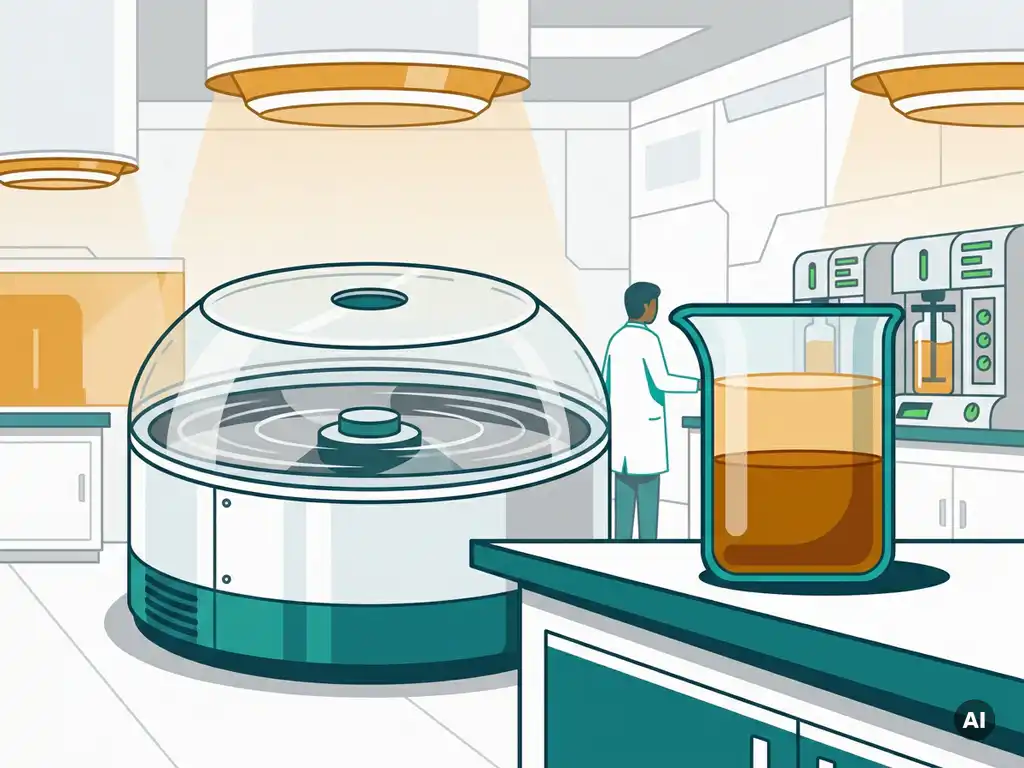
Centrifugation in fermentation is used to separate biomass, cells, or target products from the liquid fermentation broth through the application of centrifugal force. It is one of the most common first steps in downstream processing, enabling the rapid, scalable recovery of microbial cells, enzymes, proteins, or other fermentation-derived products with minimal product loss.
The technique applies across a wide range of bioprocesses, from single-cell protein production to enzyme manufacturing and microbial fermentation for food and feed applications. The sections below address the most common technical questions around centrifugation in fermentation downstream processing.
How does centrifugation separate biomass from fermentation broth?
Centrifugation separates biomass from fermentation broth by spinning the liquid at high rotational speeds, generating centrifugal force that causes denser particles, such as microbial cells, to migrate outward and form a pellet, while the clarified liquid (the supernatant) remains above. The separation efficiency depends on particle size, density difference between the cells and the broth, and the applied centrifugal force expressed as relative centrifugal force (RCF).
In practical terms, a fermentation broth is a complex mixture. It contains living or dead microbial cells, residual nutrients, metabolic byproducts, extracellular proteins, and the target product, which may be inside the cells or secreted into the broth. Centrifugation addresses the first and most critical question in downstream processing: how do you get what you want out of that mixture efficiently?
The physics are straightforward. Stokes’ law describes how the sedimentation velocity of a particle increases with the square of its radius, the density difference between the particle and the fluid, and the applied gravitational or centrifugal force. This means larger, denser particles sediment faster, which is why bacterial and yeast cells, with their relatively high density compared to the surrounding broth, respond well to centrifugation. Smaller particles, such as cell debris or fine precipitates, may require higher RCF values or longer run times to achieve adequate separation.
What types of centrifuges are used in fermentation downstream processing?
The most common centrifuge types used in fermentation downstream processing are disc-stack centrifuges, tubular bowl centrifuges, and decanter centrifuges. Each is suited to different biomass concentrations, particle sizes, and throughput requirements. Disc-stack centrifuges are the industrial standard for continuous clarification of microbial fermentation broths at scale.
Disc-stack centrifuges
Disc-stack centrifuges use a series of closely spaced conical discs to increase the effective settling area within the bowl. They operate continuously and are capable of handling large volumes with high clarification efficiency, making them the preferred choice for industrial-scale fermentation. They work well with bacteria and yeast at moderate to high cell densities and can be configured for either clarification (retaining the supernatant) or concentration (retaining the biomass).
Tubular bowl and decanter centrifuges
Tubular bowl centrifuges generate very high RCF values and are used when fine particles or low-density cells require more aggressive separation. They are typically a batch operation and better suited to smaller volumes or high-value products. Decanter centrifuges, by contrast, handle slurries with high solids content and are used when the biomass concentration in the broth is substantial, such as in algae harvesting or certain single-cell protein processes. The choice between centrifuge types is a process engineering decision that depends on cell morphology, broth viscosity, solids loading, and the required purity of the output stream.
Get in Touch
Let’s Talk Microbial Solutions
Book a conversation with Stijn, our CEO, or send us your request.
| Book an Appointment | Request Information |
What happens to the product after centrifugation in a bioprocess?
After centrifugation in a bioprocess, the product is either in the pellet (cell-associated products) or in the supernatant (secreted products), and subsequent processing steps depend entirely on where the target compound resides. If the product is intracellular, the cell pellet must be further processed through cell disruption and extraction. If the product is extracellular, the clarified supernatant moves directly to purification steps such as ultrafiltration, chromatography, or precipitation.
For biomass itself as the end product, for example in microbial biomass fermentation for animal feed or single-cell protein, the pellet after centrifugation is the primary output. It is then typically washed to remove residual broth components, and subjected to downstream treatments such as pasteurization to ensure microbial safety and regulatory compliance before drying or formulation.
The centrifugation step therefore defines the downstream pathway. Getting it right, in terms of the correct RCF, run time, and temperature, determines both the yield of the target product and the efficiency of all subsequent processing steps. Poorly optimized centrifugation leads to product loss in the discarded fraction, contamination between fractions, or carryover of impurities that complicate later purification.
How does centrifugation affect product quality and cell viability?
Centrifugation can negatively affect product quality and cell viability if the applied shear forces, temperature, or processing time are not carefully controlled. High rotational speeds generate heat and mechanical stress that can lyse fragile cells, denature proteins, or degrade sensitive metabolites. For processes where intact, viable cells are the product, such as probiotic cultures or live microbial inoculants, centrifugation parameters must be optimized to minimize cellular damage.
The main risks are shear-induced cell lysis, temperature rise during prolonged runs, and oxidative stress from exposure to air during processing. Each of these can reduce the biological activity of the product, lower viable cell counts, or introduce intracellular contaminants into the supernatant that then complicate downstream purification.
Mitigation strategies include operating at lower temperatures, using refrigerated centrifuges, minimizing run time while achieving adequate separation, and selecting centrifuge geometries that reduce shear stress at the bowl wall. For extracellular protein products, the concern shifts from cell viability to protein stability: aggregation, denaturation, or proteolytic degradation can all occur if centrifugation conditions are not matched to the biochemical properties of the target molecule.
This is why centrifugation optimization is treated as an integral part of process development rather than a generic unit operation. The parameters that work for one fermentation process may be entirely unsuitable for another, even when the equipment is identical.
When should centrifugation be chosen over filtration for downstream processing?
Centrifugation is generally preferred over filtration for downstream processing when the fermentation broth has high cell density, high viscosity, or contains particles that would rapidly foul a filter membrane. It is also the better choice when continuous, high-throughput processing is required, or when the biomass itself is the target product and needs to be recovered as a concentrated slurry rather than a dry cake.
Filtration, particularly microfiltration and ultrafiltration, offers advantages when the target product is a small molecule or protein in the supernatant that needs further size-based fractionation, or when very high clarification is needed to remove fine cell debris that centrifugation leaves behind. In practice, centrifugation and filtration are often used in sequence rather than as alternatives: centrifugation handles the bulk separation, and a polishing filtration step removes residual fine particles from the clarified supernatant.
The decision also has economic dimensions. Centrifuges have high capital costs but low consumable costs and can run continuously without membrane replacement. Filtration systems have lower upfront costs but ongoing membrane replacement and cleaning expenses that increase with broth complexity. For processes involving mixed microbial cultures or complex fermentation broths, centrifugation tends to be more robust because it is less sensitive to broth composition variability, a practical consideration when scaling up processes where the microbial community is not perfectly homogeneous from batch to batch.
Organizations developing fermentation processes without in-house downstream processing infrastructure often find that access to properly equipped pilot facilities, including centrifugation and pasteurization capability, is the bottleneck between lab proof of concept and scalable production. Avecom’s fermentation R&D and contract manufacturing services include downstream processing equipment at pilot scale, allowing process developers to validate centrifugation parameters under realistic conditions before committing to full-scale infrastructure investment.