

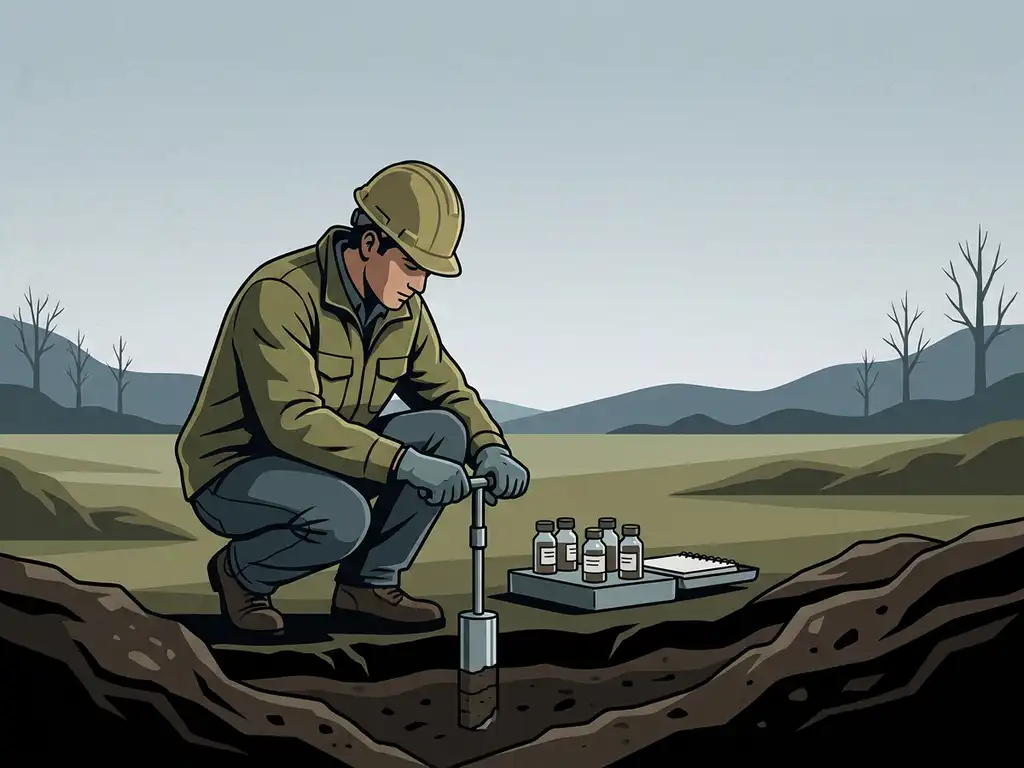
Environmental engineers assess contamination risk by combining site investigation, chemical analysis, and risk modeling to determine whether contaminants in soil or groundwater pose an unacceptable threat to human health, ecosystems, or future land use. The process moves from initial screening through detailed laboratory analysis to a formal risk characterization that informs remediation decisions. The questions below walk through each stage of that process, from the first site visit to ongoing monitoring after treatment begins.
What methods do environmental engineers use to investigate contaminated sites?
Environmental engineers investigate contaminated sites using a phased approach that combines desk research, field sampling, and laboratory analysis. The goal is to map the extent and concentration of contamination before any remediation decisions are made. A thorough site investigation typically includes a historical land use review, soil and groundwater sampling, and chemical characterization of the contaminants present.
The investigation usually begins with a Phase I assessment, which involves reviewing historical records, aerial photographs, permit databases, and land registry documents to identify potential contamination sources. If historical use suggests risk, a Phase II investigation follows, involving physical sampling.
During Phase II, engineers install monitoring wells to collect groundwater samples and use drilling or direct-push technology to extract soil cores at various depths. Samples are sent to accredited laboratories for chemical analysis. Geophysical techniques such as electrical resistivity or ground-penetrating radar may also be used to identify subsurface anomalies without extensive drilling. The resulting data is used to build a conceptual site model, which maps contamination sources, transport pathways, and potential receptors.
Get in Touch
Let’s Talk Microbial Solutions
Book a conversation with Stijn, our CEO, or send us your request.
| Book an Appointment | Request Information |
What are the main types of soil and groundwater contaminants engineers look for?
Environmental engineers screen for a broad range of contaminants depending on the site’s industrial history. The most commonly encountered categories include petroleum hydrocarbons, heavy metals, polycyclic aromatic hydrocarbons (PAHs), pesticides, and chlorinated solvents. Each group behaves differently in the subsurface and requires different analytical methods and remediation strategies.
Chlorinated solvents, also known as volatile organochlorine compounds (VOCl), are among the most problematic. Substances such as tetrachloroethylene (PCE) and trichloroethylene (TCE) were widely used in dry cleaning, metal degreasing, and electronics manufacturing. They are dense, poorly soluble, and tend to migrate deep into aquifers, where they can persist for decades. Their persistence and toxicity make them a priority concern on many brownfield and industrial sites.
Heavy metals such as lead, cadmium, arsenic, and chromium are common on former industrial or mining sites and bind tightly to soil particles, limiting their mobility but creating long-term exposure risks. Petroleum hydrocarbons from fuel storage or spills are highly mobile in certain soil types and can affect groundwater rapidly. Understanding which contaminant class is present determines not only the analytical approach but also which remediation options are technically feasible.
How do engineers determine whether contamination poses an unacceptable risk?
Engineers determine unacceptable risk through a formal risk assessment that evaluates the likelihood and magnitude of exposure for identified receptors, such as future site users, construction workers, or nearby ecological systems. Risk is not defined by contamination concentration alone but by the combination of contaminant toxicity, exposure pathways, and the sensitivity of the people or environment at risk.
In Flanders, this process is governed by the VLAREBO regulation, which sets soil quality standards and requires site owners to demonstrate compliance before land use changes are approved. OVAM, the Flemish public waste agency, oversees the reporting and approval process. A risk assessment under this framework evaluates whether measured concentrations exceed threshold values for the intended land use, whether groundwater is affected, and whether off-site migration is occurring.
Where concentrations exceed regulatory thresholds, engineers must determine whether natural attenuation is sufficient or whether active remediation is required. The outcome of the risk assessment directly shapes the remediation obligation, the timeline, and the monitoring requirements attached to the site.
What is a microcosm test and when is it used in contamination assessment?
A microcosm test is a small-scale laboratory experiment that uses actual soil and groundwater from a contaminated site to evaluate whether naturally occurring or introduced microorganisms can break down specific contaminants under controlled conditions. It is used to assess the feasibility of biological remediation before committing to a full-scale in-situ treatment strategy.
The test replicates subsurface conditions in the laboratory, allowing engineers to observe whether indigenous microbial communities are already degrading the target contaminants, whether degradation stalls at a toxic intermediate, and whether adding specific microbial strains or electron donors accelerates the process. For VOCl contamination, microcosm tests are particularly valuable because complete dechlorination requires specific bacterial populations that may or may not be present in sufficient numbers at a given site.
Conducting a microcosm test before designing a remediation strategy saves significant cost and reduces uncertainty. Rather than applying a treatment approach based on general assumptions, engineers can make data-driven decisions about whether bioaugmentation is warranted, what amendments are needed, and what degradation rates are realistic. Avecom’s soil remediation services include microcosm testing as a standard feasibility step, ensuring that biological approaches are only proposed where site conditions genuinely support them.
How does biological remediation compare to excavation for managing contaminated soil?
Biological remediation and excavation represent fundamentally different approaches to contaminated soil management. Excavation physically removes contaminated material from the site, offering a fast and verifiable outcome but at high cost and significant disruption. Biological remediation degrades contaminants in place using microbial activity, which takes longer but is far less invasive and often more cost-effective for deep or widespread contamination.
When excavation is the right choice
Excavation is most appropriate when contamination is shallow, well-defined, and located in an area where ground disturbance is acceptable. It provides a clear, auditable endpoint and is familiar to regulators, which can simplify approval processes. However, for sites with deep groundwater contamination, active construction above, or contamination spread across a large area, excavation becomes technically impractical or prohibitively expensive.
When biological remediation is preferable
Biological remediation, particularly in-situ bioaugmentation, is well-suited to sites where excavation is not feasible. By introducing specialized microbial consortia directly into the contaminated zone, engineers can stimulate degradation of persistent compounds such as chlorinated solvents without removing soil or disrupting surface structures. The process requires patience and robust monitoring, but it addresses contamination at depth and can treat dissolved plumes in groundwater that excavation cannot reach.
The two approaches are not always mutually exclusive. On complex sites, excavation may remove the most concentrated source zone while biological treatment addresses residual contamination in the surrounding soil and groundwater. The right strategy depends on site geometry, contaminant type, land use plans, and budget constraints. Biological soil decontamination is particularly relevant where chlorinated solvents have persisted despite previous remediation attempts.
How do engineers monitor remediation progress after treatment begins?
After remediation begins, engineers monitor progress by tracking contaminant concentrations in soil and groundwater over time, comparing results against baseline measurements and regulatory target values. Effective monitoring confirms whether the chosen treatment is working, identifies areas where the approach needs adjustment, and provides the documented evidence required by regulatory authorities such as OVAM.
Traditional monitoring relies on periodic chemical sampling from monitoring wells, which provides accurate concentration data but offers limited insight into why degradation is or is not occurring. For biological remediation, molecular monitoring tools add a critical layer of diagnostic information. Techniques such as quantitative PCR (qPCR) and amplicon sequencing allow engineers to measure the abundance and activity of specific microbial populations responsible for contaminant breakdown directly in soil and groundwater samples.
This means that rather than waiting months for chemical results to confirm whether a bioaugmentation treatment is taking hold, engineers can detect the presence and growth of key degrading bacteria within weeks of application. If the target organisms are not establishing themselves, the treatment protocol can be adjusted early, avoiding wasted time and cost. Molecular monitoring also generates the kind of mechanistic data that supports regulatory reporting, demonstrating not just that concentrations are declining but why they are declining.
Avecom, a Belgian environmental biotechnology company with over 30 years of experience in microbial process management, applies both qPCR and amplicon sequencing as standard monitoring tools alongside its biological remediation work. This integrated approach, from feasibility testing through to field-scale monitoring, allows site owners and project managers to maintain clear visibility over remediation progress throughout the entire process.
For project managers and environmental coordinators dealing with a contaminated site where classical approaches have fallen short, understanding these monitoring methods is as important as choosing the right treatment. Reliable data at every stage is what makes biological remediation a credible, regulatorily defensible option, not just a technically interesting one. If you are working with a site affected by chlorinated solvents or other persistent contaminants, learn more about Avecom’s expertise and how a structured feasibility assessment can clarify your options before committing to a full remediation programme.
Related Articles
- What is the most cost-effective way to manage excess sludge in 2026?
- What is the difference between soil contamination and groundwater contamination?
- What does a soil remediation plan typically include?
- What does microbial community analysis reveal about sludge health?
- Can soil contamination affect human health?