

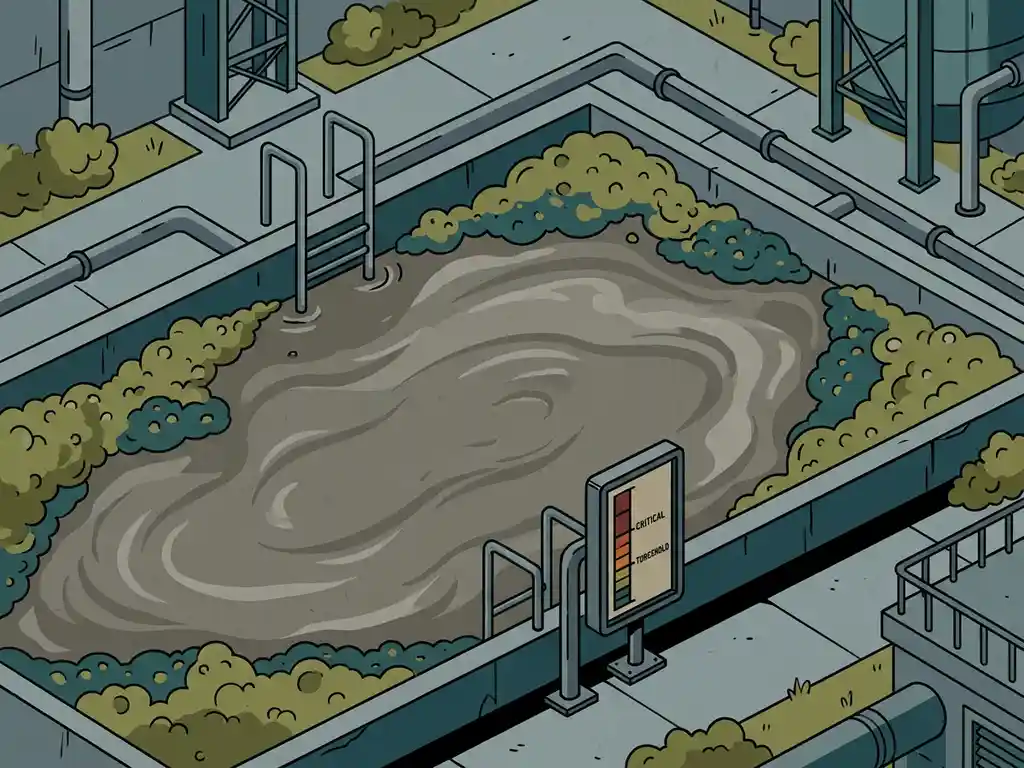
Stricter discharge limits increase sludge production because they require more intensive treatment to remove pollutants before water can be released. As treatment processes remove more suspended solids, nutrients, and organic matter from the water, that material has to go somewhere — and it accumulates as sludge. For industrial operators already managing tight margins and compliance pressure, this is one of the most immediate operational consequences of tightening environmental regulation. The questions below unpack how that chain reaction unfolds and what decisions it forces at plant level.
Why do tighter discharge limits produce more sludge?
Tighter discharge limits produce more sludge because stricter removal targets require more biological or chemical activity to strip pollutants from the water, and every unit of pollutant removed generates a corresponding quantity of residual biomass or precipitate. The more thoroughly a treatment system cleans the water, the more material it concentrates into the sludge stream.
In biological systems, microorganisms consume organic matter and nutrients, converting them into new cell mass. As treatment targets become more demanding — lower chemical oxygen demand limits, tighter nitrogen and phosphorus thresholds — the biological load on the system increases, and so does the rate of biomass growth. In chemical treatment, the same principle applies through precipitation reactions: adding coagulants or precipitants to remove phosphorus or heavy metals generates chemical sludge in direct proportion to the pollutant load removed.
For industrial facilities running seasonal production cycles, this effect is amplified. Nutrient peaks after high-production periods can push a biological system into overloaded conditions, generating excess sludge that wastewater plant operators were not designed to handle. When the treatment system is already operating near its design limits, a stricter discharge standard does not just raise the bar — it fundamentally changes how much residual material the process generates.
Get in Touch
Let’s Talk Microbial Solutions
Book a conversation with Stijn, our CEO, or send us your request.
| Book an Appointment | Request Information |
How do discharge limits affect sludge disposal costs?
Stricter discharge limits raise sludge disposal costs in two ways: they increase the volume of sludge produced, and they often increase its contamination level, which limits disposal routes and drives up the cost per tonne. Facilities that previously disposed of sludge as an agricultural soil amendment may find that higher treatment intensity changes the sludge composition in ways that disqualify it from cheaper disposal categories.
Disposal costs are not linear. Moving from one disposal category to another — from land application to incineration or landfill, for example — can multiply the cost per tonne by a factor of three to five. When tighter limits force a facility to use more chemical dosing, the resulting sludge often contains higher concentrations of metals or synthetic compounds that restrict its end use. Biological sludge from well-managed aerobic systems tends to have a more favorable profile for downstream use, but its volume can still increase substantially under stricter operational targets.
Transport, dewatering, and regulatory documentation add further layers of cost. As sludge volumes grow, facilities that previously managed disposal in-house often find that their dewatering equipment becomes the bottleneck. Investing in additional centrifuge capacity or outsourcing dewatering adds operational overhead that was not factored into the original compliance budget.
What sludge management options are available to industrial operators?
Industrial operators managing sludge problems in wastewater treatment have several options, ranging from on-site volume reduction to third-party processing and resource recovery. The right combination depends on sludge composition, available space, local disposal costs, and whether the facility has the operational capacity to manage additional on-site processes.
- Thickening and dewatering: Reducing water content through gravity thickeners, belt presses, or centrifuges lowers transport and disposal costs by reducing volume. This is often the first intervention when sludge volumes increase.
- Anaerobic digestion: For facilities with sufficient organic load, on-site digestion can stabilize sludge and recover biogas, partially offsetting disposal costs through energy recovery.
- Aerobic stabilization: Extended aeration reduces volatile solids and pathogen load, making sludge more suitable for agricultural application where regulations permit.
- Third-party processing: Composting facilities, incineration plants, and dedicated sludge treatment operators accept dewatered sludge, though costs vary significantly by region and sludge classification.
- Nutrient recovery: Nitrogen and phosphorus can be recovered from sludge reject water as struvite or as concentrated nutrient streams, reducing the nutrient load returned to the treatment process.
No single option fits every industrial context. A food processor generating high-organic, low-toxicity sludge has very different options than a chemical manufacturer whose sludge carries trace contaminants. Matching the management strategy to the actual sludge characteristics requires both analytical data and operational experience.
How does biological treatment change sludge characteristics compared to chemical treatment?
Biological treatment produces sludge that is primarily composed of microbial biomass — living and dead cells that have consumed organic pollutants and nutrients. Chemical treatment produces sludge dominated by inorganic precipitates or flocs formed by coagulants and flocculants. These two sludge types differ significantly in volume, dewaterability, and downstream disposal options.
Biological sludge from a well-operated aerobic system tends to have better dewaterability over time as the microbial community matures and floc structure stabilizes. It is generally lower in heavy metals and synthetic compounds, which broadens its disposal options and can reduce classification costs. However, biological sludge is more sensitive to process upsets — a phenomenon known as sludge bulking, where filamentous bacteria disrupt floc structure and cause poor settling in the secondary clarifier.
Sludge bulking in biological treatment is one of the most operationally disruptive problems a plant manager can face. It reduces clarifier capacity, risks discharge limit breaches, and can require emergency chemical intervention that adds cost and temporarily reverses the advantages of biological treatment. Addressing how to fix sludge bulking in biological treatment typically involves adjusting nutrient ratios, controlling dissolved oxygen levels, or modifying the microbial community composition — interventions that require microbiological expertise rather than just engineering adjustments.
Chemical sludge, by contrast, is more predictable in volume but often more problematic in disposal. The inorganic content is higher, and if the coagulants used contain aluminium or iron salts, the resulting sludge may be classified as a waste category that restricts land application. Over time, the cost difference between chemical and biological sludge disposal tends to favor biological treatment, provided the biological system is properly managed.
Avecom’s biological wastewater treatment services include microbiological audits of existing installations, which can identify whether sludge quality issues stem from process design, microbial community imbalance, or operational parameters — before the facility invests in infrastructure changes.
When should an industrial facility reconsider its entire sludge management strategy?
An industrial facility should reconsider its entire sludge management strategy when disposal costs exceed the cost of treatment optimization, when regulatory changes alter the classification or permitted disposal routes of its sludge, or when the volume of excess sludge from the wastewater plant consistently exceeds the capacity of existing dewatering equipment. Any one of these triggers warrants a strategic review rather than incremental fixes.
The 2026 regulatory environment across the Benelux is pushing more facilities toward this review point. Stricter VLAREM standards and the requirements of the EU Water Framework Directive are narrowing the gap between what existing installations can achieve and what discharge permits now require. Facilities that have been managing sludge through the same combination of thickening and third-party disposal for ten or more years often find that the underlying assumptions — sludge classification, disposal tariffs, available capacity at receiving facilities — have changed significantly.
A strategic review should address not just disposal logistics but the upstream process design. If the treatment system is generating more sludge than necessary because of suboptimal biological conditions, fixing the root cause reduces disposal costs more sustainably than optimizing the disposal chain alone. Equally, if the facility is still relying primarily on chemical treatment, the review is an opportunity to evaluate whether a shift toward biological treatment would reduce both sludge volume and disposal costs over a five-year horizon.
Can sludge from stricter treatment processes become a resource instead of a waste?
Yes — sludge from stricter treatment processes can be repositioned as a resource, particularly when the treatment system is biological and the sludge composition supports downstream valorization. The most established pathways are energy recovery through anaerobic digestion, nutrient recovery as fertilizer inputs, and protein production from nutrient-rich reject streams. Whether any of these routes is economically viable depends on sludge quality, volume, and the regulatory framework governing end-use applications.
Nutrient recovery from reject water — the liquid stream produced when sludge is dewatered — is one of the more accessible entry points for industrial facilities. Reject water is typically high in ammonia nitrogen and phosphorus, both of which have value as agricultural or feed inputs if they can be recovered in a stable, concentrated form. Recovering these nutrients also reduces the load returned to the biological treatment process, which can improve treatment performance and reduce the risk of nutrient-driven sludge problems.
Avecom has developed the ProMic platform specifically to recover nitrogen and other nutrients from reject water streams as a high-value input for animal feed. This approach reframes the sludge management question: rather than asking how to dispose of what the treatment process generates, it asks how to extract value from it. For food and feed industry operators in particular, this creates a direct link between wastewater compliance and raw material supply chains.
The shift from waste to resource does not happen automatically. It requires process design that preserves the quality of the biological sludge, downstream processing infrastructure, and in most cases a regulatory pathway for the recovered material. Avecom’s team of environmental and industrial engineers works with facilities from feasibility assessment through to operational implementation, which is the practical support most industrial operators need to make this transition without disrupting existing compliance obligations.
For facilities currently managing excess sludge from a wastewater plant as a pure cost, the resource recovery angle is worth evaluating seriously. Even partial valorization of the nutrient stream can shift the economics of a stricter compliance program from net cost to near-neutral, and in some cases to a modest revenue contribution. The Avecom team can assess whether your specific water composition and sludge profile supports this kind of approach through lab- and pilot-scale feasibility testing before any capital commitment is required.