
A wastewater treatment plant that stops performing as expected is rarely a sudden failure. In most cases, the warning signs build gradually: rising effluent values, inconsistent sludge behaviour, or a compliance notice that finally forces the issue. For environmental and production managers in food processing, chemical manufacturing, or pharmaceuticals, a plant that is not working properly is not just an operational headache. It is a direct regulatory and financial risk. Understanding why biological treatment systems underperform is the first step toward fixing them without unnecessary downtime or costly overhauls.
The causes of wastewater treatment not working as intended are often interconnected. A change in influent composition, a shift in temperature, or an unnoticed imbalance in the microbial community can each trigger a cascade of problems. This article breaks down the most common failure points, explains what they mean for plant performance, and outlines when and how targeted intervention restores stable operation.
Common causes of wastewater treatment failure
Most biological treatment failures trace back to one of three root causes: changes in influent load, operational disruptions, or inadequate process design for the actual wastewater being treated. Industrial facilities are particularly vulnerable because their wastewater composition can shift dramatically depending on production cycles, seasonal raw materials, or new product lines introduced without adjusting the treatment process.
Hydraulic overloading is a frequent culprit. When flow rates exceed the design capacity of a system, residence time drops and biological conversion becomes incomplete. Similarly, organic shock loads, such as those that occur after a cleaning cycle or a production peak, can overwhelm the active biomass and lead to elevated chemical oxygen demand (COD) in the effluent. Temperature fluctuations, particularly in outdoor or poorly insulated systems, slow microbial activity and reduce treatment efficiency without any visible warning until effluent quality deteriorates. Toxicity events, caused by cleaning agents, solvents, or heavy metals entering the system, can suppress or kill the biological community entirely.
Get in Touch
Let’s Talk Microbial Solutions
Book a conversation with Stijn, our CEO, or send us your request.
| Book an Appointment | Request Information |
How microbial imbalance disrupts treatment performance
The biological core of any activated sludge or biofilm system is a complex community of microorganisms working in coordinated stages. When that community is disrupted, treatment performance deteriorates in ways that are often misdiagnosed as mechanical or hydraulic problems.
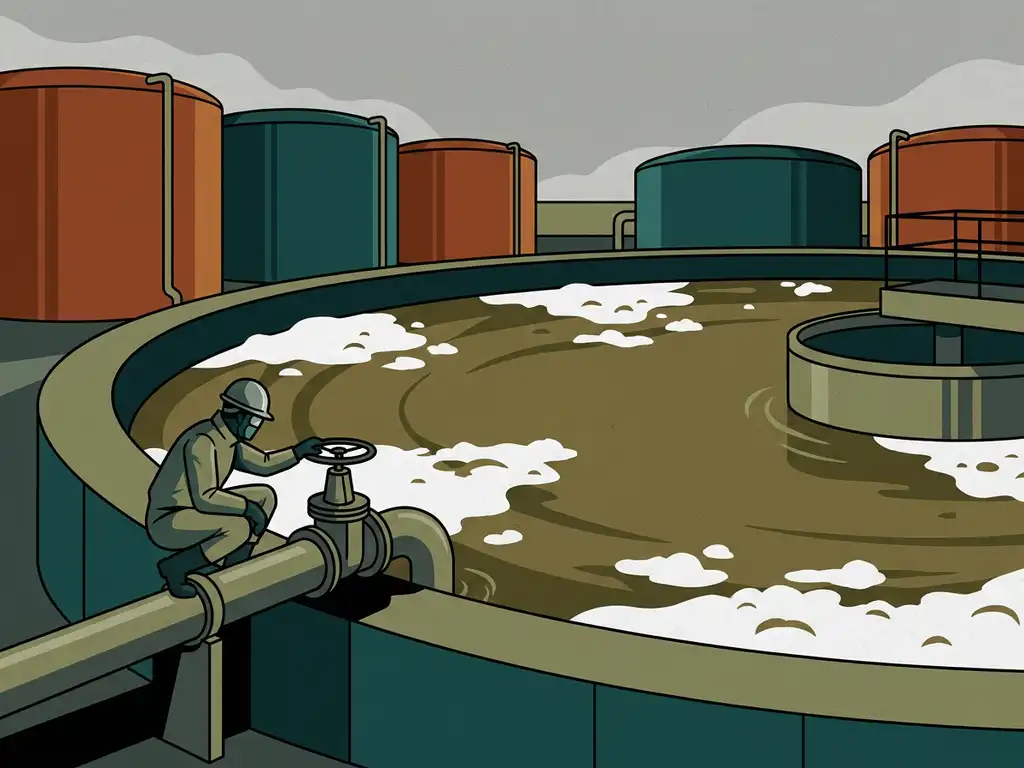
One of the most visible symptoms is sludge problems in wastewater treatment, particularly bulking and foaming. Filamentous bacteria, which thrive when organic loads are unbalanced or dissolved oxygen is insufficient, cause sludge to become light and poorly settling. This leads to sludge loss in the clarifier, rising effluent suspended solids, and loss of active biomass from the system. Foaming, often caused by specific filamentous species or lipid-rich influent, compounds the problem by making the plant difficult to operate and creating hygiene risks. Nitrification failure is another common consequence of microbial imbalance. Nitrifying bacteria are slow-growing and sensitive to pH swings, temperature drops, and toxic compounds. When their population collapses, ammonia concentrations in the effluent spike, often triggering an immediate compliance breach.
What makes microbial imbalance particularly challenging is that standard operational monitoring, focused on flow, temperature, and basic chemistry, rarely captures community-level shifts until the damage is already visible. Molecular monitoring of microbial communities, which tracks the composition and relative abundance of key functional groups, provides early warning that conventional methods miss. This is an area where specialist knowledge adds significant value, and it is one of the core competencies that Avecom’s water treatment services are built around.
Signs your plant is approaching a compliance breach
Compliance failures in industrial wastewater treatment rarely arrive without warning. The signals are there, but they require attention to patterns rather than single data points.
A gradual upward trend in effluent ammonia or total nitrogen, even while still within permitted limits, is a strong early indicator of nitrification stress. Increasing effluent turbidity or rising suspended solids in the clarifier overflow suggest sludge settleability is deteriorating. Inconsistent COD removal, particularly after production changeovers, points to a biological community that is struggling to adapt to variable influent. Phosphorus peaks following seasonal production cycles are common in food and beverage facilities and frequently catch operators off guard when discharge limits are recalculated under updated permit conditions.
In 2026, regulatory pressure across the Benelux region continues to tighten under frameworks such as VLAREM and the Water Framework Directive. Facilities that were previously compliant may find that revised discharge standards now require either process upgrades or more precise biological control. Recognising these early warning signs and acting before a formal enforcement notice is both operationally and financially the smarter approach.
When to call in external biological expertise
Internal engineering teams are well equipped to manage hydraulics, mechanical maintenance, and standard chemical dosing. Biological process optimisation is a different discipline, and the gap becomes apparent when standard troubleshooting fails to resolve recurring performance issues.
External expertise becomes necessary when the root cause of underperformance is unclear after internal investigation, when effluent values are trending toward or exceeding permit limits, or when a significant change in production is planned that will alter influent composition. It is also the right call when a facility is considering switching from chemical to biological treatment, or when an existing biological system needs to be restarted or reconfigured without a full shutdown. The fear of downtime during process adjustment is legitimate, but it should not prevent action. A structured feasibility assessment and pilot-scale validation, carried out before any changes are made to the operational plant, significantly reduces that risk.
Avecom’s team of environmental engineers and microbiologists has more than 27 years of experience working with mixed microbial cultures in exactly these situations. Rather than applying a standard solution, the approach begins with a microbiological audit of the existing installation, followed by lab- and pilot-scale testing to determine which biological consortia perform best for the specific wastewater in question.
How targeted process optimisation restores plant performance
Restoring a struggling biological treatment system does not always require rebuilding it. In many cases, targeted adjustments to aeration patterns, sludge retention time, nutrient dosing, or inoculation with the right microbial populations can bring a system back into stable operation within weeks rather than months.
The starting point is always an accurate diagnosis. A microbiological audit, combined with detailed influent characterisation, identifies which functional microbial groups are present, which are missing or suppressed, and what operational conditions are limiting their activity. From there, interventions can be sequenced to minimise disruption to ongoing production.
Bioaugmentation and inoculation
When specific microbial functions, such as nitrification or the degradation of particular organic compounds, are absent or insufficient, introducing targeted microbial inocula accelerates recovery. ABIL technology, developed and applied by Avecom, allows existing biofilters to be restarted or redirected more quickly, without requiring a complete system shutdown or extended re-seeding period.
Nutrient recovery as an added dimension
For facilities dealing with nitrogen and phosphorus overloads, particularly those with high-strength reject water streams, process optimisation can go beyond compliance. Through the ProMic platform, nitrogen-rich side streams can be valorised as a feedstock for microbial protein production, converting what was a disposal problem into a recoverable resource. This shifts the business case from pure cost management toward partial revenue recovery, which strengthens the argument for investing in biological process improvements.
The path forward for any facility experiencing industrial wastewater compliance failure starts with accurate diagnosis, not assumption. Whether the issue is sludge instability, nitrification failure, or a system simply not designed for today’s influent, the solution lies in understanding the microbiology at work and adjusting conditions to support it. For facilities ready to take that step, specialist biological water treatment support offers a structured route from problem identification to stable, compliant operation.