

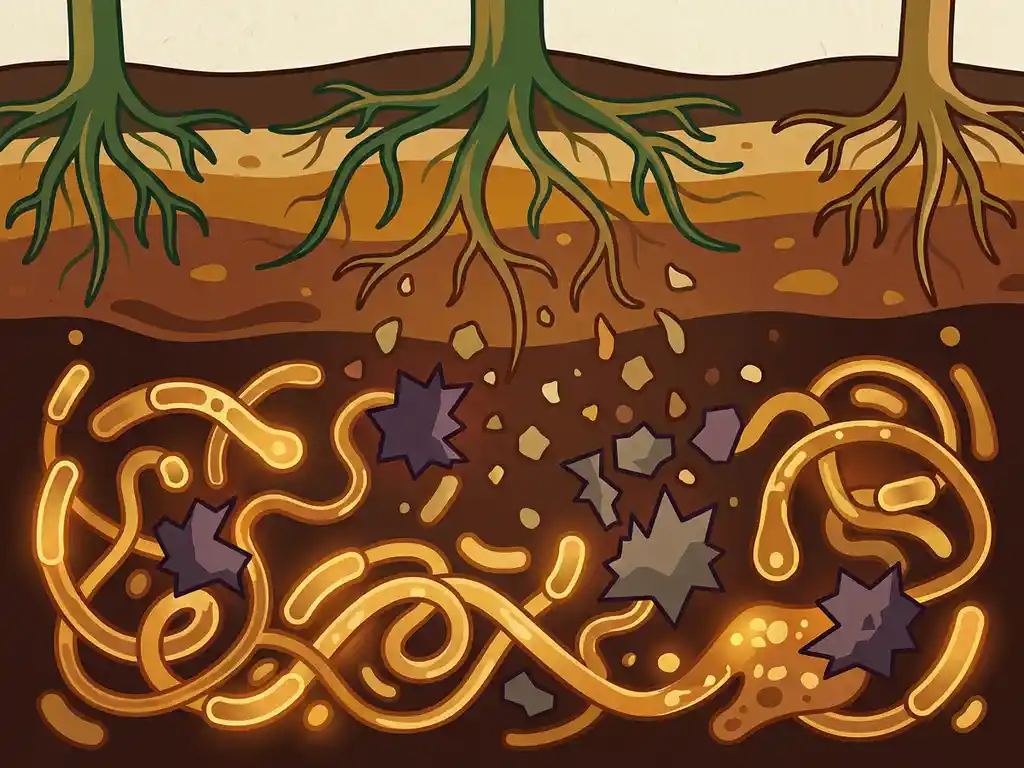
Microbial communities play a central role in biological soil cleanup: they are the organisms that actually break down, transform, or immobilize contaminants in the ground. Without active microbial populations, bioremediation simply does not happen. The effectiveness of any biological approach depends entirely on whether the right microorganisms are present, active, and operating under conditions that support their metabolic work. The sections below answer the most common questions about how this process works, when it applies, and what to expect from it in practice.
How do microorganisms actually break down soil contaminants?
Microorganisms break down soil contaminants by using them as an energy source, a carbon source, or by transforming them through co-metabolic reactions. Bacteria, fungi, and archaea produce enzymes that attack the chemical bonds in contaminant molecules, converting them step by step into simpler compounds, ideally carbon dioxide, water, and harmless mineral salts. This process is called biodegradation, and it occurs naturally in most soils to some degree.
The mechanism differs depending on the contaminant and the microbial species involved. Aerobic bacteria use oxygen as a terminal electron acceptor, making them effective against petroleum hydrocarbons and many organic compounds. Anaerobic bacteria operate without oxygen and are essential for degrading chlorinated solvents such as trichloroethylene (TCE) and perchloroethylene (PCE), which are among the most persistent groundwater contaminants found at industrial sites. These chlorinated compounds are broken down through a process called reductive dechlorination, in which the bacteria strip chlorine atoms from the molecule one by one, ultimately producing ethylene, which is non-toxic.
What makes this complex is that complete degradation often requires a sequence of different microbial species, each handling a specific step in the transformation chain. A mixed microbial community, rather than a single organism, is usually more capable of completing this chain reliably under real field conditions.
Get in Touch
Let’s Talk Microbial Solutions
Book a conversation with Stijn, our CEO, or send us your request.
| Book an Appointment | Request Information |
What types of soil contamination can microbial communities treat?
Microbial communities can treat a broad range of organic soil contaminants, including petroleum hydrocarbons, polycyclic aromatic hydrocarbons (PAHs), BTEX compounds (benzene, toluene, ethylbenzene, xylene), and chlorinated solvents such as PCE and TCE, also known as volatile organochlorine compounds (VOCl). These are among the most commonly found contaminants at former industrial sites, dry cleaners, fuel depots, and manufacturing facilities.
Biological treatment is generally less effective for heavy metals and inorganic contaminants, because microorganisms cannot destroy these elements. However, certain microbial processes can change the oxidation state of metals, making them less mobile or less bioavailable in the soil, which can reduce risk even if the metal itself remains present.
VOCl contamination deserves particular attention because it is both widespread and resistant to many conventional treatment methods. These chlorinated solvents are denser than water, meaning they sink through the soil and groundwater, making excavation impractical and pump-and-treat systems slow. Specialized anaerobic bacteria capable of reductive dechlorination are the most reliable biological tool available for this type of contamination, and their activity can be stimulated or supplemented through targeted intervention.
How does bioremediation compare to excavation for contaminated sites?
Bioremediation and excavation address contaminated soil through fundamentally different approaches. Excavation physically removes contaminated material from the site and disposes of it elsewhere. Bioremediation destroys or transforms the contamination in place, using microbial activity to eliminate the source rather than relocate it. The right choice depends on the nature of the contamination, site conditions, and project constraints.
Excavation is fast and produces a definitive result within a predictable timeframe, which is why it remains the default reference for many project managers. But it carries significant costs, particularly when contamination is deep, spread across a large area, or located beneath existing structures. It also generates large volumes of contaminated soil that must be transported and treated or landfilled, with associated environmental and logistical burdens.
Bioremediation is slower, typically operating over months to years, but it treats contamination where it sits, without the disruption and cost of excavation. It is particularly well suited to sites where:
- Contamination is too deep or too extensive for cost-effective excavation
- Buildings or infrastructure make excavation technically impossible
- The contaminant is a chlorinated solvent that has migrated into groundwater
- Budget constraints rule out large-scale soil removal
The key limitation of bioremediation is uncertainty at the outset. Not every site has the right microbial populations or geochemical conditions to support effective degradation. This is why feasibility testing before committing to a full biological approach is not optional, it is essential.
How do you know if a site is suitable for microbial soil remediation?
Site suitability for microbial soil remediation is determined through a feasibility assessment, typically starting with a microcosm test. This is a controlled laboratory experiment using actual soil and groundwater samples from the site, which tests whether the indigenous microbial community can degrade the target contaminant, and under what conditions. It is the most reliable and cost-efficient way to answer the question before committing to a full remediation strategy.
A microcosm test evaluates several critical factors: whether the right degrading organisms are present in the soil, whether they are metabolically active, whether they require additional nutrients or electron donors to function effectively, and whether the geochemical conditions in the soil support the target degradation pathway. For chlorinated solvents, this means confirming the presence and activity of dechlorinating bacteria capable of completing the full degradation chain.
Beyond the microcosm test, a site assessment for biological remediation also considers:
- Soil permeability and structure, which affects how amendments and nutrients can be distributed
- Groundwater depth and flow direction
- pH, temperature, and redox conditions in the soil
- The concentration and distribution of the contaminant
- Whether co-contaminants are present that might inhibit microbial activity
Avecom’s biological soil remediation services include microcosm testing as a standard first step, providing site owners and project managers with concrete data on feasibility before any larger investment is made. This approach avoids committing resources to a biological strategy on a site where the conditions do not support it.
How is the progress of microbial soil cleanup monitored?
Progress in microbial soil remediation is monitored through a combination of chemical analysis of contaminant concentrations and molecular biological tools that track the microbial populations responsible for degradation. Chemical monitoring tells you whether contaminant levels are declining. Molecular monitoring tells you why, and whether the biological process is functioning as intended.
Molecular tools such as quantitative PCR (qPCR) allow direct measurement of specific degrading microorganisms in soil and groundwater samples. For chlorinated solvent sites, this means quantifying the bacteria responsible for reductive dechlorination and confirming they are present in sufficient numbers to drive the process. Amplicon sequencing provides a broader picture of the microbial community structure, which is useful for understanding whether the community is shifting in the right direction over time.
This combination of chemical and biological data serves two purposes. First, it gives the remediation team the information needed to adjust the approach if the process stalls, for example by adding electron donors, adjusting pH, or supplementing with additional microbial cultures. Second, it provides regulators and reporting bodies with documented evidence of remediation progress, which is directly relevant for compliance with frameworks such as OVAM and VLAREBO in Belgium.
Monitoring is not just a regulatory obligation. When done with the right tools, it is a cost-saving mechanism. Early detection of a stalled process allows intervention before months of ineffective treatment have been paid for.
What factors can slow down or stop microbial soil remediation?
Several factors can reduce or halt the effectiveness of microbial soil remediation. The most common are the absence of the right degrading microorganisms, unfavorable geochemical conditions, insufficient nutrients or electron donors, and contaminant concentrations that are toxic to the microbial community itself. Understanding these limiting factors is what separates a well-designed remediation from one that produces no measurable result.
For chlorinated solvent sites specifically, a frequent problem is incomplete dechlorination. The degradation chain requires a sequence of microbial species, and if one link in that chain is missing or inactive, the process stalls at an intermediate compound. In some cases, these intermediates, such as vinyl chloride, are more toxic than the original contaminant. This is why confirming the full dechlorination capacity of the microbial community before and during treatment matters.
Other common limiting factors include:
- Low permeability soils that prevent uniform distribution of amendments and limit contact between microorganisms and the contaminant
- Extreme pH levels outside the range that supports microbial activity
- Competing electron acceptors such as sulfate or nitrate, which can divert microbial metabolism away from the target degradation pathway
- High contaminant concentrations that exceed the tolerance threshold of the degrading organisms
- Temperature, since microbial activity slows significantly in cold soils, particularly below 10 degrees Celsius
When a site is not responding as expected, the solution is not always to abandon the biological approach. Often, targeted interventions, such as bioaugmentation with specialized microbial consortia, the addition of specific electron donors, or pH adjustment, can restart a stalled process. The team at Avecom has over 30 years of experience diagnosing and correcting these kinds of process failures, drawing on both laboratory analysis and field expertise to find what the site actually needs.
If you are dealing with contaminated soil where conventional methods have not delivered results, or where excavation is not a realistic option, a biological feasibility assessment is a practical starting point. Avecom offers screening and microcosm testing to determine whether a biological approach is viable for your specific site and contaminant profile, before any major investment is committed.
Related Articles
- What are the legal obligations when contamination is found on a site?
- Is it possible to fully remediate heavily contaminated soil?
- How do you restart a biological wastewater plant after sludge failure?
- How does sludge bulking affect treatment performance?
- What causes sludge bulking in biological treatment?