

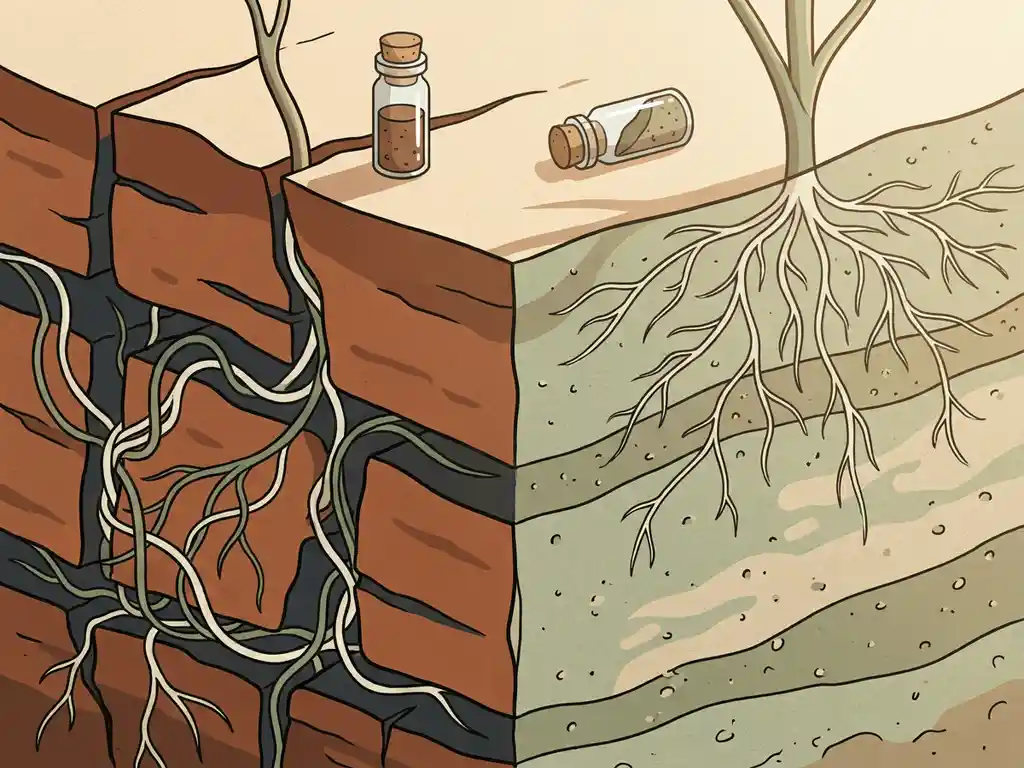
Soil type directly affects remediation outcomes because it controls how contaminants move, where they accumulate, and whether microorganisms can reach and break them down. A sandy soil and a clay-rich soil may contain the same contaminant at the same concentration, yet respond entirely differently to the same remediation approach. The sections below work through the specific mechanisms behind that difference, from contaminant transport to the conditions that make biological treatment viable.
How does soil composition influence how contaminants spread?
Soil composition determines the speed, direction, and distribution of contaminant migration. Coarse-grained soils like sand and gravel allow rapid lateral and vertical movement of dissolved contaminants through interconnected pore spaces. Fine-grained soils like clay and silt slow that movement dramatically, but contaminants that do penetrate them become tightly bound and extremely difficult to flush out later.
The organic matter content of a soil adds another layer of complexity. Hydrophobic contaminants, including chlorinated solvents such as perchloroethylene (PCE) and trichloroethylene (TCE), partition preferentially into organic matter. This means that a soil with high organic content acts as a reservoir, slowly releasing contaminants back into groundwater long after the primary source has been removed. This slow back-diffusion is one of the main reasons contaminated sites remain problematic for decades.
Heterogeneous soils, where layers of sand alternate with clay lenses, create the most challenging transport scenarios. Dense non-aqueous phase liquids (DNAPLs) like chlorinated solvents sink through permeable zones until they hit a low-permeability layer, spread laterally, and then diffuse into the fine-grained material over time. Reconstructing where the contamination actually is, and in what form, requires careful site characterization before any remediation strategy is designed.
Get in Touch
Let’s Talk Microbial Solutions
Book a conversation with Stijn, our CEO, or send us your request.
| Book an Appointment | Request Information |
Which soil types are hardest to remediate and why?
Clay-rich soils and heterogeneous layered profiles are the hardest to remediate. Clay has very low hydraulic conductivity, which makes it almost impossible to flush reagents or electron donors through the matrix using conventional injection. Contaminants that have diffused into clay over years create a persistent secondary source that continues to leach back into cleaner zones even after active treatment has stopped.
Compacted or poorly structured soils present similar challenges. Without natural permeability, there is no effective way to distribute treatment amendments evenly through the subsurface. Injection wells reach only the most permeable pathways, leaving contaminated zones between them largely untouched.
Heavily urbanized or built-up sites compound the problem further. Where excavation is blocked by existing structures, utilities, or infrastructure, in-situ approaches are the only option. If the soil conditions do not support those approaches, the site can remain in a state of managed risk rather than genuine remediation for many years. This is precisely the situation where a thorough feasibility assessment before committing to any strategy saves both time and money.
How does soil type affect the performance of biological remediation?
Soil type affects biological remediation by controlling microbial access to contaminants, the availability of electron donors and acceptors, and the physical distribution of the microbial community itself. Biological treatment works best in soils with sufficient permeability to allow nutrient and amendment delivery, moderate organic matter to support microbial activity, and a stable geochemical environment.
In coarse-grained soils, the main challenge is ensuring that injected microbial cultures or substrates do not simply flush past the contaminated zone too quickly. In fine-grained soils, the challenge is the opposite: getting anything into the matrix at all. Biological degradation can still occur in clay-rich environments, but it tends to be limited to the interface between permeable and impermeable zones rather than throughout the contaminated volume.
Soil pH, redox potential, and temperature also interact with soil texture to shape biological performance. Anaerobic reductive dechlorination of chlorinated solvents, for example, requires strongly reducing conditions that can be difficult to establish and maintain in soils with high natural oxidant demand. Understanding these geochemical parameters alongside the physical soil structure is essential for predicting whether a biological approach will work on a given site. Avecom’s biological soil remediation services are built around exactly this kind of site-specific assessment.
Can a microcosm test determine if biological remediation will work in a specific soil?
Yes. A microcosm test is one of the most reliable and cost-efficient ways to determine whether biological remediation is feasible for a specific soil and contaminant combination. The test uses actual soil and groundwater from the site, incubated under controlled laboratory conditions, to observe whether indigenous microorganisms can degrade the target contaminant and at what rate.
The value of a microcosm test lies in its specificity. It does not rely on generic assumptions about what should work in theory. Instead, it tests whether the actual microbial community present in the soil is capable of carrying out the required degradation pathway, and whether that activity can be stimulated with amendments such as electron donors, pH adjusters, or bioaugmentation cultures.
A well-designed microcosm study will typically run several treatment variants alongside an unamended control. This allows comparison of natural attenuation rates against stimulated conditions, and gives a clear indication of whether bioaugmentation, biostimulation, or a combination of both is likely to be needed at full scale. The result is not a guarantee, but it is a scientifically grounded basis for a go or no-go decision, which is far more defensible than proceeding on assumptions alone.
What soil conditions must be met for enhanced reductive dechlorination to succeed?
Enhanced reductive dechlorination (ERD) requires anaerobic conditions, the presence of a suitable electron donor, a near-neutral pH, and a microbial community that includes dechlorinating organisms capable of driving the degradation pathway to completion. When any of these conditions are absent or inadequate, the process stalls, sometimes at intermediate products that are more toxic than the original contaminant.
The requirement for anaerobic conditions is non-negotiable. Reductive dechlorination is an anaerobic process in which chlorinated compounds like PCE or TCE are used as electron acceptors. If dissolved oxygen or nitrate levels in the soil are too high, competing electron acceptors will dominate and dechlorinating bacteria will be outcompeted. Establishing and sustaining sufficiently reducing conditions is often the primary engineering challenge on sites with high natural oxidant demand.
The electron donor requirement is equally important. Organisms responsible for complete dechlorination to ethene rely on hydrogen as a direct electron donor, which is typically supplied indirectly through the fermentation of added organic substrates such as lactate, molasses, or slow-release compounds. The rate of hydrogen supply must be carefully matched to the demand of the dechlorinating community. Too little, and dechlorination stalls. Too much, and competing methanogens consume the hydrogen before dechlorinators can use it.
Finally, the microbial community itself must contain the right organisms. Not all contaminated sites have a native population capable of complete dechlorination. Where indigenous dechlorinators are absent or present in insufficient numbers, bioaugmentation with a specialized microbial consortium is necessary. This is where a site-specific microbial assessment is indispensable before committing to an ERD strategy.
How does molecular monitoring help track remediation progress across different soils?
Molecular monitoring tools, particularly quantitative PCR (qPCR) and amplicon sequencing, allow direct measurement of the microbial community responsible for contaminant degradation. Rather than inferring biological activity from chemical concentration changes alone, molecular methods quantify the abundance and activity of specific functional genes and organisms in the soil at any point during the remediation process.
This matters across different soil types because the relationship between chemical and biological indicators varies with the physical environment. In a heterogeneous soil, a drop in contaminant concentration in one monitoring well does not necessarily mean that the whole contaminated zone is responding. Molecular data from multiple sampling points can reveal whether dechlorinating organisms are active throughout the treatment zone or only in the more permeable pathways.
For project managers responsible for OVAM reporting and regulatory compliance, molecular monitoring provides a layer of documentation that chemical data alone cannot supply. Demonstrating that the right microorganisms are present, active, and increasing in abundance over time is a strong line of evidence that the remediation process is working as intended. It also enables early detection of problems, such as a stall in the dechlorination pathway, before they become costly setbacks.
Avecom applies qPCR-based molecular monitoring as a standard component of its biological remediation projects, providing clients with concrete, quantitative data throughout the process. For site owners and project managers dealing with a contaminated industrial site or brownfield, this kind of continuous insight is not just scientifically valuable. It is a practical tool for managing timelines, budgets, and regulatory obligations with confidence. To understand how this approach applies to a specific site, the soil remediation expertise at Avecom offers a useful starting point, or you can contact the team directly for a preliminary screening.
Related Articles
- What is anaerobic fermentation used for in industry?
- How do microorganisms break down soil contaminants?
- How do stricter discharge limits affect sludge management decisions?
- How do you restart a biological wastewater plant after sludge failure?
- What questions should you ask before starting a soil remediation project?