

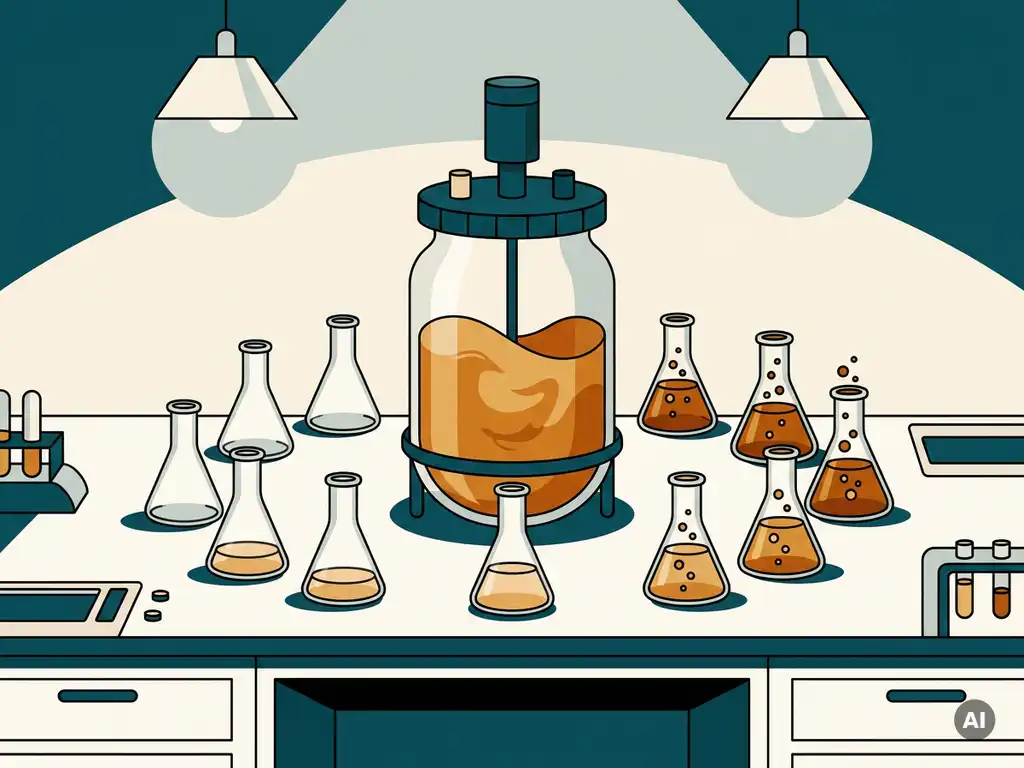
Fermentation process development typically takes 6 to 24 months from initial lab feasibility to a validated pilot-scale process, depending on the complexity of the microbial system and the clarity of the target product specifications. Simpler processes with well-characterized organisms can reach proof-of-concept within six months; complex mixed-culture or novel substrate applications often require 18 months or more. The sections below break down each phase and the factors that compress or extend the timeline.
What factors determine how long fermentation process development takes?
The single biggest determinant of fermentation development time is the biological complexity of the system being developed. A process built around a well-characterized organism on a defined substrate can move quickly; a process involving a mixed microbial community, a novel carbon source, or a poorly understood metabolic pathway requires substantially more characterization time before scale-up becomes meaningful. Beyond biology, regulatory requirements, downstream processing needs, and the availability of suitable infrastructure all shape the overall timeline.
The most commonly underestimated factor is process understanding. Teams that rush through the lab phase without fully mapping the relationship between process parameters and product quality consistently face expensive failures at pilot scale. Investing time in understanding pH sensitivity, oxygen transfer, temperature optima, and inhibition thresholds during the early phase saves multiples of that time later.
Other key factors include:
- Substrate variability: Industrial side streams and food processing waters vary in composition, which forces additional robustness testing compared to synthetic media.
- Product purity requirements: Feed-grade microbial protein has different analytical hurdles than a pharmaceutical-grade enzyme, directly affecting how long validation takes.
- Team experience: A team that has scaled similar processes before will identify critical control points faster than one approaching fermentation for the first time.
- Access to infrastructure: Waiting for bioreactor time, analytical capacity, or specialized equipment creates idle periods that extend timelines without adding scientific value.
What are the main stages of fermentation process development?
Fermentation process development follows a staged progression from concept to production, with each stage building on validated knowledge from the one before. The standard stages are: concept definition and literature review, lab-scale feasibility testing, process optimization, pilot-scale validation, and technology transfer or scale-up to production. Each stage has its own go/no-go criteria, and skipping or compressing any stage increases the risk of failure at the next.
Concept definition and screening
Before any fermentation runs begin, the target product, the candidate microbial system, and the substrate need to be clearly defined. This stage often involves a rapid literature review, strain or consortium selection, and a risk assessment of the proposed process. Done well, it takes two to four weeks and prevents months of misdirected lab work.
Lab-scale feasibility and optimization
This is where the core science happens: shake flasks, small bioreactors, and analytical characterization establish whether the process is fundamentally viable and what parameters control it. This stage typically produces the process window: the range of conditions under which the organism performs acceptably.
{div style=”box-sizing: border-box !important; margin: 32px 0 !important; padding: 28px 32px !important; background-color: #004070 !important; background-image: linear-gradient(135deg, #004070 0%, #003057 100%) !important; border: none !important; border-left: 4px solid #36a9e1 !important; font-family: ‘Exo’, sans-serif !important; text-align: center !important; line-height: normal !important;”}
{p style=”margin: 0 0 6px 0 !important; padding: 0 !important; font-family: ‘Exo’, sans-serif !important; font-size: 12px !important; font-weight: 500 !important; color: #36a9e1 !important; text-transform: uppercase !important; letter-spacing: 1.5px !important; line-height: 16px !important;”}Get in Touch{/p}
{p style=”margin: 0 0 8px 0 !important; padding: 0 !important; font-family: ‘Exo’, sans-serif !important; font-size: 20px !important; font-weight: 500 !important; color: #ffffff !important; line-height: 26px !important;”}Let’s Talk Microbial Solutions{/p}
{p style=”margin: 0 0 20px 0 !important; padding: 0 !important; font-family: ‘Exo’, sans-serif !important; font-size: 14px !important; font-weight: 300 !important; color: #ffffff !important; line-height: 20px !important;”}Book a conversation with Stijn, our CEO, or send us your request.{/p}
{table style=”border-collapse: collapse !important; border-spacing: 0 !important; margin: 0 auto !important; padding: 0 !important; width: auto !important;” cellpadding=”0″ cellspacing=”0″ role=”presentation”}
{tr style=”margin: 0 !important; padding: 0 !important;”}
{td style=”margin: 0 !important; padding: 0 6px 0 0 !important; white-space: nowrap !important;”}
{a href=”https://avecom.be/contact-2/” style=”display: inline-block !important; box-sizing: border-box !important; margin: 0 !important; padding: 11px 24px !important; background-color: #95c11f !important; color: #ffffff !important; font-family: ‘Exo’, sans-serif !important; font-size: 14px !important; font-weight: 500 !important; text-transform: uppercase !important; text-decoration: none !important; border: none !important; line-height: 18px !important; letter-spacing: 0.3px !important; white-space: nowrap !important;”}Book an Appointment{/a}
{/td}
{td style=”margin: 0 !important; padding: 0 !important; white-space: nowrap !important;”}
{a href=”https://avecom.callista.be/contactus” style=”display: inline-block !important; box-sizing: border-box !important; margin: 0 !important; padding: 9px 24px !important; background-color: transparent !important; color: #ffffff !important; font-family: ‘Exo’, sans-serif !important; font-size: 14px !important; font-weight: 500 !important; text-transform: uppercase !important; text-decoration: none !important; border: 2px solid #ffffff !important; line-height: 18px !important; letter-spacing: 0.3px !important; white-space: nowrap !important;”}Request Information{/a}
{/td}
{/tr}
{/table}
{/div}
Pilot-scale validation and scale-up
Validated lab conditions are transferred to a larger reactor to confirm that performance holds at scale. This is where engineering factors such as mixing, heat transfer, and aeration become critical. Pilot validation generates the data needed for a business case, investor presentation, or regulatory submission.
How long does the lab-scale feasibility phase typically take?
Lab-scale feasibility for a new fermentation process typically takes two to six months, depending on how well-defined the biological system is at the outset. A process using a known organism on a familiar substrate can generate a clear feasibility verdict in eight to ten weeks. A process involving enrichment of a mixed microbial community from environmental samples, or optimization on a complex industrial waste stream, routinely takes four to six months before reliable, reproducible results can be reported.
The feasibility phase is not just about confirming that fermentation occurs. It must establish the process window: the combination of temperature, pH, dissolved oxygen, nutrient ratios, and feeding strategy that produces the target product at acceptable yield and quality. Without that understanding, any scale-up attempt is essentially guesswork.
Teams with access to high-throughput molecular tools, amplicon sequencing, qPCR-based community monitoring, can compress the characterization time for complex microbial systems significantly. Rather than waiting for weeks of culture-based evidence, these techniques provide near-real-time feedback on community composition and metabolic activity, allowing faster iteration on process conditions.
When does fermentation scale-up from lab to pilot become the bottleneck?
Scale-up from lab to pilot becomes the bottleneck when the process is sensitive to engineering parameters that change non-linearly with reactor volume. The most common culprits are oxygen transfer rate, mixing homogeneity, and heat removal. A process that performs well in a two-liter benchtop bioreactor can fail at 200 liters if the oxygen transfer coefficient is insufficient or if gradients in substrate concentration develop in larger vessels. Identifying these sensitivities before scale-up, not during it, is what separates efficient development from costly iteration.
Mixed microbial cultures present a particular challenge at this stage. Because the community composition responds to process conditions, any shift in the engineering environment at pilot scale can select for different organisms than those dominant at lab scale. This is why microbiome monitoring during the transition is not optional: it is the only reliable way to confirm that the same biological process is running in the larger vessel.
The scale-up bottleneck is also an organizational one. Many companies complete solid lab work and then face a gap: their internal lab cannot accommodate pilot-scale equipment, and building or buying that infrastructure takes time and capital that the development timeline cannot absorb. Partnering with a facility that already operates reactors in the relevant volume range, including the fermentation infrastructure needed for aerobic and anaerobic processes up to 2,000 liters, eliminates that gap without requiring capital investment.
How does working with a contract R&D partner affect the development timeline?
Working with a specialist contract R&D partner typically reduces the fermentation development timeline by three to nine months compared to building internal capability from scratch. The primary reason is immediate access to infrastructure, analytical tools, and accumulated process knowledge that would otherwise take years and significant capital to develop internally. A partner that has run hundreds of fermentation campaigns across different substrates and organisms will recognize failure modes and optimization opportunities that an internal team encounters for the first time.
The timeline benefit is not just about equipment access. Experienced contract R&D teams bring structured experimental design, established analytical workflows, and a library of process data from comparable projects. That institutional knowledge compresses the learning curve at every stage of the fermentation R&D timeline.
There are also organizational benefits. A contract partner operates as an extension of the internal R&D team, running experiments in parallel with internal work rather than sequentially. For a scale-up with investor deadlines, that parallel capacity can be the difference between hitting a proof-of-concept milestone on schedule and missing it by a quarter.
The critical factor in selecting a contract partner is alignment of scientific approach. A partner whose expertise lies in genetically modified pure cultures will not be the right fit for a process that benefits from mixed microbial communities, and vice versa. The methodology must match the biology of the target process, not just the available reactor volume.
What can realistically be achieved in 6 to 12 months of fermentation development?
In 6 to 12 months of focused fermentation process development, a team can realistically achieve a validated lab-scale process and initial pilot-scale proof-of-concept for most biological systems. This means a defined process window, reproducible performance data, a preliminary understanding of the critical control parameters, and enough pilot-scale evidence to support a business case or investor conversation. It does not typically mean a production-ready process with full regulatory clearance.
What is achievable within this window depends heavily on the starting point. If the microbial system is already partially characterized and the substrate is well-defined, six months is sufficient to reach a credible pilot-scale demonstration. If the project starts from a blank slate with an uncharacterized community and a variable industrial waste stream, 12 months is a more realistic target for the same milestone.
A realistic 12-month fermentation R&D timeline might look like this:
- Months 1 to 2: Concept definition, substrate characterization, initial strain or consortium screening in shake flasks.
- Months 3 to 5: Lab-scale bioreactor runs, process parameter optimization, yield and quality assessment.
- Months 6 to 8: Process consolidation, reproducibility testing, preliminary downstream processing evaluation.
- Months 9 to 12: Pilot-scale transfer, engineering parameter adjustment, performance confirmation at scale.
This timeline assumes consistent access to bioreactors and analytical capacity throughout. Gaps in infrastructure access are the most common reason development timelines stretch beyond 12 months, not scientific complexity. Companies that partner with an established fermentation R&D facility from the outset, rather than attempting to build or source infrastructure mid-project, consistently achieve more within the same window. Avecom, as a Ghent University spin-off with over 30 years of applied fermentation experience, structures its contract R&D engagements precisely around these milestone-driven timelines, making it a practical option for teams under investor or commercial pressure to deliver results within a defined period.
Related Articles
- What is the difference between pure culture and mixed culture fermentation?
- How does lab-scale fermentation testing work?
- How do you choose the right remediation method for your site?
- Can nutrient imbalance trigger sludge problems in wastewater treatment?
- Why is my wastewater treatment plant not working properly?