

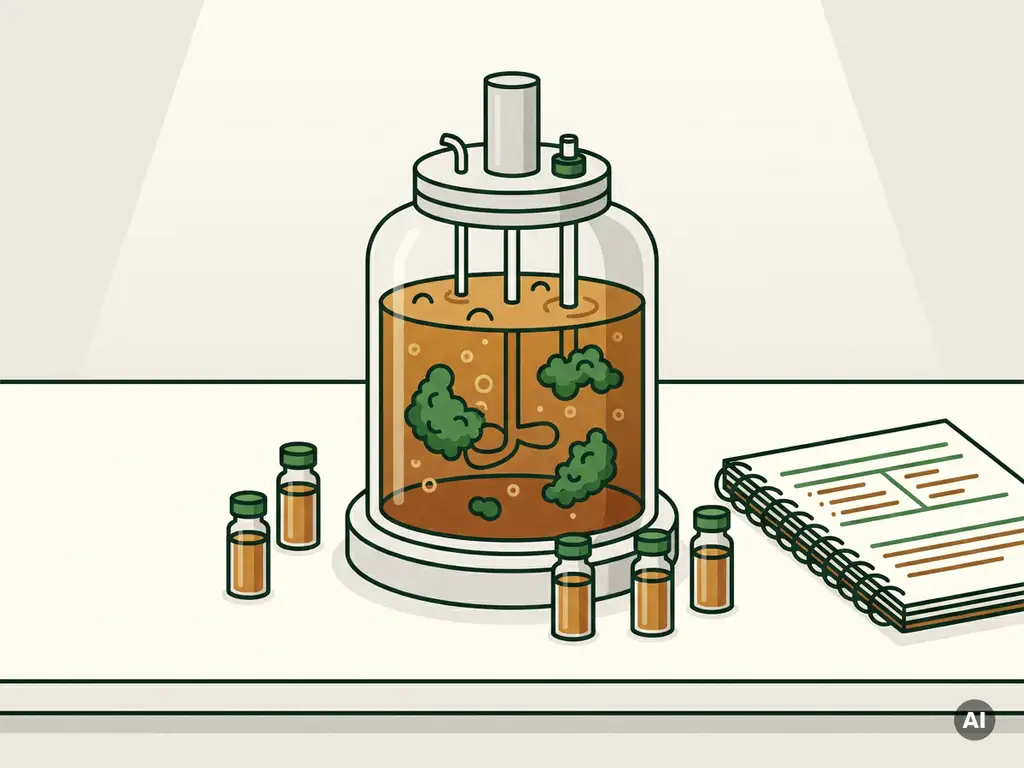
Producing a proof-of-concept for a fermentation process in 2026 typically takes between three and nine months, depending on process complexity and the infrastructure available to you. The critical factor is whether you start at lab scale with a clear hypothesis or attempt to skip directly to pilot validation without sufficient process understanding. The questions below unpack each stage of fermentation PoC development, from what the work actually involves to how you protect your intellectual property when working with an external partner.
What does a fermentation proof-of-concept actually involve?
A fermentation proof-of-concept is a structured series of experiments designed to demonstrate that a microbial process can produce a target compound or achieve a target outcome under controlled, reproducible conditions. It is not a single experiment. A PoC spans hypothesis testing, parameter optimization, and at minimum one round of scale confirmation, producing data that can support investment decisions, patent applications, or regulatory submissions.
In practice, a fermentation PoC involves several interconnected workstreams. First, the microbial system itself must be selected or characterized. This means identifying whether a pure culture, a defined mixed consortium, or a more complex environmental community is best suited to the application. Second, the process parameters that govern productivity and stability must be mapped: pH, temperature, dissolved oxygen, nutrient feed rates, and residence time are all variables that interact and need to be understood before scale-up is attempted.
Third, analytical monitoring must run in parallel with the fermentation work. Without data on microbial community composition, substrate conversion efficiency, and product yield at each stage, it is impossible to distinguish a process that works from one that merely appears to work once. A well-executed fermentation feasibility study generates a documented process envelope, not just a positive result.
How long does it take to validate a fermentation concept at pilot scale?
Validating a fermentation concept at pilot scale typically requires three to nine months from the start of lab-scale screening. The timeline depends primarily on the complexity of the microbial system, the number of process variables that need optimization, and whether the transition from lab to pilot introduces unexpected instability. Simple batch processes with well-characterized organisms move faster; continuous processes with mixed cultures require more iteration.
A realistic timeline for most fermentation process development projects in 2026 breaks down roughly as follows. The first four to eight weeks are spent on lab-scale screening: testing the microbial system under a range of conditions to identify a working parameter space. The following six to twelve weeks focus on optimization within that space, narrowing conditions to maximize yield, consistency, and robustness. Pilot-scale runs then begin, typically requiring four to eight additional weeks to confirm that lab findings hold at larger volume and under real operational conditions.
Investor pressure often creates the expectation that a proof-of-concept can be compressed into six months. That is achievable for straightforward processes, but only when the lab phase generates clean, well-documented data that removes ambiguity before the first pilot run. Skipping rigorous lab-scale work to accelerate the timeline almost always extends the overall schedule, because problems surface at pilot scale where they are far more expensive to diagnose.
Get in Touch
Let’s Talk Microbial Solutions
Book a conversation with Stijn, our CEO, or send us your request.
| Book an Appointment | Request Information |
What’s the difference between lab-scale and pilot-scale fermentation results?
Lab-scale fermentation results are generated in small reactors, typically one to ten liters, under tightly controlled conditions that are easier to maintain and monitor than in larger systems. Pilot-scale fermentation operates in reactors of tens to hundreds of liters, where mixing dynamics, heat transfer, oxygen distribution, and foam behavior change in ways that can significantly alter microbial performance. A process that performs well at lab scale does not automatically reproduce those results at pilot scale.
Why results diverge between scales
The core reason for divergence is that physical parameters do not scale linearly. Dissolved oxygen gradients, for example, are manageable in a two-liter reactor but can become significant in a 200-liter vessel, creating zones of oxygen limitation that affect microbial activity and product formation. Similarly, pH control becomes more challenging as volume increases, because the response time between a pH shift and the addition of a corrective agent lengthens.
What this means for your PoC strategy
Understanding the gap between scales is why fermentation scale-up should be treated as a scientific step, not a logistical one. The lab phase should deliberately probe the boundaries of the process, testing how the microbial system responds to stress conditions that are more likely to occur at larger volume. If the process is brittle at lab scale, it will fail at pilot scale. If it is robust across a range of conditions in the lab, the pilot transition becomes a confirmation exercise rather than a discovery exercise.
This is also where microbial fermentation expertise in mixed culture systems becomes particularly relevant. Mixed microbial communities often show greater resilience across scale transitions than pure cultures, because their functional redundancy buffers against the localized environmental variation that larger reactors introduce.
Should you build your own fermentation infrastructure or use a contract partner?
For most companies at the proof-of-concept or early scale-up stage, using a contract fermentation R&D partner is faster and more capital-efficient than building internal infrastructure. Equipping a pilot-scale fermentation facility with bioreactors, analytical instrumentation, downstream processing equipment, and qualified personnel requires significant capital investment and years of setup time. A contract partner with existing infrastructure eliminates that cost and compresses time-to-data substantially.
The decision depends on how central fermentation is to your long-term business model. If fermentation is the core of your production process and you expect to run it at industrial scale indefinitely, building internal capacity eventually makes strategic sense. But at the PoC and pilot validation stage, even companies that plan to internalize production eventually benefit from externalizing the early risk. The PoC phase is precisely when process understanding is lowest and the probability of needing to redesign the approach is highest.
A contract partner also brings accumulated process knowledge that internal teams rarely develop quickly. Working with organisms and reactor systems every day across multiple projects creates pattern recognition that accelerates troubleshooting and optimization in ways that are difficult to replicate from a standing start.
What analytical methods are essential during fermentation PoC development?
The analytical methods essential during a fermentation proof-of-concept depend on the process type, but several are broadly applicable regardless of application. At minimum, a fermentation PoC requires quantitative monitoring of substrate consumption and product formation, measurement of key process parameters over time, and characterization of the microbial community driving the process. Without these three categories of data, the PoC cannot generate the process understanding needed to support scale-up or investment decisions.
For processes involving mixed microbial cultures, amplicon sequencing and quantitative PCR are particularly important. Amplicon sequencing reveals the composition and relative abundance of the microbial community at different process stages, making it possible to identify which organisms are responsible for target activity and how the community shifts in response to process changes. qPCR allows specific populations to be monitored quantitatively in real time, providing early warning of community drift before it affects process performance.
Beyond microbial characterization, standard analytical tools include HPLC or GC for metabolite quantification, respirometry for aerobic process monitoring, and offline sampling protocols that capture process dynamics without disturbing the fermentation. The choice of downstream analytical methods should be driven by the specific compounds being produced or transformed, and the detection sensitivity required to distinguish meaningful differences between conditions.
Rigorous analytical coverage during the PoC phase also serves a secondary purpose: it generates the documented evidence base that supports patent applications, regulatory submissions, and investor due diligence. Data collected during early-stage development that is well characterized and reproducible has substantially more value than results that cannot be explained mechanistically.
How do you protect your IP when working with a contract fermentation partner?
Protecting intellectual property when working with a contract fermentation R&D partner starts before any technical work begins, with a well-drafted confidentiality agreement and a clear contractual definition of IP ownership. The agreement should specify which party owns background IP brought into the project, which party owns foreground IP generated during the collaboration, and how any jointly developed innovations are handled. These terms should be agreed in writing before sharing any proprietary process details.
Beyond the legal framework, practical IP protection during fermentation process development involves controlling information flow. Share process details on a need-to-know basis: the contract partner needs to understand the process parameters and target outcomes, but does not necessarily need access to the full upstream or downstream context of your technology. Document your own contributions carefully throughout the project, maintaining dated records of your internal hypotheses, decisions, and results alongside the data generated at the partner’s facility.
When evaluating a contract partner, look for organizations with a clear track record of working with multiple industrial clients simultaneously without conflicts of interest. Partners with established confidentiality protocols, experience in regulated industries, and a scientific culture that values integrity are lower-risk choices than those without that history. A partner that publishes academic research is not automatically a risk to your IP, but you should confirm that any publication plans involving your project require your prior written approval.
Finally, consider the timing of patent filings relative to the PoC work. If your process concept is novel and the PoC will generate data that strengthens a patent application, filing a provisional application before pilot-scale work begins can establish a priority date that protects your position even as external partners contribute to process development. A contract partner with experience supporting patent applications and regulatory submissions can be a genuine asset at this stage rather than a liability, provided the contractual foundations are solid.
Related Articles
- What is microbiome monitoring and why does it matter in fermentation?
- How serious is contamination found on an industrial site?
- How do you reduce sludge disposal costs in an industrial plant?
- What are common sludge problems in the food and beverage industry?
- When should you test your land for soil contamination?