

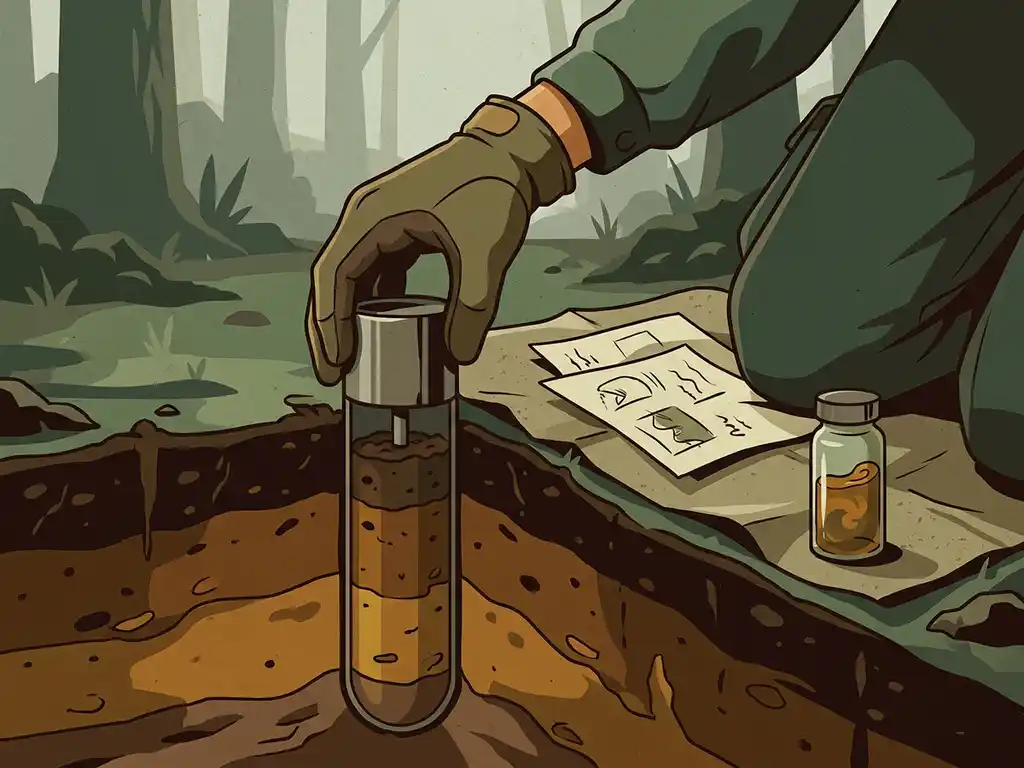
Before starting a soil remediation project, you need to ask six core questions: what contaminant you are dealing with, whether excavation is the right method, whether biological remediation is feasible, what regulatory requirements apply, how long the process will take, and who needs to be involved. Getting clear answers to these questions upfront prevents costly missteps, keeps your project compliant with authorities like OVAM, and ensures you choose a remediation approach that actually works for your specific site conditions.
What type of contamination are you actually dealing with?
The first step after soil contamination is discovered is identifying exactly what you are dealing with. The contaminant type determines every subsequent decision: which remediation methods are viable, how urgent the situation is, and what monitoring will be required. A site contaminated with petroleum hydrocarbons presents a fundamentally different challenge than one affected by volatile organochlorine compounds (VOCl), such as chlorinated solvents.
VOCl contamination, which includes compounds like perchloroethylene (PCE) and trichloroethylene (TCE), is among the most persistent and complex soil contamination types encountered on industrial and brownfield sites. These compounds migrate downward through the soil profile and dissolve into groundwater, meaning the contamination often extends far beyond the original source zone. Standard soil sampling alone is rarely sufficient to map the full extent of the problem.
A thorough contamination assessment should determine:
- The specific contaminant or mixture of contaminants present
- The concentration levels at different depths and locations
- Whether groundwater is affected and to what degree
- The soil type and hydrogeological conditions that influence contaminant behaviour
- Whether natural attenuation processes are already active in the subsurface
Knowing whether groundwater is affected by soil contamination is critical at this stage. Dissolved contaminants in groundwater can travel significant distances from the source, creating a plume that affects neighbouring parcels and complicates both the legal and technical scope of the remediation.
Get in Touch
Let’s Talk Microbial Solutions
Book a conversation with Stijn, our CEO, or send us your request.
| Book an Appointment | Request Information |
Is excavation always the right remediation approach?
Excavation is not always the right approach, and for many contaminated sites, it is neither technically feasible nor economically justified. While dig-and-dump remains the default mental model for many project managers, it has significant limitations that make it unsuitable for a large proportion of real-world contamination scenarios.
Excavation becomes impractical or impossible when contamination sits beneath existing buildings or infrastructure, when the water table is high, when contamination has reached depths that make mechanical removal disproportionately expensive, or when the contaminant has migrated into a complex soil matrix where clean boundaries cannot be defined. In these situations, removing all contaminated material simply cannot be guaranteed, and the disruption caused often outweighs the benefit.
In-situ techniques, including biological, chemical, and physical methods, treat contamination where it sits. For sites where VOCl contamination has spread through deep soil layers and into groundwater, in-situ biological remediation is often the most targeted and cost-proportionate option. The biological soil remediation approach works by stimulating or introducing microorganisms capable of breaking down chlorinated compounds directly in the subsurface, avoiding the need for large-scale excavation entirely.
The honest answer is that the right approach depends on the contaminant type, site conditions, and project constraints. Excavation may still be appropriate for shallow, well-defined contamination in accessible areas. But for complex, deep, or extensive contamination, it is worth evaluating alternatives before committing to a method that may deliver incomplete results at high cost.
How do you know if biological remediation will work on your site?
You determine whether biological remediation will work on your site through a microcosm test, which is a controlled laboratory experiment using actual soil and groundwater samples from your site. This test evaluates whether the microorganisms needed to degrade the specific contaminants are present or can be introduced, and whether the site conditions support their activity. Results are typically available within weeks, at a fraction of the cost of a full remediation trial.
Not every contaminated site is suitable for biological treatment. The feasibility depends on factors including the concentration and type of contaminants, the availability of electron donors, the pH and temperature of the soil, and the presence of competing microbial processes. A microcosm test removes the guesswork by generating site-specific data rather than relying on general assumptions.
For VOCl contamination specifically, the biological degradation pathway is well understood. Certain anaerobic bacteria are capable of reductive dechlorination, progressively breaking down chlorinated solvents into non-toxic end products. The key question is whether these organisms are naturally present at sufficient levels or need to be supplemented through bioaugmentation. Molecular analysis tools such as qPCR can quantify the relevant microbial populations directly from soil samples, giving a precise picture of what is already happening in the subsurface.
Avecom’s soil remediation services are built around this diagnostic-first approach: establish feasibility through laboratory testing before committing to a full-scale intervention. This reduces financial risk for the project owner and ensures that the remediation design is grounded in the actual biology of the site.
What does regulatory compliance require throughout the remediation process?
Regulatory compliance in soil remediation in Flanders requires adherence to VLAREBO, the Flemish soil remediation decree, and reporting to OVAM, the public waste agency. Compliance is not a one-time checkpoint at the end of a project. It applies from the moment contamination is discovered through to the formal closure of the remediation dossier, and it governs how you assess, report, plan, execute, and monitor the work.
Key compliance requirements typically include:
- Notification of contamination to OVAM within the timeframes set by VLAREBO
- A descriptive soil investigation (beschrijvend bodemonderzoek) to define the extent and risk of contamination
- A remediation project (bodemsaneringsproject) approved by OVAM before work begins
- Periodic monitoring reports demonstrating progress toward remediation targets
- Final reporting and formal closure confirmation from OVAM
One of the practical challenges in long-running remediation projects is the cost and administrative burden of monitoring. Molecular monitoring tools that quantify microbial activity and contaminant degradation in real time can reduce the number of traditional chemical analyses required while providing more informative data for OVAM reporting. This is an area where modern biological remediation approaches offer a regulatory as well as a technical advantage.
How long does a soil remediation project typically take?
A soil remediation project can take anywhere from one year to several decades, depending on the contaminant type, the extent of contamination, the chosen remediation method, and the regulatory process. There is no universal timeline. Biological in-situ remediation of VOCl contamination, for example, typically operates over a period of several years, with measurable progress trackable through regular monitoring.
The duration is shaped by several variables:
- Contaminant persistence: Chlorinated solvents are among the most slowly degraded compounds in natural conditions. Biological augmentation accelerates the process, but complete remediation still takes time.
- Site complexity: Heterogeneous soils, deep contamination, and large plumes extend timelines significantly.
- Regulatory process: Investigation, approval, and reporting phases add time independently of the technical remediation work.
- Remediation targets: Stricter cleanup standards require longer treatment periods and more intensive monitoring.
Setting realistic expectations from the outset is important, particularly when contamination is blocking development plans or triggering pressure from investors or local authorities. A well-designed project with clear milestones and transparent monitoring data is far easier to manage and communicate than one that operates as a black box.
Who should be involved in planning a soil remediation project?
A soil remediation project requires input from a licensed soil expert (erkend bodemsaneringsdeskundige), the site owner or project developer, legal counsel familiar with environmental liability, and a technical remediation specialist with experience in the specific contamination type. For biological remediation of complex contamination, a microbiological specialist should be part of the team from the earliest planning stages.
The licensed soil expert is a legal requirement under VLAREBO for conducting investigations and preparing remediation projects that are submitted to OVAM. They serve as the formal interface with the regulator. However, the licensed expert does not always have deep specialisation in every remediation technology, which is why bringing in a technical partner with specific expertise in the chosen approach adds significant value.
For project managers and environmental coordinators who are responsible for budget and planning rather than technical execution, the most important role is ensuring that the right specialists are at the table before decisions are made. Choosing a remediation method without microbiological feasibility data, or committing to a timeline without understanding the regulatory approval process, are among the most common sources of project overruns.
Avecom works as a technical partner alongside licensed soil experts and project teams, providing feasibility testing, remediation design, in-situ bioaugmentation, and molecular monitoring from laboratory scale through to full field implementation. If you are managing a contaminated site and want to understand whether biological remediation is a realistic option, explore the soil remediation services or contact Avecom for an initial screening. The goal is always to give you concrete data before you commit to an approach, not after.
Related Articles
- What is the difference between soil contamination and groundwater contamination?
- What is bioaugmentation and how is it used in soil cleanup?
- What is in-situ soil remediation and how does it work?
- How does biological remediation differ from excavation?
- How do you reduce excess sludge in a wastewater plant?