

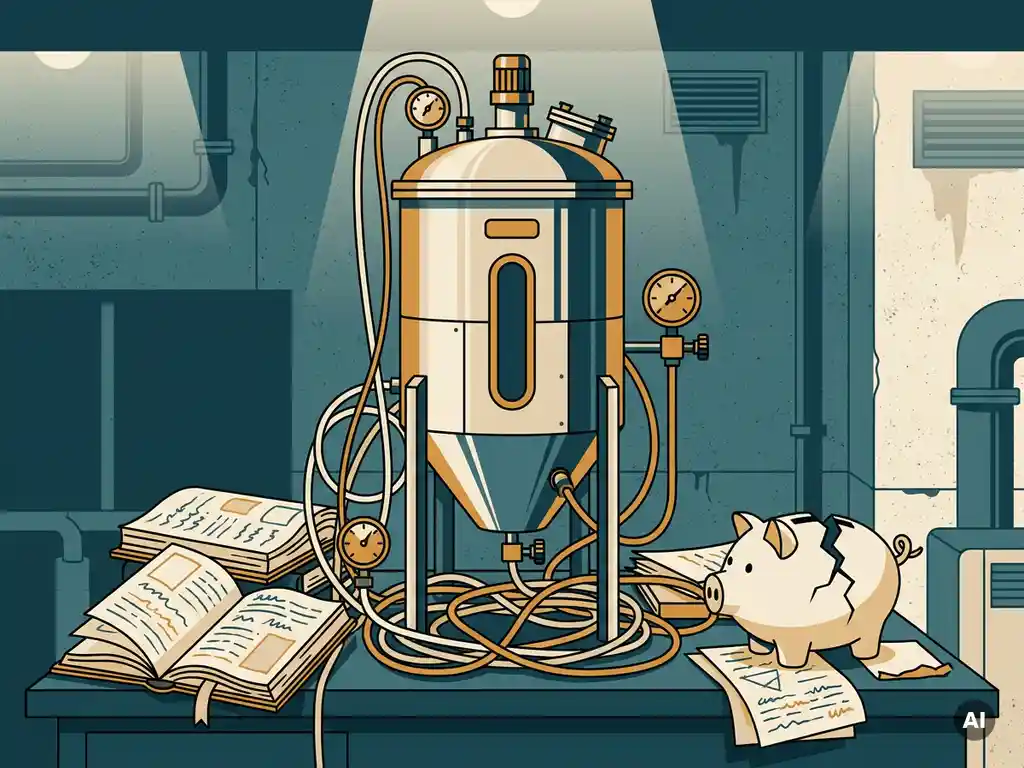
The hidden costs of in-house fermentation pilot infrastructure are significant and routinely underestimated. Beyond the capital investment in equipment, companies face ongoing expenses in skilled personnel, maintenance, regulatory compliance, and analytical tooling that can push the true cost of ownership far beyond initial projections. For scale-ups and industrial R&D teams evaluating whether to build or partner, understanding the full picture is essential before committing budget.
What do companies underestimate when budgeting for fermentation infrastructure?
Companies most commonly underestimate the operational costs that follow the initial capital expenditure. Equipment purchase is visible and easy to quote; what gets missed are the recurring costs of qualified staff, consumables, utilities, calibration, cleaning validation, and the time lost to troubleshooting equipment rather than advancing science. These indirect costs often exceed the hardware investment within two to three years of operation.
A fermentation pilot plant is not a plug-and-play asset. Bioreactors require continuous monitoring, sterile operation protocols, and specialized maintenance. Sensors drift, seals wear, and control systems need updating. Each of these demands either in-house expertise or expensive service contracts. Teams that budget for the reactor but not for the engineer who runs it consistently find themselves understaffed at the worst possible moment, when a critical experiment is underway.
There is also the question of analytical capacity. Pilot-scale fermentation generates data that only has value if it can be interpreted. Microbiome monitoring, metabolite profiling, and process analytics require equipment and expertise that most industrial R&D labs do not have on hand. Outsourcing these analyses adds cost and turnaround time; building the capability in-house adds headcount and capital.
How much does it actually cost to run a fermentation pilot plant?
Running a fermentation pilot plant at meaningful scale typically requires an annual operating budget that rivals or exceeds the original capital cost. A facility with bioreactors in the 100 to 2,000 liter range needs at minimum one or two dedicated process engineers, laboratory technicians, and access to analytical services. Personnel alone can represent 60 to 70 percent of total annual operating expenditure.
Beyond salaries, recurring costs include utilities (fermentation is energy-intensive), consumables such as media components and disposables, waste treatment for process streams, and quality assurance documentation if the output is destined for regulated markets. Maintenance contracts for precision instrumentation add a further layer. When these figures are aggregated honestly, the cost of running a modest pilot facility through a single development cycle often reaches a level that would have funded multiple rounds of contract R&D with an experienced external partner.
There is also the cost of idle capacity. A pilot plant built to support one project sits underutilized between campaigns, generating fixed costs without generating data. Contract facilities, by contrast, spread their infrastructure costs across multiple clients and projects, which is precisely why fermentation R&D and contract manufacturing services can offer access to fully equipped facilities at a fraction of the ownership cost.
Get in Touch
Let’s Talk Microbial Solutions
Book a conversation with Stijn, our CEO, or send us your request.
| Book an Appointment | Request Information |
Why do fermentation scale-up projects fail to deliver on time?
Fermentation scale-up projects most commonly fail on schedule because process parameters that work at lab scale do not transfer predictably to pilot scale. Mixing dynamics, oxygen transfer rates, heat management, and pH gradients all behave differently in larger vessels. Without a systematic approach to identifying and controlling these variables, teams spend months troubleshooting rather than validating.
A second driver of delay is the learning curve associated with new infrastructure. When a company builds a pilot plant for the first time, the team must simultaneously learn to operate the equipment and develop the process. These two activities compete for the same people and the same reactor time. In a contract facility, the infrastructure is already understood and the operators are experienced, which compresses the timeline considerably.
Investor and management timelines also create pressure that leads to poor experimental design. When a proof of concept must be delivered within six to twelve months, teams are tempted to skip systematic optimization and jump directly to scale. This almost always results in either a failed scale-up or results that cannot be reproduced, both of which cost more time than a disciplined approach would have required.
What are the IP and confidentiality risks of building in-house versus outsourcing?
Building in-house does not automatically protect intellectual property better than outsourcing. The IP risk in fermentation R&D is primarily about documentation, data ownership, and personnel continuity, all of which can be managed contractually regardless of where the work is performed. The more relevant question is which arrangement gives the company cleaner control over its process knowledge.
When working with a contract partner, IP protection depends on the quality of the collaboration agreement. A well-structured contract will define data ownership, publication rights, confidentiality obligations, and what happens to process knowledge developed jointly. Reputable contract R&D partners operate under strict confidentiality frameworks as a commercial necessity; their business model depends on client trust.
In-house development carries its own IP risks that are less often discussed. Key process knowledge often resides with individual employees. When those people leave, the knowledge walks out with them. Poorly documented internal processes are also harder to patent, because patent applications require precise, reproducible descriptions of the inventive step. A contract partner with scientific reporting standards and publication experience can actually strengthen a company’s IP position.
When does contract fermentation R&D make more financial sense than in-house?
Contract fermentation R&D makes more financial sense than in-house when a company needs to validate a concept within a defined timeframe, lacks existing fermentation infrastructure, or cannot justify the fixed costs of a pilot facility against its current pipeline volume. In practice, this describes the majority of biotech scale-ups and industrial companies entering fermentation for the first time.
The financial calculation is straightforward: if a company’s fermentation R&D needs are project-based rather than continuous, building infrastructure creates fixed costs that generate no return between projects. A contract partner converts those fixed costs into variable costs that scale with actual activity. This is particularly valuable during early-stage development, when the process is still changing and the infrastructure requirements are not yet fully defined.
There is also a speed-to-market argument. A company that partners with an established contract facility can begin pilot-scale experiments within weeks rather than the twelve to eighteen months typically required to procure, install, qualify, and staff a new pilot plant. In competitive markets, that time difference is often more valuable than any cost saving.
What should companies look for in a contract fermentation partner?
A contract fermentation partner should offer three things above all: relevant technical expertise, appropriate infrastructure, and a demonstrated commitment to confidentiality. Technical expertise means experience with the type of fermentation process in question, whether aerobic or anaerobic, batch or continuous, with defined pure cultures or complex mixed microbial communities. Not all contract facilities have equal capability across these dimensions.
Infrastructure matters in concrete terms. The partner should have bioreactors at the scale needed for the work, downstream processing equipment appropriate to the product, and analytical tools capable of characterizing the process in sufficient depth. For microbial fermentation specifically, molecular tools such as amplicon sequencing and qPCR are increasingly important for understanding what is happening inside a reactor, not just measuring what comes out.
Scientific credibility is a factor that companies sometimes overlook. A partner with a strong research track record, institutional affiliations, and the ability to produce rigorous technical documentation adds value beyond the bench work itself. That documentation supports patent applications, regulatory submissions, subsidy dossiers, and investor conversations. Avecom, for example, operates as a Ghent University spin-off with over thirty years of process development experience, which means its technical output carries the kind of scientific weight that internal pilot work from a first-time facility rarely achieves.
Finally, look for a partner that thinks in terms of your process, not their standard offering. The most valuable contract R&D relationships are those where the external team functions as an extension of the internal R&D function, adapting methods and experimental design to the specific challenge rather than fitting the project into a predefined workflow.
Related Articles
- How do you compare fermentation partners before signing a contract?
- What happens to groundwater if contaminated soil is left untreated?
- What are common sludge problems in the food and beverage industry?
- What is the role of microbiology in sludge bulking problems?
- Can you prevent sludge bulking without shutting down the plant?