

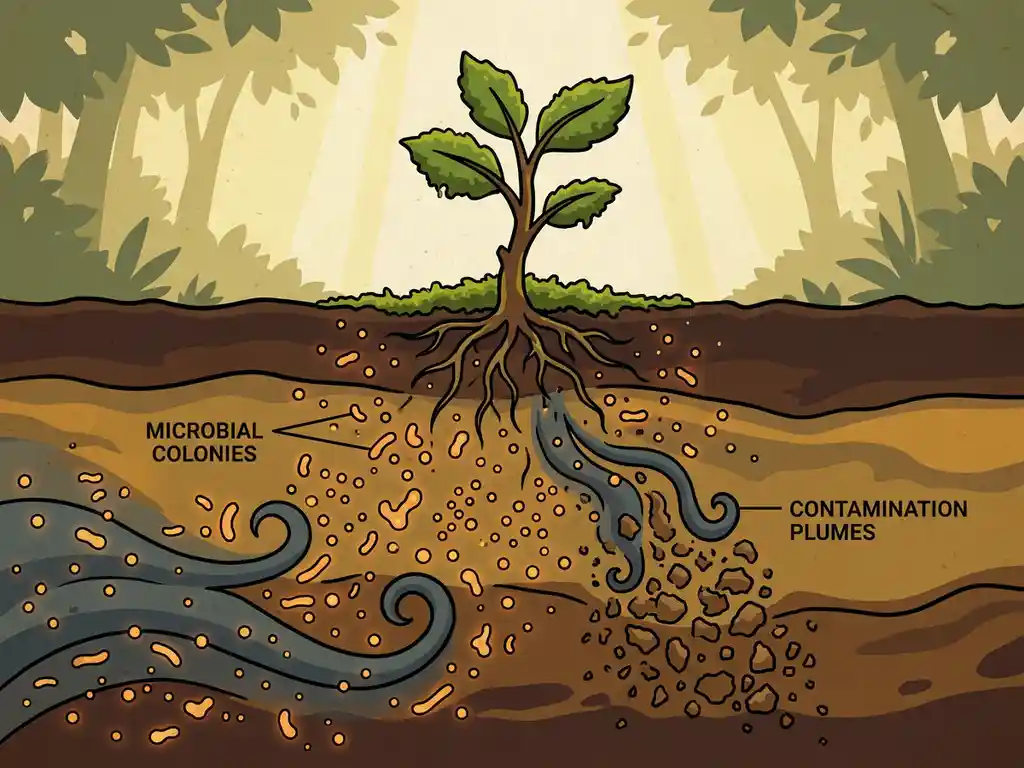
Yes, contaminated soil can be cleaned without digging it up. Biological remediation techniques treat pollution directly in the ground by activating or introducing microorganisms that break down contaminants where they sit. This approach is particularly effective for sites where excavation is too costly, physically impractical, or would cause unacceptable disruption to existing structures or infrastructure. The questions below unpack how it works, what it can treat, and how to know whether it is the right fit for your site.
How does biological soil remediation actually work?
Biological soil remediation works by using microorganisms, primarily bacteria, to chemically break down contaminants in the soil and groundwater. These microbes either already exist in the subsurface or are introduced deliberately, and they metabolize pollutants as part of their natural biological processes, converting harmful compounds into harmless byproducts such as carbon dioxide, water, or inert salts.
There are two main delivery strategies. In-situ biostimulation adds nutrients, electron donors, or oxygen to the soil to encourage native microbial populations that already have the capacity to degrade contaminants. In-situ bioaugmentation goes a step further by injecting specialized microbial consortia directly into the contaminated zone, which is particularly valuable when the native microbial community lacks the right organisms or is too sparse to drive meaningful cleanup on its own.
The key advantage of this approach is that remediation happens underground, with minimal surface disturbance. There is no need to excavate and transport contaminated material, no spoil heaps to manage, and no large machinery tearing through a site. For project managers working under budget pressure or dealing with built-up or sensitive locations, this distinction matters enormously. Avecom’s biological soil remediation services are built around precisely this in-situ model, combining scientific rigor with practical field applicability.
Get in Touch
Let’s Talk Microbial Solutions
Book a conversation with Stijn, our CEO, or send us your request.
| Book an Appointment | Request Information |
What types of soil contamination can be treated without excavation?
In-situ biological treatment is most effective for organic contaminants, particularly volatile chlorinated compounds (VOCs) such as perchloroethylene (PCE) and trichloroethylene (TCE), which are among the most persistent and widespread soil pollutants in industrial and urban brownfield sites. These solvents were historically used in dry cleaning, metal degreasing, and chemical manufacturing, and they tend to migrate deep into groundwater, making excavation impractical.
Beyond chlorinated solvents, biological approaches can also address petroleum hydrocarbons, including BTEX compounds (benzene, toluene, ethylbenzene, and xylenes), polycyclic aromatic hydrocarbons (PAHs), and certain pesticide residues. The common thread is that these are carbon-based compounds that microorganisms can use as an energy or carbon source under the right conditions.
Not all contamination types respond equally well. Heavy metals, for example, cannot be broken down biologically, though some microbial processes can alter their mobility and bioavailability in ways that reduce risk. Inorganic contaminants generally require different treatment strategies. Knowing what type of contamination you are dealing with is therefore the essential first step before any remediation decision, which is why site-specific feasibility testing is so important before committing to a full-scale approach.
How long does in-situ bioremediation take compared to excavation?
In-situ bioremediation typically takes longer than excavation in calendar time. Excavation removes contaminated material in weeks; biological treatment in the ground can take months to several years depending on contamination depth, soil permeability, contaminant concentration, and the microbial activity achieved. However, time is not the only relevant variable when comparing the two approaches.
Excavation appears fast, but it carries significant costs: mobilizing heavy equipment, managing and disposing of contaminated spoil, potential dewatering, and the disruption of any overlying structures or paved surfaces. For deep or extensive contamination, excavation may simply not be feasible at all. Biological remediation, while slower, can proceed with minimal surface disruption, allowing a site to remain partially operational or in planning while treatment progresses.
The practical timeline for in-situ bioremediation at a chlorinated solvent site, for example, commonly ranges from two to five years for significant concentration reductions, though some sites achieve compliance targets faster with intensive bioaugmentation and active monitoring. The key is setting realistic milestones from the outset and using molecular monitoring tools to track progress, so that the process can be adjusted if needed rather than running blind until a final measurement is taken.
How do you know if bioremediation is working on your site?
You know bioremediation is working by tracking both contaminant concentrations in soil and groundwater over time and the biological activity driving that degradation. Measuring pollutant levels alone tells you whether contamination is decreasing, but it does not tell you why or whether the process is on track. Combining chemical analysis with molecular biological tools gives a far more complete and actionable picture.
Modern molecular monitoring methods, including quantitative PCR (qPCR) and amplicon sequencing, allow specialists to detect and quantify specific degrading microorganisms directly in soil and groundwater samples. For chlorinated solvents, this means tracking organisms such as Dehalococcoides species, which are responsible for complete reductive dechlorination. If these organisms are present and active, degradation is happening. If their numbers are low or absent, bioaugmentation or process adjustment may be needed.
This kind of data is valuable not just operationally but also for regulatory reporting. Authorities such as OVAM require demonstrable evidence of remediation progress. Molecular monitoring provides concrete, scientifically defensible data that supports compliance reporting and can reduce the frequency of expensive groundwater sampling campaigns over time. Avecom integrates these molecular tools directly into its monitoring programs, giving site managers the data they need throughout the remediation process rather than only at the end.
When is excavation still the better choice?
Excavation remains the better choice when contamination is shallow, well-defined, and concentrated in a small volume of soil that can be removed cleanly and cost-effectively. If the polluted zone is accessible, the total volume manageable, and there are no structures or utilities in the way, excavation delivers certainty and speed that biological methods cannot match.
There are also situations where the contamination type rules out biological treatment. Heavy metals, asbestos-containing materials, and certain persistent inorganic pollutants cannot be degraded by microorganisms and must be physically removed or contained. Similarly, if a site requires immediate risk elimination, such as when contamination poses an acute exposure risk or is threatening a drinking water source, the pace of excavation may be necessary.
In practice, many remediation projects use a combination of both approaches. Excavation handles the most accessible, highest-concentration source zones, while biological treatment addresses the residual contamination in deeper or less accessible areas. The decision should always be based on a proper site characterization, including a feasibility assessment of whether biological degradation can realistically be achieved in the specific soil matrix and contaminant profile present.
What is a microcosm test and why does it matter before starting remediation?
A microcosm test is a small-scale laboratory experiment that uses actual soil and groundwater from a contaminated site to test whether biological degradation of the target contaminant is feasible under controlled conditions. It is the most reliable and cost-effective way to answer the question of whether bioremediation will work at a specific location before investing in a full-scale field intervention.
In a microcosm test, soil and water samples are placed in sealed vessels and exposed to different treatment conditions, for example with and without added electron donors, with and without bioaugmentation, or under varying temperature or pH ranges. The degradation of contaminants is then measured over several weeks. The results reveal whether the native microbial community can degrade the pollutant, whether it needs stimulation or supplementation, and what conditions produce the best outcome.
For anyone dealing with a contaminated site and asking what to do next, this is often the most important early investment. A microcosm test avoids the risk of deploying an expensive field remediation program on a site where biological degradation is not achievable, or where the wrong approach is chosen. It also generates data that supports regulatory discussions with bodies such as OVAM, demonstrating that the proposed remediation strategy has a scientific basis.
Avecom’s soil remediation team conducts microcosm tests as a standard first step in feasibility screening, providing clients with a clear, evidence-based answer on whether biological treatment is viable for their specific soil matrix and contamination profile before any field commitment is made. For site managers who need to justify decisions to investors, authorities, or planning bodies, this kind of upfront evidence is not just useful – it is often essential. If you are facing a contaminated site where classical methods have fallen short or are not viable, learn more about Avecom’s expertise in microbiological decontamination and how a feasibility screening can define the right path forward.