

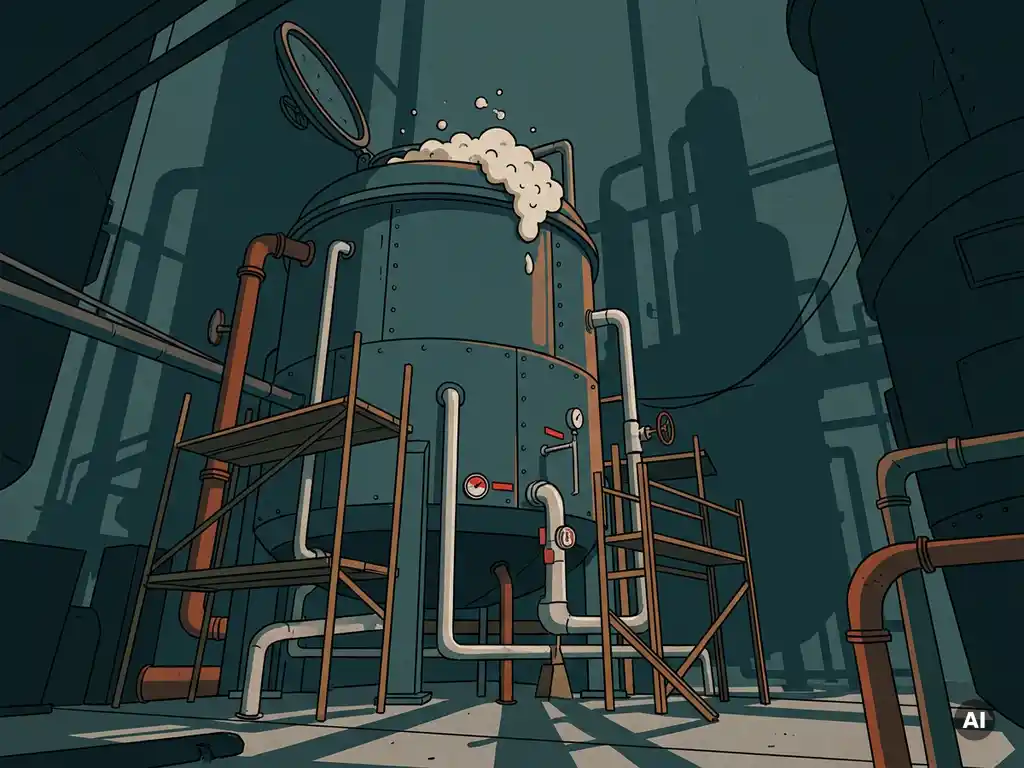
Scaling up a fermentation process internally carries significant risks, and for many companies those risks outweigh the benefits. The most common failures involve process parameters that behave unpredictably at larger volumes, unexpected capital costs, and timelines that stretch far beyond initial estimates. Understanding where these risks concentrate helps technical teams make better decisions about whether to build internally or work with a specialist partner.
Why do fermentation processes fail when moving from lab to pilot scale?
Fermentation processes fail at the transition from lab to pilot scale primarily because the physical and chemical environment changes in ways that are difficult to predict from small-scale data alone. Mixing dynamics, oxygen transfer rates, heat distribution, and pH gradients all behave differently in larger vessels, and microbial communities respond to those differences in ways that can collapse productivity or shift the process entirely.
At lab scale, a researcher works with volumes of one to ten liters where mixing is nearly instantaneous, temperature is uniform, and dissolved oxygen can be maintained with relative ease. Move to a 500-liter or 2,000-liter vessel and those assumptions no longer hold. Shear stress increases, dead zones form, and the microorganisms experience fluctuating conditions that were never present during development. For processes built around mixed microbial cultures, this is especially consequential: community composition can shift within a few generations when environmental conditions change, altering the metabolic output of the entire system.
A second common failure point is the assumption that process parameters optimized at lab scale translate directly upward. Growth rates, substrate conversion efficiencies, and product yields measured in a benchtop bioreactor are often artifacts of that specific setup rather than intrinsic properties of the microbial process. Without systematic characterization of the process across intermediate scales, teams discover this only after investing heavily in larger equipment.
What are the most common technical risks of internal fermentation scale-up?
The most common technical risks of fermentation scale-up are loss of process control at larger volumes, contamination events, inconsistent product quality, and insufficient analytical capacity to diagnose problems when they arise. Each of these risks compounds the others, making troubleshooting slow and expensive when teams lack specialized infrastructure.
- Loss of mixing homogeneity: Larger reactors create gradients in substrate, pH, and dissolved oxygen that do not exist at bench scale. Microbial metabolism responds to local conditions, not bulk averages, so these gradients directly affect yield and consistency.
- Contamination and microbiome instability: Sterility is harder to maintain at scale, and for processes using open or mixed cultures, unwanted organisms can outcompete the target community. Without molecular monitoring tools such as amplicon sequencing or qPCR, contamination events are often identified too late.
- Heat management failures: Fermentation generates heat. At lab scale this is trivial to manage; at pilot scale it requires dedicated cooling infrastructure. Inadequate thermal control stresses microbial communities and degrades product quality.
- Downstream processing bottlenecks: A fermentation process is only as good as the separation and concentration steps that follow it. Teams that focus exclusively on the bioreactor often discover that centrifugation, filtration, or pasteurization at scale requires entirely separate engineering work.
- Insufficient process data: Internal labs frequently lack the analytical depth needed to understand why a process is underperforming. Without detailed microbiome characterization or metabolic flux data, scale-up troubleshooting becomes trial and error.
The combination of these risks means that a process that looks robust at lab scale can become unreliable and costly within weeks of moving to a larger system. For companies without dedicated fermentation engineering expertise, diagnosing the root cause is the hardest part.
Get in Touch
Let’s Talk Microbial Solutions
Book a conversation with Stijn, our CEO, or send us your request.
| Book an Appointment | Request Information |
Get in Touch
Let’s Talk Microbial Solutions
Book a conversation with Stijn, our CEO, or send us your request.
| Book an Appointment | Request Information |
How much does it cost to build internal fermentation scale-up infrastructure?
Building internal pilot-scale fermentation infrastructure typically requires an investment in the range of several hundred thousand to several million euros, depending on reactor volume, process type, and the analytical and downstream processing equipment required. For most scale-ups and mid-sized industrial companies, this capital expenditure is difficult to justify before the process has been validated.
The bioreactor itself is only one part of the cost. A functional pilot fermentation facility also requires utilities infrastructure such as compressed air, cooling water, and steam; instrumentation and control systems for monitoring pH, dissolved oxygen, temperature, and flow; containment and waste management systems appropriate for the organism and product involved; and downstream processing equipment for separation, concentration, and purification.
Beyond capital costs, there are ongoing operational expenses: qualified personnel to run and maintain the systems, consumables, quality control testing, and regulatory compliance depending on the product category. For a company producing a feed ingredient or food-grade fermentation product, additional certification requirements add both cost and time.
The financial case for building internally only becomes compelling when the process is proven, volumes are predictable, and the product has a clear commercial pathway. At the validation and optimization stage, the cost of building infrastructure is almost always higher than the cost of working with an established contract fermentation partner that already has the equipment, expertise, and certifications in place.
What happens to IP and confidentiality when scaling up with an external partner?
Intellectual property and confidentiality can be fully protected when scaling up with an external fermentation partner, provided the right contractual framework is in place before work begins. A well-structured collaboration agreement defines ownership of background IP, any foreground IP generated during the project, publication rights, and confidentiality obligations for all parties.
For R&D-stage companies, IP protection is often the first concern raised when considering external partners. The concern is legitimate: sharing process details, microbial strains, or formulation data with a third party creates theoretical exposure. In practice, reputable contract fermentation partners work under strict non-disclosure agreements as a matter of routine, and many have established legal frameworks specifically designed to separate client projects and protect proprietary information.
Key contractual elements to address before starting any external scale-up work include:
- Ownership of process improvements: Clarify in advance whether any optimization insights generated during the collaboration belong to the client, the partner, or are jointly owned.
- Data handling and storage: Define how experimental data, analytical results, and process records are stored, accessed, and eventually transferred or deleted.
- Publication and disclosure restrictions: If the partner has academic affiliations, ensure that no results can be published without explicit client approval.
- Strain and material handling: Specify protocols for the receipt, use, storage, and return or destruction of any proprietary biological materials.
Companies that approach external scale-up with a clear IP strategy in place typically find that the risks are manageable. The greater risk, in many cases, is delaying scale-up altogether while waiting to build internal infrastructure, losing time-to-market in the process.
When should a company outsource fermentation scale-up instead of doing it internally?
A company should outsource fermentation scale-up when it lacks the specialized infrastructure, expertise, or time to validate and optimize the process internally without significant delay or risk. The clearest indicators are an internal lab that is not equipped for pilot-scale work, a proof-of-concept deadline driven by investors or customers, and a process that involves complex microbial systems requiring specialized analytical support.
Outsourcing is the more rational choice in several specific situations:
- The company needs to demonstrate pilot-scale feasibility within six to twelve months and cannot build infrastructure in that timeframe.
- The fermentation process involves mixed microbial cultures or non-standard organisms that require specialized monitoring and control capabilities.
- Internal engineering resources are focused on core product development rather than fermentation process engineering.
- The product requires regulatory compliance such as feed or food certification that the company does not currently hold.
- The scale-up involves process parameters that are not yet fully understood, making expert guidance essential to avoid costly failures.
Outsourcing is not the right choice when the process is already fully characterized, production volumes are high enough to justify dedicated infrastructure, and the company has the engineering talent to operate and maintain the systems independently. But for most companies at the validation and early-scale stage, the economics and risk profile favor working with a specialized partner.
Avecom’s fermentation R&D and contract manufacturing services are designed specifically for this stage: lab-scale feasibility testing, pilot-scale process validation, and small-scale contract production, supported by molecular monitoring tools and downstream processing capabilities. For companies facing the scale-up decision in 2026, the question is rarely whether external expertise adds value. It is whether the cost of delay and internal failure is worth avoiding by engaging that expertise earlier.