

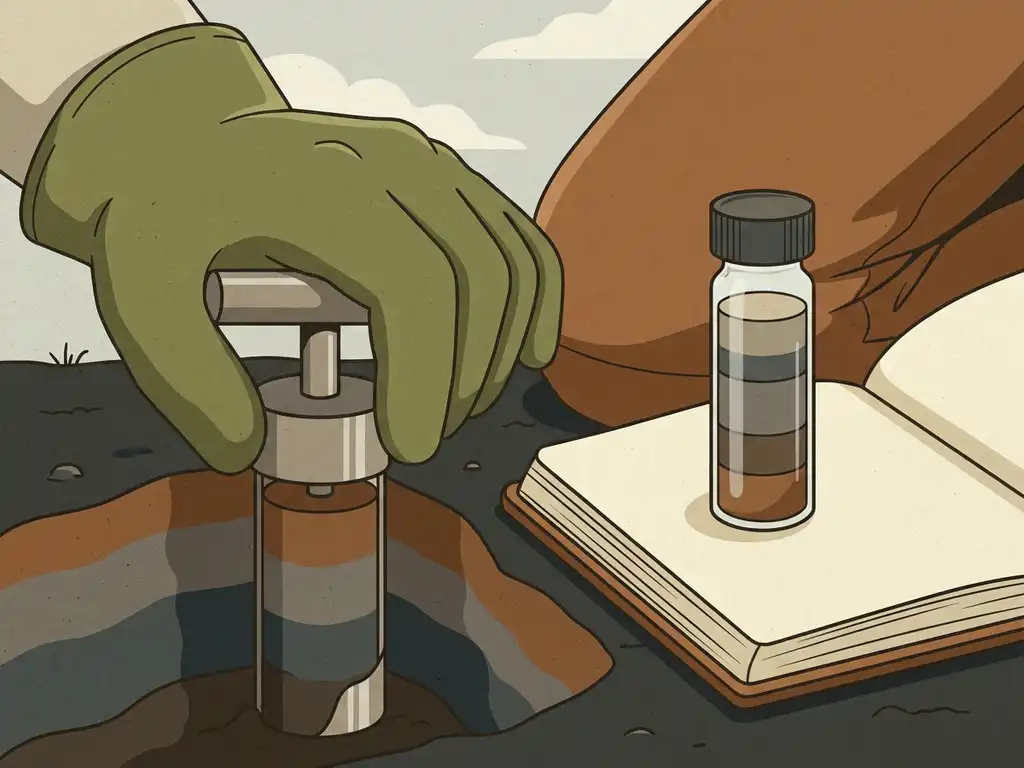
A soil screening is a limited, preliminary investigation that identifies whether contamination is present and at what approximate levels. A full soil assessment goes further, mapping the spatial extent of contamination, identifying all relevant substances, and providing the detailed data needed to make legally binding decisions about land use or remediation. The choice between them depends on the purpose of the investigation and what the results will be used for.
In practice, most contaminated land investigations start with a screening phase. Whether that is sufficient depends on what the results show and what decisions need to follow. The sections below walk through each stage, from initial testing to remediation planning, so you can understand what each level of investigation involves and when you need to go further.
When is a soil screening sufficient, and when is it not?
A soil screening is sufficient when you need to determine whether a contamination problem exists before committing to a full investigation. It answers the question “is there a problem?” rather than “how big is the problem?” For regulatory purposes, a screening alone is rarely enough to close a file or approve a building permit on a suspected contaminated site.
Screenings are appropriate in the early stages of due diligence, when evaluating a property for purchase, or when you need a quick, cost-effective indication of risk before deciding whether to invest in a full assessment. They are also used to prioritize sites when multiple parcels require attention and resources are limited.
A screening is not sufficient when contamination is detected above threshold values, when the site has a history of industrial use involving hazardous substances, or when planning decisions, permit applications, or remediation orders are on the table. In those cases, regulatory frameworks such as VLAREBO in Flanders require a full descriptive soil investigation before any further steps can be approved. At that point, you need data that is both spatially precise and legally defensible.
Get in Touch
Let’s Talk Microbial Solutions
Book a conversation with Stijn, our CEO, or send us your request.
| Book an Appointment | Request Information |
What does a soil screening actually include?
A soil screening typically includes a limited number of soil and groundwater samples taken at strategic locations across a site, analyzed for a defined set of contaminants based on the site’s historical use. The goal is to establish whether concentrations exceed screening reference values, not to fully characterize the contamination.
In a standard screening, the investigator reviews the site history, identifies likely source zones, and selects sampling points accordingly. Samples are analyzed in an accredited laboratory, and the results are compared against regulatory reference values. The output is usually a concise report indicating whether contamination is absent, present below the threshold, or present above the threshold.
What a screening does not include is a full picture of contaminant distribution, depth, migration pathways, or risk to groundwater. It will tell you that chlorinated solvents are present in the soil, for example, but not how far the plume extends, whether it has reached the groundwater, or whether natural degradation is occurring. For sites where volatile organochlorine compounds such as PCE or TCE are involved, that additional information is critical for planning any meaningful response.
What additional steps does a full soil assessment involve?
A full soil assessment, referred to in Flanders as a descriptive soil investigation, involves a systematic characterization of the contamination across the entire affected area. It maps the horizontal and vertical extent of contamination, identifies all relevant substances and their concentrations, assesses exposure pathways, and evaluates the risk to human health and the environment.
In practice, this means a higher density of sampling points, deeper boreholes, groundwater monitoring wells, and laboratory analysis for a broader range of parameters. The investigation must follow accredited protocols, and the resulting report must meet the formal requirements of the competent authority before it can be submitted as the basis for a remediation decision.
For complex sites, particularly those with persistent contamination in the saturated zone, a full assessment may also include specialized analyses. Molecular soil analysis using techniques such as qPCR can determine whether specific degrading microorganisms are present and active, which is directly relevant when evaluating whether biological soil remediation is a viable option. This kind of diagnostic data can significantly influence which remediation approach is selected and how it is designed.
How do the costs and timelines compare?
A soil screening is substantially less expensive and faster than a full assessment. A screening can typically be completed within a few weeks and at a fraction of the cost of a full descriptive investigation. A full soil assessment, depending on site complexity, number of sampling points, and laboratory turnaround, can take several months and cost considerably more.
The cost difference reflects the scope of work involved. A screening involves fewer samples, a narrower analytical panel, and a shorter report. A full assessment requires more fieldwork, more laboratory analyses, more complex data interpretation, and a report that meets formal regulatory standards.
However, treating cost as the primary decision criterion is a false economy. Conducting only a screening when a full assessment is needed delays the process, generates additional costs later, and can create legal exposure if a site is transferred or developed without adequate investigation. Investing in the right level of investigation from the outset is almost always more efficient over the full project timeline.
What happens if screening results exceed contamination thresholds?
If screening results exceed the applicable contamination thresholds, a full descriptive soil investigation becomes mandatory under VLAREBO before any remediation, sale, or change of use can proceed. The screening result triggers a formal obligation, not just a recommendation to investigate further.
Once threshold exceedances are confirmed, the site owner or responsible party must notify the competent authority and commission a full investigation through an accredited soil expert. The descriptive investigation then determines the nature and extent of the contamination in sufficient detail to support a remediation decision.
Depending on the outcome of the full assessment, the site may require a remediation project, a risk management plan, or in some cases, both. For contamination involving chlorinated solvents, which are among the most persistent and mobile contaminants encountered on former industrial sites, the remediation pathway often depends heavily on whether the groundwater is affected and whether in-situ biological degradation is occurring. A microcosm test can determine at this stage whether biological breakdown is feasible before a full remediation design is committed to.
How does the choice of investigation level affect remediation planning?
The depth and quality of the soil investigation directly determine the quality of the remediation plan. A poorly characterized site leads to a poorly designed remediation, which in turn leads to cost overruns, extended timelines, and regulatory delays. The investigation is the foundation on which every subsequent decision is built.
A full assessment provides the data needed to evaluate which remediation technique is appropriate, where it should be applied, and what performance targets are realistic. For sites where excavation is not feasible, whether due to existing structures, depth of contamination, or cost, the assessment data is what makes the case for an alternative approach such as in-situ biological treatment.
Avecom’s approach to biological decontamination of volatile organochlorine compounds illustrates why investigation quality matters. Before designing a bioaugmentation strategy, the team evaluates the site-specific conditions, the contaminant profile, and the microbial community already present. That evaluation is only possible when the underlying investigation data is complete and reliable. Molecular monitoring tools then track the progress of degradation throughout the remediation, providing continuous, quantitative data for both internal reporting and regulatory compliance.
For project managers dealing with contaminated land, the practical implication is straightforward: do not treat the investigation as a formality to get through as quickly and cheaply as possible. The data you collect at this stage determines whether your remediation succeeds on time and on budget. If you are working with a site where previous investigations have been inconclusive or where classical remediation techniques have not delivered results, Avecom’s expertise in microbial soil remediation may offer a more targeted path forward. The team works from preliminary feasibility testing through to full-scale field remediation, with reporting aligned to OVAM and VLAREBO requirements.
For an overview of the full range of environmental services available, visit avecom.be.
Related Articles
- How does lab-scale fermentation testing work?
- Can a small biotech company access pilot-scale fermentation without building it?
- What is the most cost-effective way to manage excess sludge in 2026?
- How does temperature affect sludge behavior in biological treatment?
- How do you know if a remediation approach is working?