

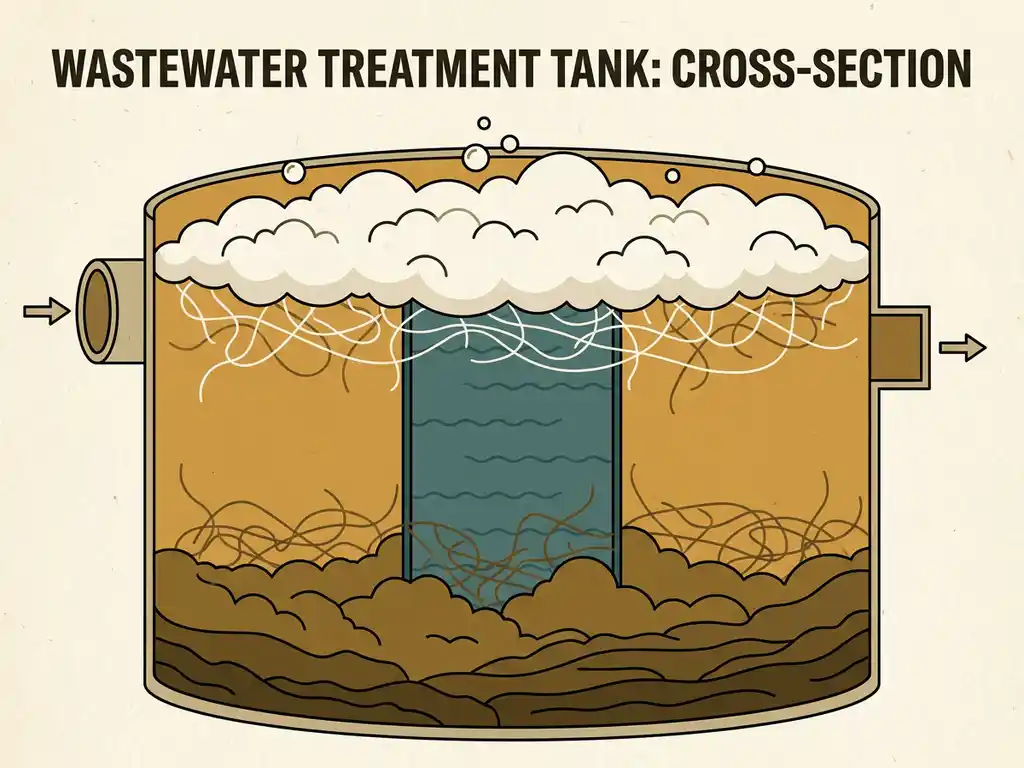
Sludge bulking and sludge foaming are two distinct operational problems in activated sludge systems, but they are often confused because both disrupt the settling process and can cause effluent quality to deteriorate. Bulking is a settling failure caused by filamentous bacteria that prevent sludge from compacting, while foaming is a surface accumulation problem caused by hydrophobic microorganisms that trap air and produce a stable foam layer. Understanding the difference matters because each problem has a different root cause, a different diagnostic signature, and a different corrective approach. The sections below walk through each problem in turn, how to tell them apart, and what you can do about them.
What causes sludge bulking in activated sludge systems?
Sludge bulking occurs when filamentous microorganisms outcompete floc-forming bacteria in the activated sludge process, producing a loose, open sludge structure that settles poorly and results in a high sludge volume index (SVI). The fundamental cause is a microbial imbalance in which thread-like organisms dominate the biomass, preventing the sludge from compacting in the secondary clarifier.
Several process conditions favor the growth of filamentous bacteria over floc-formers. Low dissolved oxygen (DO) concentrations are among the most common triggers, particularly in systems handling high-strength organic loads. When oxygen is consistently limiting, filamentous species with a higher surface-area-to-volume ratio gain a competitive advantage because they can scavenge dissolved oxygen more efficiently at low concentrations.
Nutrient imbalances, specifically a shortage of nitrogen or phosphorus relative to the organic carbon load, also promote filamentous overgrowth. Similarly, low pH, low sludge loading rates (low F/M ratio), and the presence of specific substrates such as simple sugars or sulfur compounds can each favor particular filamentous species. In food processing wastewater, where organic loads fluctuate seasonally and nutrient ratios are often skewed, bulking events are a recurring operational risk.
The result is sludge that expands dramatically in the clarifier, sometimes overflowing the weir and carrying biomass into the final effluent. This directly threatens compliance with discharge standards, which in the Benelux context are governed by frameworks such as VLAREM and the Water Framework Directive.
Get in Touch
Let’s Talk Microbial Solutions
Book a conversation with Stijn, our CEO, or send us your request.
| Book an Appointment | Request Information |
What causes sludge foaming in wastewater treatment?
Sludge foaming in wastewater treatment is caused primarily by hydrophobic, slow-growing bacteria that attach to air bubbles and produce a thick, viscous foam on the surface of aeration tanks and clarifiers. The most frequently implicated organisms are Microthrix parvicella and members of the nocardioform actinomycetes group, both of which thrive under specific conditions.
Microthrix parvicella is particularly associated with low-temperature operation and systems receiving lipid-rich wastewater, such as effluent from food processing or dairy operations. These organisms have a strong affinity for long-chain fatty acids and use their hydrophobic cell surfaces to attach to rising air bubbles, gradually building up a stable foam layer that can become meters thick in severe cases.
Foaming is also influenced by sludge age. Systems operating at long sludge retention times (SRT) tend to accumulate the slow-growing organisms responsible for foam because they are not wasted out of the system fast enough. Low dissolved oxygen, high fat and oil concentrations in the influent, and sudden changes in loading can all trigger or worsen a foaming event.
Unlike bulking, foaming does not always impair settling directly, but it creates serious operational problems: foam can overflow containment structures, create hygiene hazards, reduce oxygen transfer efficiency, and carry pathogens or contaminants to areas outside the treatment system. In industrial settings, persistent foam is also a sign of an underlying microbiome imbalance that is unlikely to resolve without targeted intervention.
What’s the difference between sludge bulking and sludge foaming?
The key difference between sludge bulking and sludge foaming is where the problem manifests and what is driving it. Bulking is a settling problem caused by filamentous bacteria that make the sludge too light and fluffy to compact, while foaming is a surface accumulation problem caused by hydrophobic microorganisms that stabilize air bubbles into a persistent foam layer. Both are symptoms of microbial imbalance, but they involve different organisms and different process mechanisms.
The table below summarizes the main distinguishing features:
- Location of the problem: Bulking appears in the clarifier as poor sludge settling and a rising sludge blanket; foaming appears on the surface of aeration tanks and clarifiers as a stable foam layer.
- Primary organisms involved: Bulking is driven by filamentous bacteria (e.g., Thiothrix, Type 021N, Sphaerotilus natans); foaming is driven by hydrophobic actinomycetes and Microthrix parvicella.
- Effect on effluent quality: Bulking directly causes elevated suspended solids in the effluent; foaming may not affect effluent solids immediately but creates overflow and hygiene risks.
- Key process drivers: Bulking is triggered by low DO, low F/M ratio, or nutrient deficiency; foaming is triggered by long SRT, lipid-rich influent, and low temperature.
- Sludge volume index (SVI): Bulking produces a characteristically high SVI (often above 150 mL/g); foaming does not necessarily elevate SVI.
In practice, both problems can occur simultaneously in the same system, which complicates diagnosis. A system receiving high-fat food processing wastewater at low temperature in winter may experience foaming from Microthrix parvicella while also developing bulking from filamentous overgrowth in the aeration tank.
How do you diagnose which problem you have?
Diagnosing whether you are dealing with sludge bulking or foaming starts with direct observation and a few straightforward measurements, followed by microscopic analysis to identify the organisms responsible. The combination of a high SVI with poor settling in the clarifier points toward bulking; a stable foam layer on the aeration tank surface with normal or near-normal settling points toward foaming.
Operational indicators to check first
Start with the sludge volume index. A 30-minute settling test (SV30) combined with the mixed liquor suspended solids (MLSS) concentration gives you the SVI. Values consistently above 150 mL/g indicate a settling problem consistent with bulking. If the SVI is within the normal range but foam is accumulating, foaming organisms are the more likely culprit.
Also observe the foam itself. Foaming caused by Microthrix parvicella or nocardioforms produces a thick, brown, greasy foam that is stable and does not break down easily. Foaming caused by biological activity during startup or high loading tends to produce a white, frothy foam that dissipates quickly. Persistent brown foam is a reliable indicator of a biological foaming problem rather than a transient hydraulic or chemical effect.
Microscopic and molecular analysis
Microscopic examination of a sludge sample is the most direct way to confirm the diagnosis. A trained microbiologist can identify filamentous organisms by their morphology and estimate their abundance relative to floc-forming bacteria. This tells you both whether filaments are present and which species are dominant, which is essential for selecting the right corrective measure.
For a more detailed picture, molecular monitoring of the microbial community using techniques such as 16S rRNA amplicon sequencing can reveal shifts in community composition before they become visible operational problems. This is the kind of diagnostic depth that biological wastewater treatment specialists apply when auditing an existing installation, particularly when the root cause is not obvious from operational data alone.
How can sludge bulking and foaming be controlled or prevented?
Controlling sludge bulking and foaming requires addressing the specific process conditions that favor the problematic microorganisms, rather than applying a generic fix. The most effective strategies combine short-term corrective measures with longer-term process optimization to prevent recurrence.
Controlling sludge bulking
For filamentous bulking, the first step is identifying which filamentous species is dominant, because different species thrive under different conditions. Once identified, you can target the specific driver:
- Increase dissolved oxygen setpoints if low DO is the trigger, particularly in high-load zones of the aeration tank.
- Adjust the F/M ratio by increasing the sludge wasting rate or modifying the organic loading pattern.
- Correct nutrient imbalances by dosing nitrogen or phosphorus if the influent carbon-to-nutrient ratio is too high.
- Consider selector zones at the inlet of the aeration tank, which give floc-forming bacteria a competitive advantage by exposing the incoming substrate to a high-concentration, short-contact zone before the main aeration stage.
In the short term, chlorination of the return activated sludge (RAS) can suppress filamentous populations, but this is a temporary measure and carries risks for the broader microbial community if overdone.
Controlling sludge foaming
For biological foaming, the primary lever is sludge age. Reducing the SRT by increasing wasting will gradually dilute the slow-growing foam-forming organisms out of the system, though this takes time and must be balanced against treatment performance. Other measures include:
- Reducing fat, oil, and grease (FOG) concentrations in the influent through upstream pre-treatment or process changes.
- Avoiding conditions that favor Microthrix parvicella, such as very low temperatures combined with long SRT.
- Physically removing foam from the tank surface and wasting it separately to accelerate the reduction of foam-forming biomass.
- Reviewing aeration intensity, since over-aeration can exacerbate foaming by introducing more air bubbles for hydrophobic cells to attach to.
Both bulking and foaming are ultimately microbiome management problems. Systems that experience recurring episodes often benefit from a structured audit of the microbial community, process conditions, and influent composition. Avecom has more than 30 years of experience in exactly this kind of applied microbiome engineering, working with industrial producers to stabilize biological treatment systems and bring them back into compliance without full process shutdowns.
If your installation is showing signs of either problem, or if you are trying to prevent them in a system handling variable or high-strength industrial wastewater, a microbiological audit combined with lab-scale process testing is the most reliable starting point. The team at Avecom works from your specific water composition and discharge requirements to identify which microbial consortia are performing, which are causing problems, and what process adjustments will restore stable, compliant operation.