

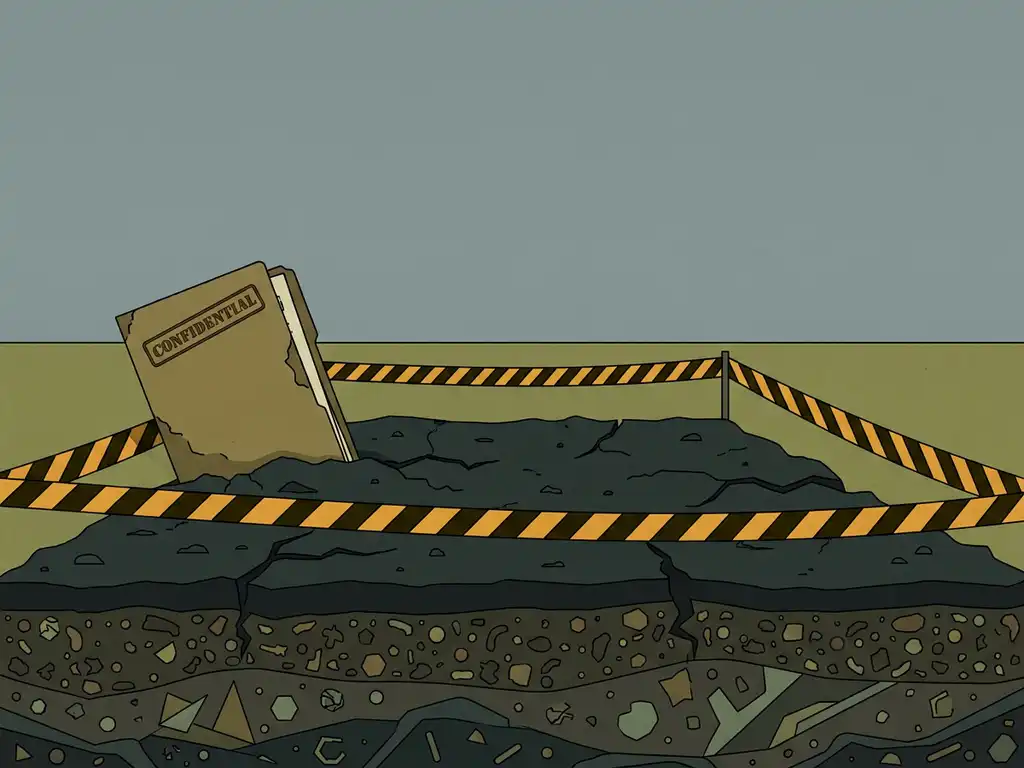
Owning contaminated soil carries real legal risk: you can be held financially liable for cleanup costs, face regulatory penalties, and find your property unsellable or undevelopable until remediation is complete. In most jurisdictions, liability follows the land, meaning current owners can be held responsible even for contamination caused by previous occupants. The questions below unpack each dimension of that risk, from who bears legal responsibility to how remediation choices affect your legal standing.
Who is legally responsible for contaminated soil?
Legal responsibility for contaminated soil typically falls on the current landowner, the party who caused the contamination, or both, depending on the jurisdiction. In Belgium, the VLAREBO decree establishes a clear framework: the polluter bears primary liability, but the owner or user of the land can also be held responsible, particularly when contamination is discovered during a transfer or development process.
This dual liability structure is important to understand. A real estate developer who acquires a brownfield site does not automatically inherit the previous operator’s liability in every circumstance, but they do inherit the obligation to report, investigate, and remediate if contamination is discovered under their ownership. Ignorance of the contamination is rarely accepted as a legal defense once a site investigation has taken place.
For public authorities managing municipal land, the situation is equally demanding. Government bodies that own or manage contaminated parcels are not exempt from cleanup obligations simply because the contamination predates current ownership. OVAM, the Flemish public waste agency, enforces these obligations and has the authority to compel remediation through formal orders.
Get in Touch
Let’s Talk Microbial Solutions
Book a conversation with Stijn, our CEO, or send us your request.
| Book an Appointment | Request Information |
What financial penalties can contaminated land trigger?
Contaminated land can trigger substantial financial consequences, including mandatory remediation costs, administrative fines for non-compliance, and civil liability claims from neighboring landowners or affected third parties. In severe cases, criminal liability can also apply where contamination resulted from deliberate or negligent disregard for environmental regulations.
The most significant financial exposure is typically the remediation cost itself. Excavation of deeply contaminated soil, for example, can run into hundreds of thousands of euros for a mid-sized industrial site, and that cost is borne entirely by the responsible party. Administrative fines for failing to report discovered contamination or for missing remediation deadlines add to that burden.
Beyond direct costs, there is also the risk of value impairment claims. Neighboring property owners whose land or groundwater has been affected by migrating contamination, such as chlorinated solvents spreading through an aquifer, can pursue civil claims for damages. These claims can be complex and protracted, making early, documented remediation action a sound legal strategy as well as an environmental one.
Can contaminated soil block a property sale or development permit?
Yes, contaminated soil can legally block both a property sale and a development permit. In Flanders, a soil certificate issued by OVAM is mandatory before any transfer of land that is listed in the soil register. If that certificate reveals contamination requiring remediation, the transfer cannot proceed until a remediation agreement is in place or the cleanup has been completed.
Development permits face a parallel obstacle. Planning authorities can refuse or suspend a permit application when the site in question has unresolved contamination, particularly if the planned use, such as housing or public space, is incompatible with the contamination risk. This effectively freezes a project until the environmental status of the land is resolved.
For developers and municipal project managers, this is often the most immediate and painful consequence of discovering contamination. A construction timeline built around permit milestones can collapse entirely when a soil investigation returns unexpected results. Acting early, commissioning a preliminary soil investigation before acquiring land or submitting a permit application, is the most reliable way to avoid this blockage.
What are the reporting obligations for discovered soil contamination?
When soil contamination is discovered in Flanders, the landowner or responsible party is legally required to report it to OVAM within a defined timeframe. This obligation is triggered by any finding that exceeds the reference values established under VLAREBO. Failure to report is itself a regulatory violation, independent of the contamination itself.
After reporting, OVAM typically requires a phased investigation process: first a descriptive soil investigation to characterize the nature and extent of the contamination, and then, where necessary, a remediation project plan. Each phase has defined timelines and documentation requirements. Delays or gaps in this process can result in enforcement action.
It is worth noting that reporting obligations also apply when contamination is discovered incidentally, during construction works, for example, rather than through a planned investigation. Site managers and project leaders should have a clear protocol in place for handling unexpected soil finds, including who is authorized to notify OVAM and what documentation needs to be preserved from the moment of discovery.
How does biological soil remediation affect legal standing?
Biological soil remediation, when properly documented and executed in accordance with regulatory requirements, is a legally recognized remediation method that can satisfy OVAM obligations and support permit approvals. The key factor for legal standing is not the technique itself but the quality of the monitoring data and reporting that accompanies it.
This is where the approach matters significantly. Biological methods such as in-situ bioaugmentation, where specialized microbial consortia are introduced to break down contaminants like chlorinated solvents directly in the soil, are increasingly accepted as credible alternatives to excavation. However, regulators and project stakeholders need verifiable evidence that the process is working. Molecular monitoring tools, including qPCR analysis that quantifies the activity of degrading microorganisms in the soil, provide exactly that kind of evidence.
Avecom’s biological soil remediation service is built around this documentation requirement. The process begins with a microcosm test that rapidly determines whether biological degradation is feasible for a specific soil matrix and contaminant profile, producing data that can be submitted to OVAM as part of a remediation feasibility assessment. Throughout the active remediation phase, molecular soil analysis provides continuous, quantified evidence of progress, which directly supports regulatory reporting obligations.
For project managers under pressure to demonstrate results to investors or planning authorities, this data-driven approach transforms biological remediation from an uncertain alternative into a traceable, reportable process. A science-driven remediation partner who provides OVAM-compliant reporting at every stage removes a significant source of legal and reputational risk for the landowner.
It is also worth noting that choosing a proven biological approach early, rather than defaulting to excavation only to find it is technically unfeasible due to existing structures or groundwater conditions, avoids the legal complications that arise when a remediation plan fails to deliver and needs to be revised mid-process. Avecom’s team of environmental engineers has over 27 years of experience guiding contaminated land projects from initial feasibility through to regulatory closure, making them a reliable partner for landowners navigating both the technical and legal dimensions of soil contamination. If you are managing a contaminated parcel where conventional approaches are not viable, explore the biological remediation options available before committing to a remediation plan that may not hold up under regulatory scrutiny.