

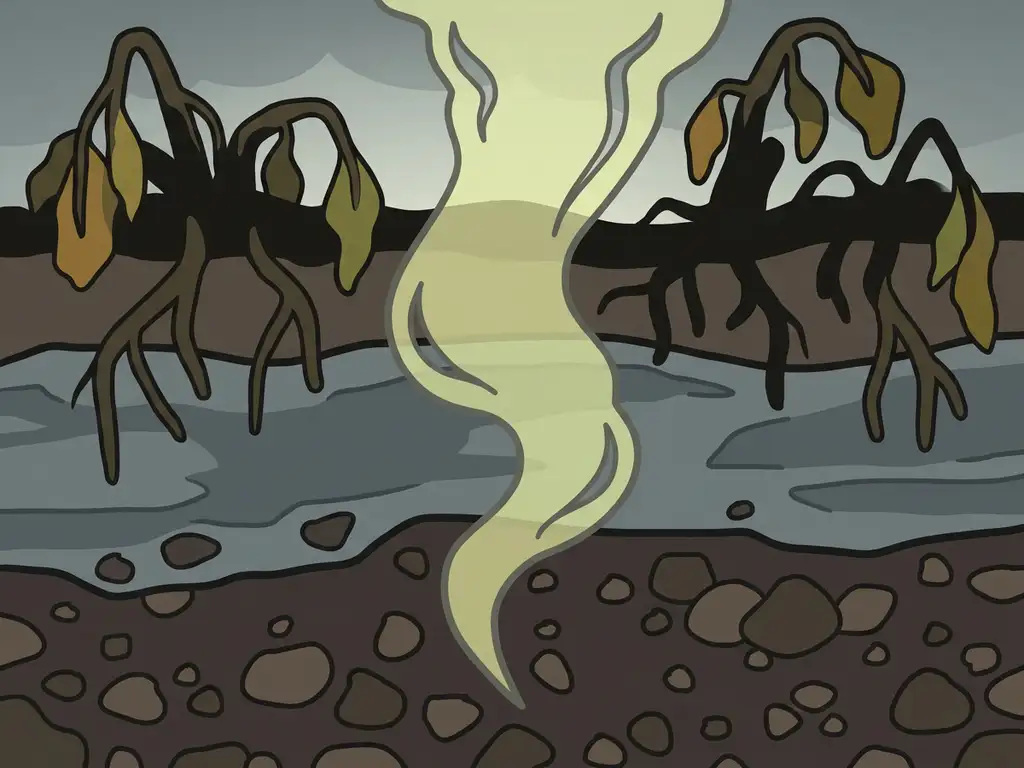
VOCl contamination is so difficult to clean up because chlorinated solvents behave unlike most other pollutants: they are denser than water, chemically stable, and capable of persisting in soil and groundwater for decades without breaking down. Their physical properties allow them to migrate deep into geological layers where conventional remediation methods cannot easily reach them. The sections below unpack each dimension of that challenge, from how VOCl moves through the ground to what realistic solutions look like.
Why do chlorinated solvents sink deeper into the ground than other pollutants?
Chlorinated solvents sink deeper than most pollutants because they are denser than water, a property that causes them to migrate downward through the unsaturated zone and continue sinking through groundwater rather than floating on it. This makes them a category of contaminant known as dense non-aqueous phase liquids, or DNAPLs, and it fundamentally changes how contamination spreads across a site.
When a lighter petroleum product spills, it tends to pool near the water table where it can be intercepted and removed. Chlorinated solvents do the opposite. Compounds like tetrachloroethylene (PCE) and trichloroethylene (TCE) descend through soil layers, following fractures and pathways in the geology until they reach an impermeable layer such as clay. There they pool in depressions and spread laterally, often far from the original source. Over time, the solvent slowly dissolves into passing groundwater, creating a diffuse plume that can extend hundreds of meters downgradient from the source zone.
This behavior means that by the time contamination is discovered during a soil contamination assessment, the actual source may be deep, inaccessible, and spread across an area that bears little obvious relationship to the surface footprint of the original release.
Get in Touch
Let’s Talk Microbial Solutions
Book a conversation with Stijn, our CEO, or send us your request.
| Book an Appointment | Request Information |
What makes VOCl contamination so persistent in soil and groundwater?
VOCl contamination persists because chlorinated solvents are chemically resistant to natural breakdown, have low solubility that prolongs their release into groundwater over years or decades, and tend to sorb onto organic matter in the soil matrix, creating a slow-release reservoir that continuously recontaminates groundwater even after the primary source is addressed.
The chemical stability of these compounds is what originally made them attractive as industrial solvents. They do not react readily with oxygen, which is the primary driver of natural biodegradation for many organic pollutants. In aerobic environments, most VOCl compounds are essentially inert. Anaerobic conditions are required for the main natural degradation pathway, reductive dechlorination, to occur at all.
Sorption to soil particles adds another layer of persistence. A fraction of the contaminant mass binds to the soil matrix and is released slowly over time. This back-diffusion effect means that even after aggressive treatment of the mobile phase, residual contamination continues to leach into groundwater for years. For anyone managing a site where contamination was found, this explains why a single intervention rarely resolves the problem and why long-term monitoring is not optional.
How does natural VOCl degradation work — and why does it often stall?
Natural VOCl degradation occurs through a process called reductive dechlorination, in which anaerobic bacteria strip chlorine atoms from the solvent molecule one by one, progressively converting highly chlorinated compounds like PCE into less chlorinated ones, ultimately yielding ethene, which is harmless. The process stalls when the specific bacteria capable of completing the full degradation sequence are absent or when the subsurface environment lacks the conditions they need.
The key organism responsible for the final steps of this pathway is Dehalococcoides mccartyi, a strictly anaerobic bacterium that is not universally present in contaminated soils. Without it, degradation halts at intermediate products such as cis-1,2-dichloroethylene (cis-DCE) or vinyl chloride. Vinyl chloride is more toxic and more mobile than the parent compound, which means a partially degrading site can be worse than one where no degradation is occurring at all.
Even where the right organisms are present, degradation can stall due to:
- Insufficient electron donor (organic carbon) to sustain the anaerobic community
- Competing microbial processes consuming available hydrogen before dechlorinators can use it
- Unfavorable pH or redox conditions in the target zone
- Heterogeneous geology that prevents contact between organisms and the contaminant
Understanding whether natural degradation is occurring, and where it is stalling, is the starting point for any rational remediation strategy.
Why does excavation often fail to solve VOCl-contaminated sites?
Excavation fails for VOCl-contaminated sites primarily because the contamination is rarely confined to a zone that can be physically removed. The DNAPL source may be 10 to 20 meters below ground, beneath existing structures, or dispersed across a geological layer that cannot be excavated without disproportionate cost and disruption. Removing the accessible soil often leaves the deeper source and the dissolved groundwater plume completely untouched.
From a practical standpoint, excavation is also constrained by the presence of buildings, infrastructure, and groundwater. Many industrial and brownfield sites where VOCl contamination is discovered are partially or fully developed, making large-scale dig-and-dump approaches technically impossible or economically prohibitive. When excavation does proceed, it addresses the symptom rather than the source if the DNAPL zone remains in place.
There is also a regulatory dimension. Excavating contaminated soil generates waste that must be classified, transported, and processed, all of which carry cost and liability. For sites with large contaminated volumes, this approach quickly becomes the most expensive option available, and it offers no guarantee of achieving the cleanup standards required for a change of land use or a building permit.
What is enhanced bioremediation and when can it work for VOCl?
Enhanced bioremediation for VOCl is an in-situ approach that stimulates or supplements the natural microbial community in the subsurface to accelerate reductive dechlorination. It works by either adding electron donors to feed existing dechlorinating bacteria (biostimulation) or by injecting specialized microbial consortia containing Dehalococcoides strains where the native population is insufficient (bioaugmentation). It is most effective when the right geological and geochemical conditions can be established in the target zone.
The approach is well-suited to sites where:
- Excavation is not feasible due to depth, infrastructure, or cost
- Conventional pump-and-treat has failed to reduce contaminant concentrations
- Molecular analysis confirms the absence or low abundance of key dechlorinating organisms
- The geology allows reasonable distribution of injected amendments
Before committing to a full-scale field intervention, a microcosm test using actual soil and groundwater from the site can determine whether biological degradation is feasible under site-specific conditions. This laboratory-scale feasibility step is a cost-efficient way to avoid investing in a field approach that the site’s microbiology or chemistry cannot support. Avecom’s soil remediation services are structured around this logic: screen first, then design a tailored intervention based on what the data shows.
How do you monitor whether a VOCl bioremediation project is actually working?
Monitoring a VOCl bioremediation project requires tracking both chemical and biological indicators over time. Chemical monitoring measures contaminant concentrations and the ratio of parent compounds to degradation products in groundwater. Biological monitoring uses molecular tools such as quantitative PCR to quantify the abundance and activity of key dechlorinating organisms directly in soil and groundwater samples. Together, these two lines of evidence confirm whether degradation is progressing or stalling.
Chemical data alone can be misleading. A decrease in PCE concentration does not confirm successful remediation if cis-DCE or vinyl chloride is accumulating in its place. The full degradation profile, including ethene production, must be tracked to distinguish complete dechlorination from incomplete conversion to more problematic intermediates.
Molecular monitoring adds a layer of mechanistic understanding that chemical data cannot provide. By quantifying organisms like Dehalococcoides and specific functional genes, project managers can determine whether the microbial community is responding to amendments, whether bioaugmentation has established a viable population, and whether conditions in the treatment zone are shifting in the right direction. This kind of data is directly useful for regulatory reporting and gives site owners concrete evidence of progress rather than a waiting game.
For project managers under pressure to demonstrate results to investors, permitting authorities, or OVAM, having quantifiable biological indicators at defined monitoring intervals transforms an opaque remediation process into one with measurable milestones. Avecom’s molecular monitoring approach uses qPCR and amplicon sequencing to provide exactly this kind of data, supporting both internal decision-making and compliance documentation throughout the remediation lifecycle.
VOCl contamination is one of the most technically demanding categories of soil and groundwater pollution precisely because it combines unfavorable physical behavior, chemical stability, and biological complexity. For site owners and environmental project managers facing this problem, the path forward rarely involves a single intervention. It requires a diagnostic approach: understand what is present, determine what the site’s microbiology can support, and monitor closely enough to adapt when conditions change. Avecom’s background in microbial resource management means that the team approaches each contaminated site as a biological system to be understood and steered, not simply a problem to be dug out. If you are managing a site where conventional methods have fallen short, contact Avecom for a preliminary screening.
Related Articles
- How do you find the root cause of recurring sludge problems in wastewater treatment?
- What is biological soil remediation?
- What should you do when your wastewater plant fails a compliance check?
- What are the environmental costs of poor sludge management?
- What are the limitations of traditional soil excavation?