

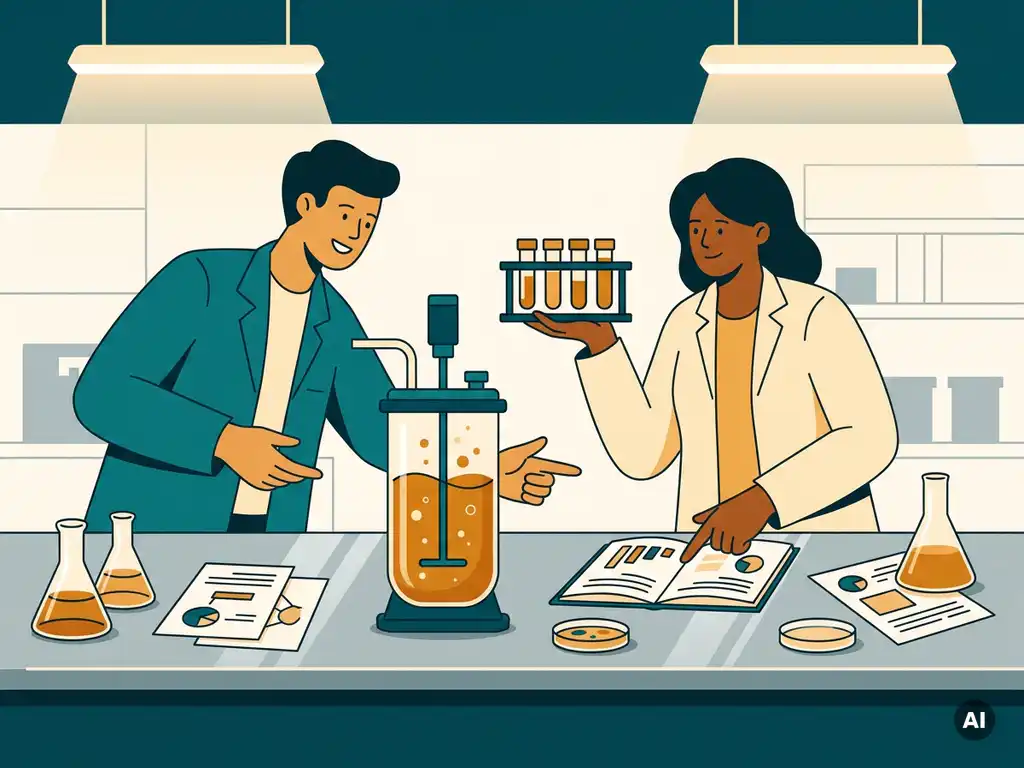
An external fermentation partner integrates with your R&D team by functioning as an extension of your internal capability rather than a separate vendor. They take on defined experimental or production tasks, share data and findings on an agreed cadence, and align their work directly with your project milestones. This model works best for companies that have a validated concept but lack the bioreactor infrastructure, analytical depth, or specialist process knowledge to move from lab to pilot scale independently. The sections below address the most common practical questions about how that collaboration actually operates.
What does an external fermentation partner actually do within a project?
An external fermentation partner takes ownership of specific technical tasks within your broader development roadmap. Depending on the project stage, this includes lab-scale feasibility testing, process parameter optimization, pilot-scale validation, microbiome monitoring, and in some cases small-scale contract manufacturing. The partner works to defined objectives set jointly with your team, and delivers results that feed directly into your decision-making.
In practice, the division of labor typically looks like this: your team defines the scientific question or production target, the partner designs and executes the experimental approach using their infrastructure, and both sides interpret results together. This is different from simply outsourcing a task. A capable fermentation R&D partner brings process expertise that shapes how the question is framed in the first place.
For microbial fermentation specifically, the partner’s role often includes selecting and stabilizing the microbial system, whether that is a defined pure culture or a mixed microbial consortium, and monitoring its behavior over time using molecular tools such as amplicon sequencing or qPCR. This level of process insight is rarely available in-house at companies without a dedicated fermentation facility.
The scope can be narrow, covering a single feasibility experiment, or broad enough to span multiple development phases from initial screening through to pilot-scale process validation. What matters is that the scope is agreed in writing before work begins, with clear deliverables and decision points built in.
How does IP protection work when sharing fermentation data with an external partner?
IP protection in contract fermentation R&D is governed primarily by the agreements signed before any technical information changes hands. A well-structured Non-Disclosure Agreement (NDA) and a project-specific contract define who owns foreground IP generated during the collaboration, how background IP contributed by each party is protected, and what happens to data and biological materials at the end of the project.
The standard approach in contract R&D is that IP brought into the project by the client remains the client’s property, while any new IP generated during the project is assigned according to terms negotiated upfront. In most cases where the client defines the application and the partner provides the process service, the client retains ownership of the resulting process knowledge and any patentable outcomes. The partner retains the right to use general methodological knowledge, but not your specific formulations, strains, or process parameters.
Confidentiality in practice also depends on the partner’s operational culture. Partners with a track record in regulated industries, or those with academic spin-off backgrounds, tend to treat data compartmentalization seriously. It is reasonable to ask a prospective partner how they separate client projects within their facility, who has access to your data, and whether they work with any competitors in your application space.
If your project has patent potential, it is worth involving your IP counsel before the first technical conversation. The moment you disclose an invention to a third party without a signed NDA, you may affect your ability to file in certain jurisdictions. Reputable partners will not object to this requirement.
Get in Touch
Let’s Talk Microbial Solutions
Book a conversation with Stijn, our CEO, or send us your request.
| Book an Appointment | Request Information |
Get in Touch
Let’s Talk Microbial Solutions
Book a conversation with Stijn, our CEO, or send us your request.
| Book an Appointment | Request Information |
What information does a fermentation partner need to get started?
To begin a contract fermentation R&D project, a partner needs enough technical context to design a meaningful experimental approach. This does not require you to share everything upfront, but the intake conversation should cover your target output, the microbial system you are working with (if known), the substrate or feedstock, and the performance criteria that define success for your application.
More specifically, a partner will typically ask for:
- A description of the product or outcome you are trying to achieve (for example, a specific biomass composition, a target metabolite, or a treated waste stream)
- Any existing lab data, including fermentation conditions that have shown promise or failed
- The substrate or medium composition, and whether it is available in sufficient quantity for testing
- Regulatory or quality constraints that the process or end product must meet
- Your timeline and the decision gates that depend on the results
If you are at an early stage and have limited data, that is not a barrier to starting. Many productive collaborations begin with a feasibility study specifically designed to generate the baseline data needed to define the next phase. What matters most at the intake stage is clarity about what question you need answered, not the completeness of existing results.
Partners with strong process expertise will often help you sharpen the technical question during the intake conversation itself. This is a useful signal of whether the collaboration is likely to be genuinely productive.
How does communication and reporting work during a contract fermentation project?
Communication in a contract fermentation project typically follows a structured cadence agreed at the start: regular progress updates, data-sharing checkpoints, and formal written reports at defined milestones. The format depends on the project length and complexity, but the principle is the same across all engagements: your team should never be waiting for information to make a decision.
In shorter feasibility studies, a single interim update midway through and a final report at the end is often sufficient. For longer pilot-scale optimization projects, monthly or biweekly calls with shared data summaries are more appropriate. The key is that reporting is tied to experimental milestones rather than just calendar dates, so you receive information when it is actionable.
Good partners document not just results but reasoning. A fermentation experiment that does not hit its target is still valuable if the report explains what the data suggests about the process and what should be tested next. This kind of analytical reporting is what distinguishes a scientific partner from a service provider that simply executes instructions.
For teams working across different organizations or geographies, it also helps to designate a single point of contact on each side. This avoids information bottlenecks and ensures that technical questions get to the right person quickly. Shared project management tools or simple shared documentation can support this, though the specific tools matter less than the discipline of using them consistently.
When should a company switch from contract R&D to in-house fermentation capacity?
A company should consider building in-house fermentation capacity when the volume of fermentation work justifies the capital investment, when process knowledge has matured to the point where it can be reliably transferred, and when speed or confidentiality requirements make external dependency a strategic risk. None of these conditions typically exist at the early development stage.
The most common trigger is production volume. Contract manufacturing makes economic sense when your volumes are low or unpredictable, because you avoid fixed infrastructure costs. Once you reach a throughput level where the per-unit cost of contract production consistently exceeds what in-house production would cost at that scale, the business case for investment starts to build.
Process maturity is the second factor. Moving fermentation in-house before the process is fully understood is a common and costly mistake. If key parameters are still being optimized, or if the microbial system is not yet stable and reproducible, building a facility around an immature process locks in uncertainty at significant cost. External partners can continue to refine the process while your team prepares for the transition.
The third consideration is strategic control. Some companies reach a point where the fermentation process is so central to their competitive position that managing it externally carries too much risk, even with strong contractual protections. At that point, the decision to invest in infrastructure is as much about strategic independence as it is about economics.
For many scale-ups and mid-sized industrial companies, the right answer in 2026 is a hybrid approach: maintain an external partner relationship for continued process development and overflow production, while building limited in-house capacity for core production runs. This preserves flexibility without abandoning the expertise access that a specialist microbial process partner provides.
Related Articles
- What analytical tools are used to monitor fermentation microbiomes?
- How does soil contamination affect a building permit?
- What does microbial community analysis reveal about sludge health?
- What causes poor sludge settling in a food industry wastewater plant?
- What is the difference between sludge bulking and sludge foaming?