

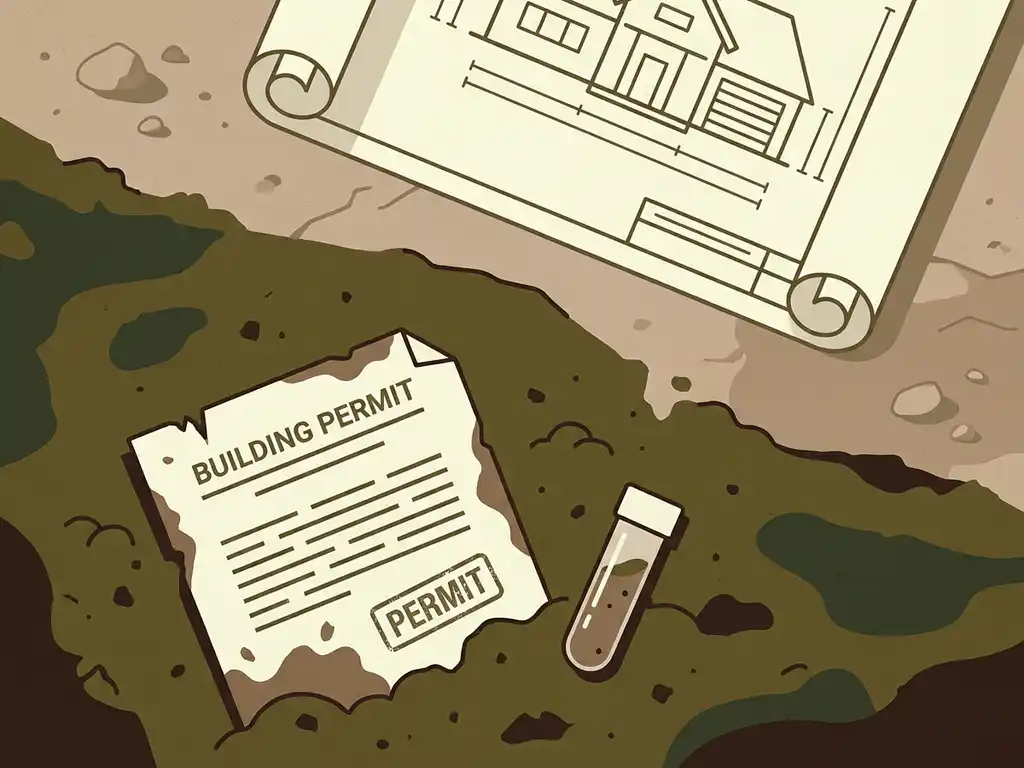
In most cases, you cannot build on contaminated soil without addressing the contamination first. Belgian planning regulations, governed by VLAREBO and enforced by OVAM, require that soil conditions do not pose unacceptable risks to human health or the environment before a building permit can be granted or a land use change approved. The sections below unpack the specific questions that project managers and site owners face most often when contamination stands between them and development.
Can you build on contaminated land without remediating it first?
In Belgium, building on contaminated land without prior remediation is generally not permitted when the contamination poses a risk to human health, groundwater, or the planned land use. OVAM can block or condition a building permit if a valid soil certificate does not confirm the land is clean or that residual contamination is managed to an acceptable level. In some cases, risk management measures can allow limited development to proceed alongside ongoing remediation, but this requires formal OVAM approval and a binding remediation plan.
The key legal instrument is the soil certificate, which must accompany any transaction or permit application involving potentially contaminated land. If contamination is discovered on an industrial site or a brownfield, the landowner is legally obligated to notify OVAM and initiate a descriptive soil investigation. Only after that investigation determines the nature and extent of the problem can a path forward be defined, whether that involves full remediation, risk containment, or a phased approach tied to development milestones.
Project managers often assume excavation is the fastest route to a clean certificate, but for complex or deep contamination, that assumption rarely holds. Understanding what types of contamination create the most significant permit obstacles is the logical next step.
Get in Touch
Let’s Talk Microbial Solutions
Book a conversation with Stijn, our CEO, or send us your request.
| Book an Appointment | Request Information |
What types of soil contamination are most likely to block a permit?
Volatile chlorinated compounds (VOCl), petroleum hydrocarbons, heavy metals, and polycyclic aromatic hydrocarbons (PAHs) are the contamination types most likely to block a building permit. VOCl contamination, which includes chlorinated solvents such as trichloroethylene (TCE) and perchloroethylene (PCE), is particularly problematic because these compounds migrate into groundwater, spread beyond the source zone, and persist for decades without active intervention.
VOCl contamination is especially common on former dry-cleaning sites, metal degreasing facilities, and chemical processing plants. Because these solvents are denser than water, they sink through the soil profile and create deep contamination plumes that are difficult to delineate and even harder to remove mechanically. Heavy metals such as lead, cadmium, and arsenic are also frequent permit blockers on former industrial land, as they do not degrade naturally and require either removal or permanent containment.
The severity of the blockage depends not only on the contaminant type but also on the planned land use. A residential development triggers stricter soil quality thresholds than an industrial or commercial project. A site that passes risk assessment for a logistics warehouse may still fail for a housing development, which is why the intended use must be defined clearly before any investigation is commissioned.
How does OVAM’s risk assessment determine whether development can proceed?
OVAM uses a tiered risk assessment process to evaluate whether contamination at a specific site poses an unacceptable risk given the planned land use, exposure pathways, and site-specific conditions. If the risk assessment concludes that risks are acceptable, development can proceed. If not, OVAM requires a remediation plan before the permit process can advance.
The risk assessment evaluates three main factors: the nature and concentration of the contaminants, the pathways through which humans or ecosystems could be exposed, and the sensitivity of the land use. For a site with VOCl contamination, the primary exposure pathways typically include groundwater ingestion, vapor intrusion into buildings, and direct soil contact. Each pathway is modeled against site-specific data collected during the descriptive soil investigation.
When contamination levels exceed the intervention thresholds defined in VLAREBO, OVAM requires a remediation project to be submitted and approved. This document outlines the remediation objectives, the chosen technique, the timeline, and the monitoring protocol. Without an approved remediation project, or at minimum a formal risk management agreement, the building permit process stalls. This is the regulatory checkpoint where many development projects lose months or years.
What’s the difference between excavation and in-situ biological remediation for permit purposes?
For permit purposes, both excavation and in-situ biological remediation are accepted remediation techniques under VLAREBO, but they differ significantly in speed, cost, feasibility, and the type of evidence OVAM requires before approving a plan. Excavation removes contaminated soil physically and delivers immediate, verifiable results. Biological remediation degrades contaminants in place over time and requires monitoring data to demonstrate progress toward remediation objectives.
Excavation: fast but not always feasible
Excavation is the default reference for many project managers because it produces a clean site quickly and the outcome is easy to verify. Once contaminated soil is removed and replaced with clean fill, a confirmatory soil investigation can demonstrate that targets have been met. However, excavation becomes impractical when contamination is deep, when groundwater levels complicate access, when existing structures cannot be demolished, or when the volume of contaminated material makes disposal costs prohibitive.
In-situ biological remediation: evidence-based and long-term
In-situ biological remediation, particularly bioaugmentation with specialized microbial consortia for VOCl contamination, is increasingly accepted by OVAM as a primary remediation technique. The critical difference for permit purposes is that biological remediation requires a robust feasibility demonstration before OVAM will approve the plan. This typically involves microcosm testing, which uses actual soil and groundwater samples from the site to confirm that the target contaminants can be biologically degraded under site conditions.
Once a biological remediation plan is approved, the permit process can proceed in parallel with remediation in some cases, particularly when risk management measures such as vapor barriers or groundwater monitoring are in place. Molecular monitoring tools, including quantitative PCR analysis of microbial populations, provide the kind of measurable, data-driven progress reports that satisfy both internal reporting requirements and OVAM oversight. Avecom’s biological soil remediation services are built around exactly this kind of evidence chain, from microcosm testing through to field-scale monitoring.
How long does soil remediation take before a building permit is approved?
The time between discovering soil contamination and receiving a building permit depends on the contamination type, the chosen remediation technique, and OVAM’s review timelines. In straightforward cases with limited contamination and excavation as the solution, the process can take six to eighteen months. For complex contamination requiring biological or chemical in-situ treatment, the timeline is typically several years, though development can sometimes begin in phases while remediation continues.
The investigation phase alone, covering the preliminary and descriptive soil investigation, typically takes three to nine months depending on site complexity and laboratory turnaround. OVAM then has a statutory review period to assess the investigation report and determine whether a remediation project is required. Drafting, submitting, and receiving approval for a remediation project adds further time, often six months or more.
Where biological remediation is the chosen approach, the active treatment phase for VOCl contamination typically runs between two and five years, depending on contaminant concentrations, plume geometry, and hydrogeological conditions. However, this does not necessarily mean development is blocked for the entire duration. If risk management measures are accepted by OVAM, construction can sometimes proceed in areas of the site that meet permit conditions while remediation continues in others. Early and thorough site characterization is the single most effective way to compress the overall timeline.
What evidence does OVAM require to accept a biological remediation plan?
OVAM requires a biological remediation plan to demonstrate technical feasibility, define measurable remediation objectives, and include a monitoring protocol that tracks progress over time. The plan must be grounded in site-specific data, not generic claims about biological degradation. For VOCl contamination specifically, OVAM expects evidence that the relevant degrading microorganisms are present or can be introduced, and that site conditions support their activity.
The core evidence components OVAM looks for include:
- Microcosm test results showing that biological degradation of the target contaminants occurs under conditions representative of the site
- Baseline molecular analysis of the soil and groundwater, quantifying the presence and abundance of key degrading organisms using tools such as qPCR
- Hydrogeological data confirming that the distribution of amendments or microbial inocula is technically feasible
- Defined remediation objectives expressed as target concentrations aligned with VLAREBO thresholds for the planned land use
- A monitoring plan specifying sampling frequency, parameters, and decision criteria for evaluating progress or adjusting the approach
The microcosm test is the most critical starting point. It is a relatively low-cost laboratory study that uses actual soil and groundwater from the contaminated site to test whether natural or augmented biological degradation can achieve the required cleanup. Without this site-specific evidence, OVAM is unlikely to approve a biological remediation plan, regardless of how well the technique is documented in scientific literature.
Avecom has developed a structured approach to building this evidence base, combining microcosm feasibility testing with molecular soil analysis and reporting aligned with VLAREBO requirements. For project managers who have found contamination on an industrial site or brownfield and need to know whether biological remediation is a viable path forward, this kind of early-stage screening is the most efficient way to answer that question before committing to a full remediation project.
If you are working with a contaminated parcel where classical techniques have failed or are not feasible, Avecom offers an initial screening to assess whether biological remediation is technically viable for your specific site conditions. The goal is to give you concrete data early, so that the permit process and your development planning can move forward on a solid foundation.