

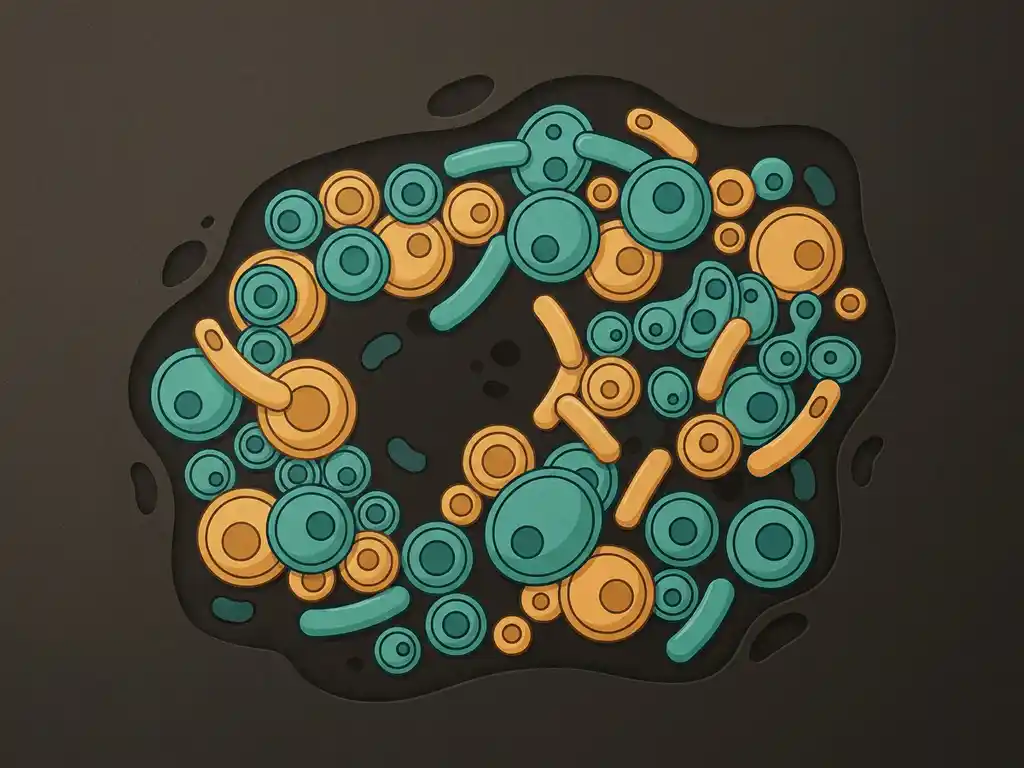
Microbial community analysis reveals the functional health of sludge by identifying which organisms are present, in what proportions, and whether the microbial balance supports stable biological treatment. A well-functioning sludge microbiome drives efficient organic matter breakdown, nutrient removal, and settleability. When that balance shifts, performance problems follow — often before any conventional measurement catches them.
For industrial wastewater operators, this kind of insight matters because sludge problems in wastewater treatment rarely announce themselves with a single, obvious cause. They build gradually through microbial imbalances that standard chemical tests simply do not detect. The sections below address the most common questions operators ask when they want to understand and act on what is happening inside their biological treatment system.
How does microbial community composition affect sludge performance?
The microbial community composition directly determines what sludge can and cannot do. Biological treatment depends on a layered consortium of organisms: fermenters, nitrifiers, denitrifiers, phosphorus-accumulating organisms, and many others. Each group occupies a functional role, and the relative abundance of these groups governs how efficiently the sludge removes organic load, nitrogen, and phosphorus under real operating conditions.
When the community is well-balanced, these groups work in sequence and support each other. Nitrifiers, for example, are slow-growing and sensitive to temperature, pH, and toxic loads. If their population is suppressed, ammonia removal fails even when the rest of the sludge appears healthy. Similarly, the dominance of filamentous bacteria over floc-forming bacteria leads directly to poor settling, which is one of the most disruptive sludge problems in wastewater treatment.
The composition also determines resilience. A diverse microbial community can absorb fluctuations in load, temperature, or influent chemistry more effectively than a narrow one. Industrial processes with seasonal production cycles or variable feedstocks are particularly vulnerable to community shifts, because the sludge may not have enough functional redundancy to compensate when conditions change quickly.
Get in Touch
Let’s Talk Microbial Solutions
Book a conversation with Stijn, our CEO, or send us your request.
| Book an Appointment | Request Information |
What are the early warning signs of an unhealthy sludge microbiome?
Early warning signs of an unhealthy sludge microbiome include rising effluent turbidity, a deteriorating sludge volume index, unexplained drops in nitrification efficiency, and foam formation on aeration tanks. These symptoms often appear weeks before a compliance breach, but they are frequently misread as hydraulic or mechanical problems rather than microbial ones.
Foam is a particularly informative signal. Stable, persistent brown foam on the surface of an aeration basin is associated with the proliferation of specific filamentous actinobacteria, which thrive under certain organic loading and sludge age conditions. Thin, white foam that collapses quickly suggests a different imbalance, often linked to surfactant loading or a disrupted microbial population after a shock event.
Excess sludge production that rises without a corresponding increase in organic load can also indicate a community shift. When the organisms responsible for endogenous respiration are suppressed, the system generates more biomass per unit of substrate removed. This drives up sludge handling costs and is a sign that the community structure has moved away from an efficient steady state.
Operators who notice any of these signals benefit from moving quickly to microbiome analysis rather than adjusting operational parameters blindly. Changing aeration rates, sludge retention time, or chemical dosing without understanding the underlying microbial cause can accelerate the problem rather than resolve it.
Which methods are used to analyse microbial communities in sludge?
The most informative methods for analysing microbial communities in sludge are DNA-based molecular techniques, particularly 16S rRNA amplicon sequencing and quantitative PCR. These approaches identify which organisms are present at the genus or species level and can quantify functional groups such as nitrifiers or anaerobic ammonium oxidation bacteria that are difficult to culture and count by conventional means.
16S rRNA amplicon sequencing
This method sequences a conserved region of the bacterial genome present in virtually all prokaryotes, then matches the sequences against reference databases to produce a community profile. It provides a broad census of the sludge microbiome and is well suited to routine monitoring because it captures the full diversity of the community, including rare organisms that may become dominant under stress.
Quantitative PCR and fluorescence in situ hybridisation
Quantitative PCR targets specific genes to measure the abundance of particular functional groups, such as ammonia-oxidising bacteria or methanogens. Fluorescence in situ hybridisation uses fluorescent probes to visualise and count target organisms directly in sludge samples under a microscope. Both methods are faster and more targeted than broad sequencing and are useful for tracking known problem organisms or confirming that a desired functional group is present at sufficient levels.
Microscopy remains a practical complement to molecular methods. Experienced analysts can identify filamentous morphotypes and floc structure visually, providing immediate context for sequencing results. biological wastewater treatment specialists typically combine molecular and microscopic approaches to build a complete picture of sludge condition.
How often should sludge microbial communities be monitored?
Sludge microbial communities should be monitored at a minimum quarterly in stable industrial systems, and monthly or more frequently during process changes, seasonal load shifts, or recovery from a disruption. The right frequency depends on how variable the influent is and how much operational risk a microbial imbalance represents for the facility.
Continuous monitoring of every microbial parameter is neither practical nor necessary. A more effective approach is to establish a baseline community profile during stable operation, then use targeted monitoring to detect deviations from that baseline. This makes it possible to identify a developing imbalance, such as the early enrichment of filamentous bacteria associated with sludge bulking, before it reaches a point that affects effluent quality.
Industrial facilities with complex or variable wastewater streams, such as food processors with seasonal production cycles, benefit from more frequent monitoring around production transitions. These are the moments when the sludge microbiome faces the greatest stress, and early detection of a community shift gives operators time to intervene before a compliance exceedance occurs.
Can microbial analysis help optimise nutrient removal in wastewater treatment?
Yes, microbial community analysis can directly improve nutrient removal by identifying whether the organisms responsible for nitrification, denitrification, and biological phosphorus removal are present at the concentrations needed to meet discharge limits. When these functional groups are underrepresented, targeted interventions can be designed rather than applying broad, costly operational changes.
Nitrogen removal in biological treatment depends on a two-step process: ammonia-oxidising bacteria convert ammonia to nitrite, and nitrite-oxidising bacteria complete the conversion to nitrate, which denitrifiers then reduce to nitrogen gas. Each step requires a distinct microbial population. If sequencing shows that nitrite-oxidising bacteria are suppressed, for example, partial nitrification and nitrite accumulation in the effluent can be explained and addressed specifically.
This kind of targeted insight is particularly valuable for facilities dealing with nitrogen and phosphorus peaks after seasonal production. Rather than over-engineering the system for worst-case loads, operators can use microbial data to understand how the community responds to peak conditions and design a more proportionate response. Avecom integrates molecular monitoring of microbial communities as part of its wastewater optimisation work, allowing interventions to be grounded in what the biology actually shows rather than what operational parameters suggest.
What is the difference between sludge microbiome analysis and standard sludge testing?
Standard sludge testing measures physical and chemical parameters: mixed liquor suspended solids, sludge volume index, volatile suspended solids, oxygen uptake rate, and effluent concentrations of ammonia, phosphorus, and chemical oxygen demand. Sludge microbiome analysis goes further by identifying the organisms driving those measurements, which makes it possible to explain why performance is changing and what is likely to happen next.
Standard tests tell you what the sludge is doing. Microbiome analysis tells you who is doing it and whether the right organisms are in control. This distinction matters most when a system is underperforming but the standard parameters do not point to an obvious cause. A sludge volume index that is slowly rising, for instance, may reflect a gradual shift in the balance between floc-forming and filamentous bacteria that only becomes visible through community profiling.
Standard testing is essential for day-to-day operations and regulatory reporting. Microbiome analysis is the diagnostic layer that sits above it, used when a facility needs to understand the root cause of a problem, validate a process change, or build confidence before modifying sludge retention time or chemical dosing. Combining both gives operators a much more complete picture of system health than either approach alone.
For facilities that lack internal microbiological expertise, this combination can feel out of reach. A specialist team with experience in applied microbiology can conduct a microbiological audit of an existing installation, interpret the community data in operational terms, and translate findings into concrete recommendations. That kind of external expertise bridges the gap between laboratory science and day-to-day process management, which is precisely where many industrial operators find themselves when sludge problems in wastewater treatment become persistent and difficult to resolve through standard adjustments alone.
Understanding what lives inside your sludge is not an academic exercise. It is one of the most practical tools available for fixing sludge bulking in biological treatment, reducing excess sludge generation, and maintaining consistent compliance without over-reliance on chemical intervention. If your system is showing signs of microbial imbalance, wastewater treatment expertise grounded in microbial science is the most direct path to a durable solution.