

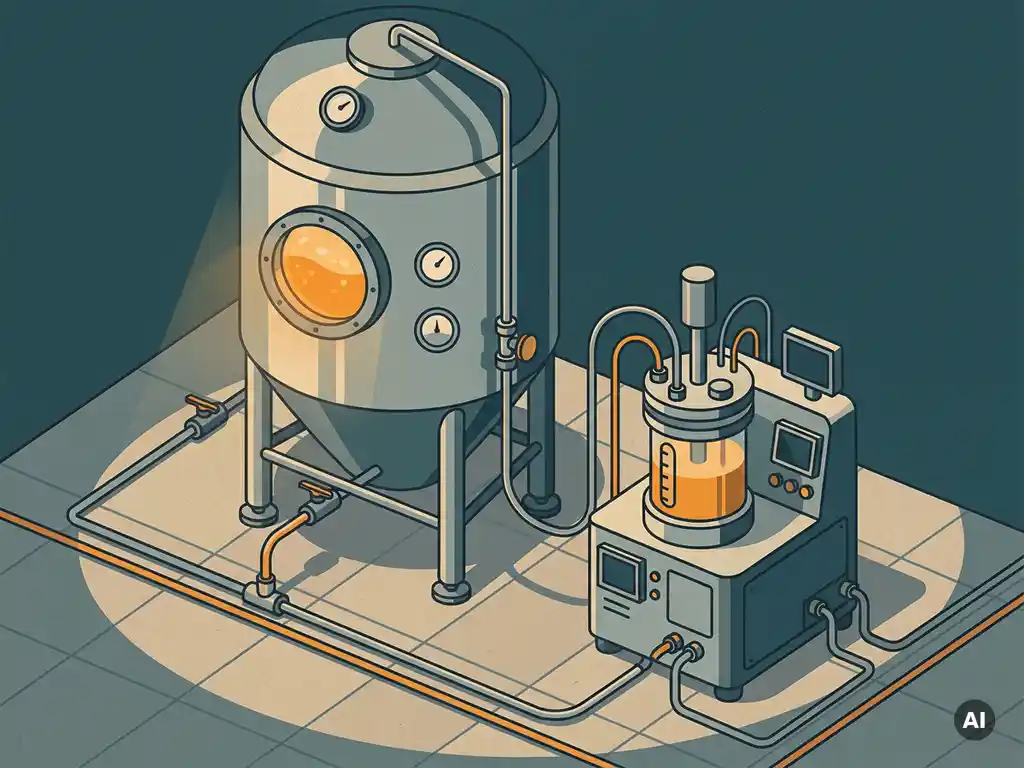
Managing technical risk in a fermentation scale-up project requires identifying critical process parameters early, validating them systematically at each scale, and building decision gates into the project timeline before committing to larger infrastructure. The most effective approach combines rigorous process characterization at lab scale with structured pilot-scale validation, reducing the chance that a process that works in a flask will fail in a bioreactor. The sections below address the most common questions R&D teams face when moving a fermentation concept from bench to pilot to production.
What causes fermentation processes to fail during scale-up?
Fermentation processes most commonly fail during scale-up because the physical and chemical conditions inside a larger vessel differ fundamentally from those in a laboratory flask or bench-top reactor. Mixing dynamics, oxygen transfer rates, heat distribution, and pH gradients all behave differently at scale, and microbial communities respond to those differences in ways that can derail performance. Scale-up failure is rarely a microbiology problem; it is almost always an engineering problem that shows up as a microbiology problem.
The most frequent root causes include:
- Insufficient mixing homogeneity: At lab scale, a magnetic stirrer or overhead mixer keeps conditions uniform. In a pilot or production vessel, dead zones form where nutrients, oxygen, or pH correction agents are not distributed evenly. Microorganisms in those zones experience stress and shift their metabolism accordingly.
- Oxygen transfer limitations: Aerobic processes that run cleanly in a shaker flask can become oxygen-limited in a stirred tank if the kLa (volumetric oxygen transfer coefficient) is not maintained. This is one of the most underestimated risks in bioprocess scale-up.
- Thermal management: Fermentation generates heat. At small volumes, ambient temperature control is sufficient. At larger volumes, inadequate cooling capacity leads to temperature excursions that stress or kill the microbial community.
- Inoculum quality and volume: Scaling the inoculum proportionally does not always preserve the microbial community structure or physiological state that drove lab-scale performance.
- Foam and pressure dynamics: Foaming behavior and headspace pressure change with vessel geometry and aeration rates, creating operational challenges that simply do not appear at bench scale.
Understanding which of these factors is most likely to affect a given process is the first step in any credible fermentation scale-up risk management strategy.
How do you identify which process parameters are critical before scaling up?
Critical process parameters (CPPs) are identified through systematic lab-scale experimentation that deliberately varies one parameter at a time and measures the effect on key performance indicators, yield, productivity, product quality, or microbial community stability. This approach, sometimes called process characterization, maps the design space of the process before any scale decision is made.
In practice, the identification process involves three steps:
- Define the performance targets: What does success look like? Yield per gram of substrate, titre of the target compound, biomass concentration, or community composition stability. Without clear targets, there is no basis for judging whether a parameter is critical.
- Screen parameters systematically: Temperature, pH, dissolved oxygen, agitation rate, feeding strategy, and inoculum density are the usual candidates. Design of experiments (DoE) approaches allow multiple parameters to be evaluated efficiently without running every possible combination.
- Establish acceptable operating ranges: For each parameter identified as critical, define the range within which performance remains acceptable. These ranges become the control strategy for pilot-scale operation.
For processes involving mixed microbial cultures, molecular monitoring tools, such as amplicon sequencing and qPCR, add an important layer of information. They reveal whether community composition shifts when a parameter moves outside its target range, which is often the earliest signal that something is going wrong before any macroscopic performance indicator changes.
Get in Touch
Let’s Talk Microbial Solutions
Book a conversation with Stijn, our CEO, or send us your request.
| Book an Appointment | Request Information |
What’s the difference between lab-scale and pilot-scale fermentation risk?
Lab-scale fermentation risk is primarily scientific: will the microbial system produce the desired outcome under controlled conditions? Pilot-scale fermentation risk is primarily engineering and operational: can those conditions be reliably reproduced and maintained in a larger, more complex system over extended run times? Both types of risk are real, but they require different mitigation strategies.
At lab scale, the main risks are:
- Selecting the wrong microbial system or substrate combination
- Optimizing for conditions that cannot be replicated at larger volumes
- Misinterpreting batch variability as process robustness
At pilot scale, the risk profile shifts:
- Engineering parameters (mixing, aeration, heat transfer) become dominant variables
- Contamination risk increases with vessel size and run duration
- Operational consistency, operator skill, sensor calibration, feed delivery, becomes a significant source of variability
- The cost of failure rises sharply: a failed pilot run consumes time, materials, and facility access that cannot easily be recovered
The transition between these two risk profiles is where most fermentation scale-up projects encounter their most serious problems. Teams that treat pilot scale as simply “a bigger version of the lab” consistently underestimate the engineering challenges involved. A well-designed scale-up project treats the lab-to-pilot transition as its own validation stage, with defined acceptance criteria before moving forward.
When should you bring in a contract R&D partner for scale-up?
The right moment to engage a contract R&D partner for fermentation scale-up is before the first pilot run, not after a failed one. If your internal team has validated the concept at lab scale but lacks access to pilot-scale bioreactors, downstream processing equipment, or the analytical tools to monitor process performance in real time, bringing in a specialist partner at that transition point significantly reduces both technical and financial risk.
There are several clear signals that external expertise adds value:
- Your internal lab is equipped for analytical work but not for controlled fermentation at volumes above a few litres
- The process involves complex microbial communities that require molecular monitoring to characterize and control
- You are working under a tight timeline, investors or customers expect a proof of concept within six to twelve months
- You need documented, scientifically credible data to support a subsidy application, patent filing, or investor conversation
- The process involves substrates or side streams that require specialized handling or safety considerations
A specialist in fermentation R&D and contract manufacturing brings not just equipment but process knowledge, the ability to design experiments that answer the right questions at each scale, and to interpret results in ways that inform the next decision. That combination of infrastructure and expertise is what makes the partnership genuinely risk-reducing rather than simply capacity-adding.
How does working with mixed microbial cultures affect scale-up risk?
Working with mixed microbial cultures introduces a different kind of scale-up risk compared to pure culture processes: the community composition itself becomes a process variable. In a pure culture system, you know exactly which organism is present and can design the process around its well-characterized physiology. In a mixed culture system, the relative abundance of different community members can shift in response to changes in substrate availability, oxygen levels, pH, or mixing, and those shifts directly affect process performance.
This sounds like a disadvantage, but in practice mixed cultures often demonstrate greater robustness at scale than pure cultures. Because the community has evolved to function under variable conditions, it tends to tolerate the environmental heterogeneity that is inevitable in larger vessels. Pure culture processes, by contrast, can be more sensitive to the gradients and fluctuations that scale-up introduces.
The key to managing mixed culture scale-up risk is monitoring. Without visibility into community composition, you cannot distinguish between a stable process and one that is drifting toward a less productive state. Molecular tools such as amplicon sequencing allow community structure to be tracked across scale-up stages, providing early warning of shifts before they manifest as performance problems. This kind of microbiome monitoring is a core part of how Avecom approaches pilot-scale fermentation projects involving complex microbial systems.
What does a structured fermentation scale-up risk management plan look like?
A structured fermentation scale-up risk management plan is a stage-gated framework that defines what must be demonstrated at each scale before resources are committed to the next. It translates scientific and engineering uncertainty into a series of answerable questions, each with defined success criteria, and it assigns responsibility for monitoring, decision-making, and documentation at every stage.
The core elements of such a plan include:
- Risk inventory: A systematic list of the technical risks specific to the process, substrate variability, contamination sensitivity, oxygen demand, foaming behavior, product stability. Each risk is assessed for likelihood and impact.
- Critical parameter identification: Based on lab-scale characterization, a defined set of parameters that must be controlled within specified ranges at pilot scale, with monitoring protocols for each.
- Stage gates: Explicit decision points between lab scale, pilot scale, and production scale. At each gate, defined data requirements must be met before the project advances. This prevents premature scale-up driven by schedule pressure rather than technical readiness.
- Contingency protocols: Pre-defined responses to the most likely failure modes, what to do if yield drops, if contamination is detected, if community composition shifts outside acceptable bounds.
- Documentation and traceability: Complete records of process conditions, analytical results, and decisions at each stage. This is essential not only for internal learning but for regulatory submissions, patent applications, and investor due diligence.
The discipline of building this plan before the first pilot run is what separates projects that reach commercial scale on schedule from those that cycle through repeated pilot failures. For companies working with an external partner, the plan also serves as the technical basis for the collaboration, defining what the partner will deliver, how success is measured, and how intellectual property generated during the project is handled.
Avecom has built this kind of structured approach into its fermentation R&D services, working as an extension of the client’s internal team from the first feasibility test through to pilot-scale validation and, where needed, small-scale contract production. For teams facing the scale-up challenge without their own pilot infrastructure, that kind of integrated support, combining equipment, expertise, and scientific rigor, is often the most direct path to a credible proof of concept.