

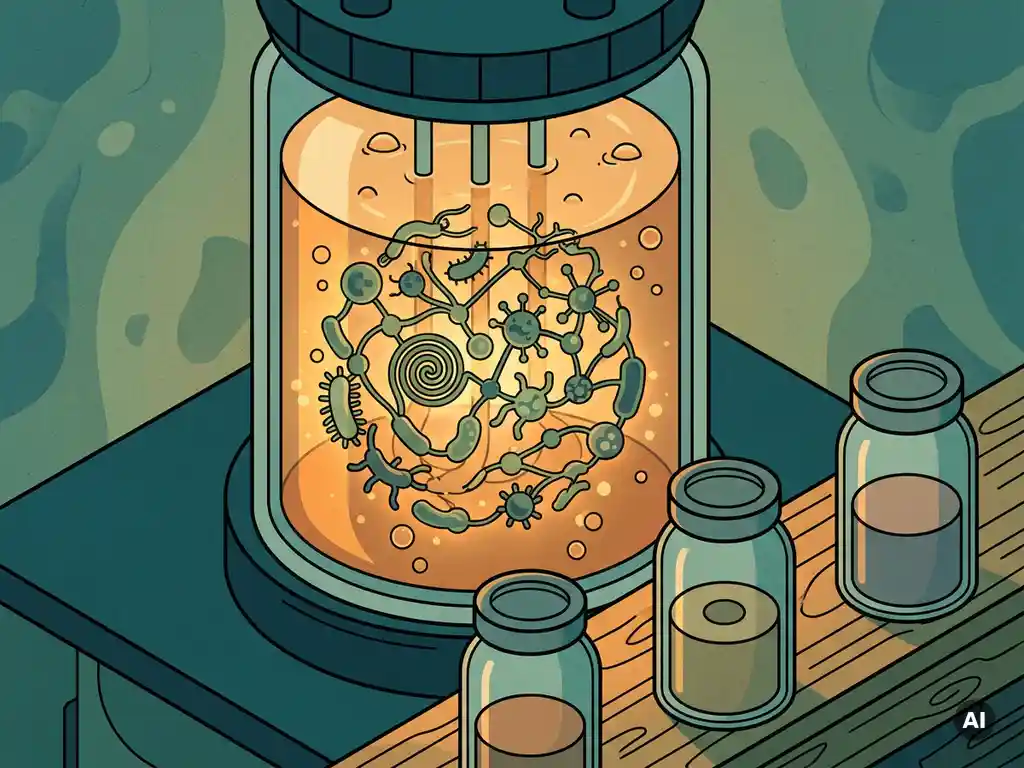
Mixed microbial cultures outperform pure cultures in applications where process robustness, metabolic diversity, or the use of complex, undefined feedstocks matters more than precision control over a single biochemical pathway. Rather than relying on one organism to do everything, a mixed community distributes the metabolic workload across multiple species, which makes the overall system more stable and often more efficient. The sections below unpack the key questions industrial biotechnologists ask when deciding between mixed and pure culture strategies.
What makes mixed microbial cultures more resilient than pure cultures?
Mixed microbial cultures are more resilient than pure cultures because they distribute metabolic functions across multiple organisms, so the failure or inhibition of one species does not collapse the entire process. This functional redundancy means the community can absorb environmental disturbances, fluctuating feedstock quality, or contamination events that would halt a pure culture entirely.
In a pure culture system, every process parameter must be held within a narrow window to keep a single organism performing at its optimum. Temperature spikes, pH shifts, or inhibitory compounds in the substrate can quickly push that organism outside its tolerance range. A mixed microbial community, by contrast, typically contains species with overlapping but distinct tolerance profiles. When one population is stressed, another compensates, maintaining overall process continuity.
This resilience is not accidental. It is the product of co-evolution within complex environments, where organisms have developed interdependencies, including cross-feeding, syntrophic relationships, and competitive exclusion of pathogens. These dynamics are difficult to engineer artificially but emerge naturally in well-managed mixed-culture fermentation systems.
Which industrial applications benefit most from mixed cultures?
Industrial applications that benefit most from mixed microbial cultures are those involving complex or heterogeneous feedstocks, multi-step biochemical conversions, or processes where sterility cannot be economically maintained at scale. Wastewater treatment, anaerobic digestion, soil bioremediation, and microbial protein production from food-processing side streams are all strong candidates.
In wastewater treatment and anaerobic digestion, the substrate is inherently complex and variable. No single organism can efficiently degrade the full range of organic compounds present. A microbial consortium handles the sequential breakdown, from hydrolysis through acidogenesis to methanogenesis, with each guild of organisms performing its specialized role.
In microbial protein production from agro-industrial side streams, mixed cultures can valorize substrates that would be too inhibitory or nutritionally incomplete for a pure culture to tolerate. Avecom has developed and patented processes in this area, using biomass fermentation approaches that leverage mixed microbial communities to convert food-processing water into high-quality single-cell protein.
Soil bioremediation is another domain where mixed cultures excel. Degrading persistent organic pollutants typically requires a cascade of enzymatic reactions that no single organism encodes. A diverse community, enriched from the contaminated site itself, is usually far more effective than any inoculated pure strain.
Get in Touch
Let’s Talk Microbial Solutions
Book a conversation with Stijn, our CEO, or send us your request.
| Book an Appointment | Request Information |
Get in Touch
Let’s Talk Microbial Solutions
Book a conversation with Stijn, our CEO, or send us your request.
| Book an Appointment | Request Information |
Why do pure cultures struggle to scale up from lab to pilot?
Pure cultures struggle to scale up from lab to pilot because the tightly controlled conditions that sustain them at small scale become progressively harder and more expensive to maintain as reactor volume increases. Contamination risk rises, mass transfer dynamics change, and any deviation in process parameters can compromise the entire batch.
At lab scale, a researcher can maintain near-sterile conditions, precise temperature control, and rapid response to any sign of contamination. At pilot scale, these controls become engineering challenges. Mixing gradients appear, heat transfer becomes uneven, and the cost of maintaining strict sterility across hundreds or thousands of liters escalates significantly.
For pure cultures of genetically modified organisms, regulatory requirements add another layer of complexity. Containment obligations, documentation burdens, and restrictions on waste streams can make pilot-scale work with GMO strains logistically demanding before the process has even been validated.
Mixed microbial cultures, because they are inherently more tolerant of environmental variation, often prove more forgiving during scale-up. The community self-regulates to some degree, and the process does not depend on maintaining the dominance of a single strain. This does not eliminate scale-up challenges, but it does shift the engineering problem from contamination control to community steering, which is a more tractable problem when the right analytical tools are available.
What’s the difference between a microbial consortium and a co-culture?
A microbial consortium is a complex community of multiple interacting species, typically undefined in composition and enriched from a natural environment, while a co-culture is a deliberately assembled combination of two or more known, defined strains cultivated together under controlled conditions. The distinction matters for both process design and regulatory classification.
Co-cultures are intentionally constructed. A researcher selects two or three organisms whose metabolic activities complement each other and cultivates them together. Because the strains are defined, the system is relatively predictable and easier to characterize for regulatory purposes. Co-cultures are common in synthetic biology and metabolic engineering contexts.
Microbial consortia, by contrast, are enriched rather than assembled. The community that develops in an anaerobic digester or a bioremediation system is shaped by selective pressure, substrate availability, and microbial ecology. The composition is complex, often comprising hundreds of species, and changes dynamically in response to operating conditions. This complexity is precisely what gives consortia their resilience and metabolic breadth, but it also demands more sophisticated monitoring to understand and steer.
In industrial fermentation, both approaches have their place. Co-cultures offer more control; consortia offer more robustness. The right choice depends on whether the process demands precision or stability, and on what the feedstock and regulatory environment permit.
How do you steer and monitor a mixed microbial community in a bioreactor?
Steering and monitoring a mixed microbial community in a bioreactor requires a combination of process parameter control and molecular analytical techniques. Operators adjust conditions such as pH, temperature, hydraulic retention time, and substrate composition to selectively favor desired microbial populations, while tools like amplicon sequencing and qPCR track community composition over time.
The core principle is that microbial communities respond to their environment. By deliberately setting and shifting process parameters, an experienced fermentation team can enrich for organisms that perform the desired function and suppress those that do not. This is not passive observation; it is active community engineering through environmental selection pressure.
On the analytical side, classical culture-based methods are insufficient for characterizing mixed communities, because the majority of microorganisms in an industrial consortium cannot be cultured in isolation. Molecular techniques have become the standard:
- Amplicon sequencing (typically targeting the 16S rRNA gene for bacteria or ITS regions for fungi) provides a compositional snapshot of the entire community, identifying which organisms are present and in what relative abundance.
- Quantitative PCR (qPCR) allows rapid, targeted monitoring of specific functional groups or indicator organisms, useful for routine process control.
- Functional metagenomics goes further, linking community composition to metabolic potential, which is valuable during process development.
Combining process data with molecular community data allows teams to build a mechanistic understanding of how the consortium behaves under different conditions. This understanding is what makes it possible to reproduce and optimize the process reliably, which is essential for any industrial application.
When should a biotech company choose mixed cultures over GMO strains?
A biotech company should choose mixed microbial cultures over GMO strains when the process involves complex or variable feedstocks, when regulatory containment requirements for GMOs would be prohibitive at the intended scale, or when process robustness and cost of goods matter more than the precise yield of a single target molecule.
GMO strains are well suited to high-value, high-precision applications: producing a specific pharmaceutical protein, synthesizing a rare metabolite, or achieving a defined biochemical conversion with maximum efficiency. In these cases, the investment in strain development, sterile infrastructure, and regulatory compliance is justified by the value of the product.
For many industrial biotechnology applications, however, that equation does not hold. When the substrate is a heterogeneous side stream, when the process needs to run at large scale without sterile conditions, or when the product is a commodity biomass rather than a refined molecule, the overhead of GMO development and containment becomes a competitive disadvantage.
Mixed cultures also carry advantages in time-to-market. Developing a validated GMO strain can take years. Enriching and optimizing a mixed microbial community from a relevant environmental source can be accomplished in months, particularly when working with a partner that has the infrastructure and expertise to accelerate the process. For scale-ups under investor pressure to demonstrate proof of concept within a defined window, this timeline difference is often decisive.
The choice is rarely absolute. Some processes benefit from a hybrid approach, using a defined inoculum of selected strains within a broader mixed community framework. What matters is matching the biological strategy to the technical, regulatory, and commercial realities of the specific application, which is ultimately an engineering judgment as much as a microbiological one. Teams at Avecom have built their practice around exactly this kind of decision-making, working with companies that need to move from concept to validated process without building their own fermentation infrastructure from scratch.