

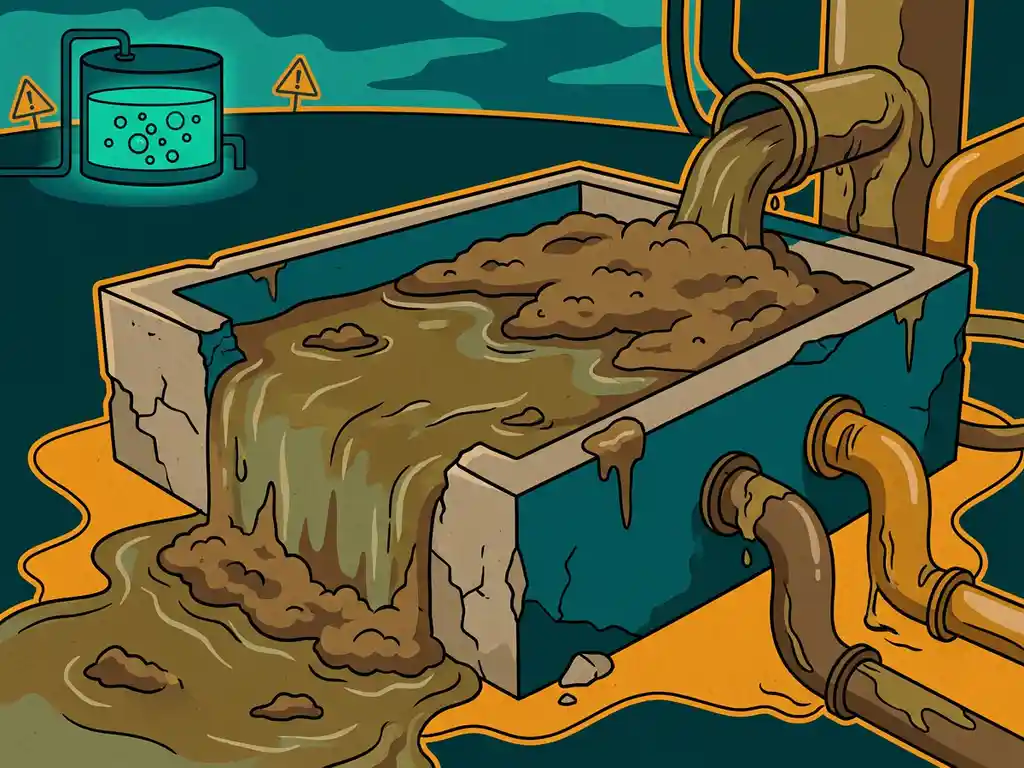
If excess sludge is not removed from a wastewater plant, the biological treatment process will progressively deteriorate. Sludge concentration rises beyond what the system can manage, disrupting the balance of microorganisms responsible for breaking down pollutants. The result is declining effluent quality, structural process failures, and a real risk of regulatory non-compliance. The sections below address the most common questions plant operators and environmental managers face when sludge accumulation becomes a problem.
How does sludge accumulate in a biological wastewater treatment system?
Sludge accumulates in a biological wastewater treatment system because the microorganisms that degrade organic pollutants continuously grow and reproduce as they consume organic matter. Every kilogram of organic load treated generates a corresponding mass of new biomass. Without regular removal, this biomass builds up in the aeration tank and secondary clarifier faster than it can settle or be processed.
In an activated sludge system, the key control parameter is the sludge retention time (SRT), also called sludge age. When excess sludge is not wasted, the SRT increases uncontrollably. A well-run system maintains a target SRT matched to the microbial community it needs to sustain. Nitrifying bacteria, for example, require a longer sludge age than general heterotrophs. But there is an upper limit: beyond a certain point, old and inactive biomass dominates, oxygen demand rises without a corresponding improvement in treatment, and the system becomes metabolically inefficient.
Industrial wastewater streams add further complexity. High-strength effluents from food processing or chemical production can cause rapid biomass growth during peak production periods, making sludge accumulation a seasonal or batch-driven problem rather than a steady-state one. Understanding the dynamics of your specific wastewater composition is the starting point for any effective sludge management strategy.
Get in Touch
Let’s Talk Microbial Solutions
Book a conversation with Stijn, our CEO, or send us your request.
| Book an Appointment | Request Information |
What happens to treatment performance when sludge is not removed?
When sludge is not removed, treatment performance declines in measurable and progressive stages. The mixed liquor suspended solids (MLSS) concentration rises, the sludge volume index (SVI) deteriorates, and the secondary clarifier becomes overloaded. Effluent quality worsens as poorly settled solids carry over into the discharge, pushing chemical oxygen demand (COD), suspended solids, and nutrient levels above permitted limits.
The biological community itself is affected. As the system becomes overloaded with biomass, oxygen transfer efficiency drops because maintaining dissolved oxygen levels in a dense mixed liquor requires disproportionately more energy. Aerobic zones can shift toward anoxic conditions, which disrupts nitrification and can cause the release of nitrous oxide, an unintended byproduct of incomplete nitrogen conversion.
In the secondary clarifier, excessive sludge blanket depth reduces the effective settling volume. Sludge that cannot settle fast enough rises toward the effluent weir, causing a direct discharge of suspended solids. This is not just a performance issue: it is a compliance failure. For industrial producers operating under strict discharge permits, this sequence of events can unfold within days of sludge management being neglected.
For facilities looking to understand whether their current system is already showing early signs of overload, a microbiological audit of the treatment installation can identify imbalances before they escalate into visible process failures.
Why does excess sludge cause sludge bulking and foaming?
Excess sludge causes sludge bulking and foaming because high sludge concentrations and elevated SRT create conditions that favor the growth of filamentous microorganisms. These bacteria form long, thread-like structures that trap air and water, producing sludge that does not compact well in the clarifier. The result is a low-density, voluminous sludge that rises to the surface rather than settling.
Filamentous bulking is one of the most common sludge problems in wastewater treatment, and it is strongly associated with process imbalances rather than random contamination. Contributing factors include:
- Excessively high sludge age, which enriches the environment for slow-growing filamentous species
- Low dissolved oxygen zones in the aeration basin, which selectively favor filamentous bacteria over floc-forming ones
- Nutrient deficiencies, particularly nitrogen and phosphorus relative to carbon load
- Highly variable organic loading, which creates feast-and-famine conditions that filamentous organisms tolerate better than floc formers
Foaming is a related but distinct problem. It is often caused by the proliferation of specific filamentous actinomycetes, which produce a stable, brown foam layer on the surface of the aeration tank. This foam can overflow into adjacent structures and is difficult to suppress without addressing the underlying microbial imbalance.
Knowing how to fix sludge bulking in biological treatment requires identifying which filamentous organism is dominant and understanding what process conditions are driving its growth. Microscopic and molecular analysis of the microbial community is the most reliable diagnostic approach, and it is far more targeted than simply adjusting aeration or dosing chemicals.
What are the regulatory risks of not managing sludge correctly?
The regulatory risks of not managing sludge correctly include exceeding discharge permit limits for suspended solids, COD, nitrogen, and phosphorus, which can result in fines, enforcement notices, and, in serious cases, forced operational shutdowns. In Belgium and the broader Benelux region, industrial dischargers operate under frameworks such as VLAREM and the EU Water Framework Directive, both of which set increasingly stringent effluent standards.
Exceeding discharge limits is not always the result of a sudden failure. Gradual sludge accumulation leads to a slow deterioration of effluent quality that may go unnoticed until a routine inspection or self-monitoring report reveals non-compliance. By that point, the process is often already in a state that requires significant corrective intervention.
Beyond direct fines, there are indirect costs: increased levies on discharge volumes and concentrations, reputational damage with local water authorities, and the operational disruption of implementing emergency corrective measures under regulatory scrutiny. For environmental and production managers already under pressure from tightening legislation, sludge mismanagement is one of the more avoidable compliance risks.
How often should excess sludge be removed from a wastewater plant?
Excess sludge should be removed from a wastewater plant at a frequency that maintains the target sludge retention time for the specific biological process in operation. In practice, this means daily or several times per week for most activated sludge systems. The precise wasting rate depends on the influent load, the target MLSS concentration, and the desired SRT for the microbial community being maintained.
There is no universal interval. A system treating high-strength food processing water with variable loads may need more frequent sludge wasting than one handling a steady, lower-strength stream. The calculation is straightforward in principle: the mass of sludge produced per day should equal the mass wasted per day to maintain a stable biomass inventory.
In practice, many industrial plants operate with inconsistent sludge wasting schedules, often because sludge handling and disposal carry their own costs and logistical challenges. This is a false economy. Irregular wasting creates the conditions for bulking, foaming, and clarifier overload described in earlier sections. Establishing a consistent, data-driven wasting protocol, ideally tied to daily MLSS measurements, is one of the most cost-effective operational improvements available to a plant manager.
Avecom’s approach to biological wastewater treatment optimization includes process monitoring and operational guidance that helps industrial facilities maintain stable sludge dynamics without requiring in-house microbiological expertise.
Can a wastewater plant recover after prolonged sludge accumulation?
Yes, a wastewater plant can recover after prolonged sludge accumulation, but the recovery process requires a structured approach and realistic timelines. The biological community does not reset instantly. Restoring a healthy, well-settling sludge after a period of filamentous bulking or clarifier overload typically takes several sludge retention time cycles, which can mean weeks rather than days.
The recovery strategy depends on the severity of the problem. In moderate cases, correcting the SRT through controlled sludge wasting, optimizing dissolved oxygen distribution, and addressing any nutrient imbalances is sufficient. The microbial community will gradually shift back toward floc-forming dominance as conditions improve.
In more severe cases, where the sludge is heavily dominated by filamentous organisms or where the clarifier has been operating under chronic overload, partial or full replacement of the sludge inventory may be necessary. Reseeding with a well-conditioned inoculum can accelerate recovery and reduce the period of suboptimal treatment performance. This is particularly relevant for industrial plants that cannot afford extended periods of non-compliance during the recovery phase.
One practical tool for reducing downtime during process recovery is the use of targeted biological inoculants. Avecom has developed ABIL technology, which allows existing biofilters and activated sludge systems to be restarted or rebalanced without a complete system shutdown, significantly shortening the recovery window.
For plants that have experienced repeated sludge problems, recovery is also an opportunity to revisit the fundamental process design. A thorough assessment of the wastewater composition, loading patterns, and existing installation can reveal whether the current system is appropriately sized and configured for the actual operational demands placed on it. Engaging a partner with expertise in mixed microbial culture management at this stage can prevent the same problems from recurring after recovery.
Avecom works with industrial producers in the food, chemical, and pharmaceutical sectors to diagnose and resolve persistent sludge problems, from initial feasibility assessment through to operational implementation. If your plant is showing signs of sludge accumulation or declining effluent quality, learn more about Avecom’s expertise and how a structured process audit can identify the root cause before it becomes a compliance issue.