

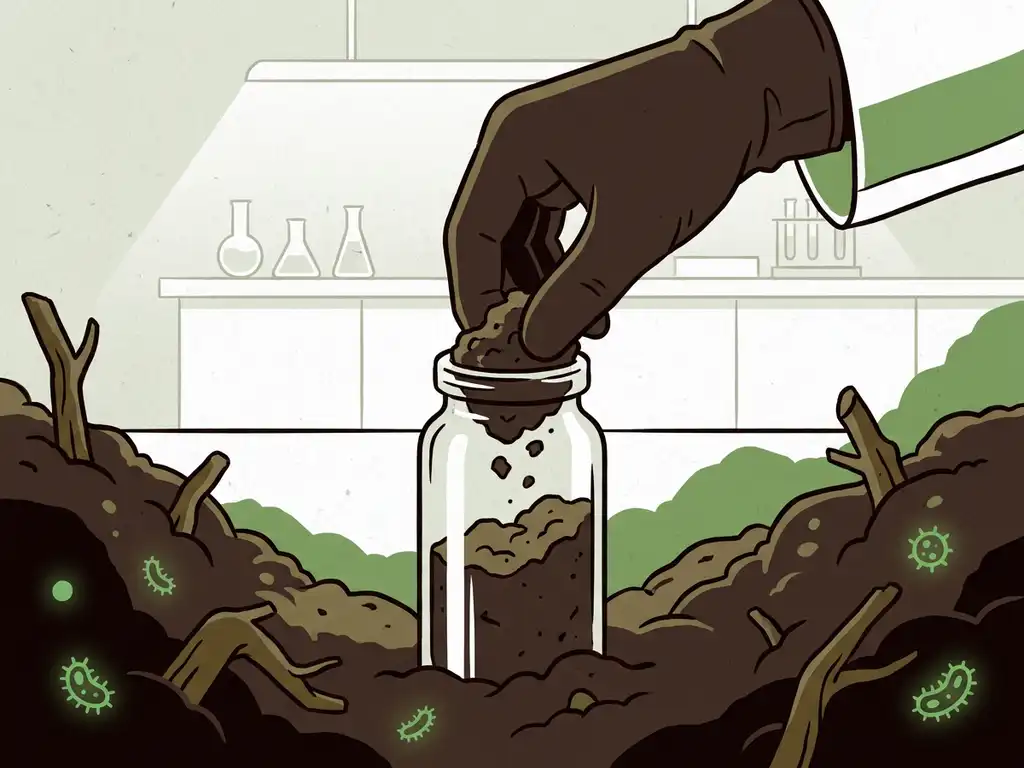
Biological soil remediation will work on a site when the right microbial conditions are present or can be created — meaning the contaminating compounds are biodegradable, the soil chemistry supports microbial activity, and the right organisms are either already present or can be introduced. The most reliable way to confirm feasibility before committing to a full remediation program is a laboratory-scale feasibility test, commonly called a microcosm test. The sections below address the most common questions project managers and environmental coordinators ask before deciding whether a biological approach is right for their site.
What factors determine whether bioremediation can work on a site?
Bioremediation can work on a site when the contaminant is biologically degradable, the soil and groundwater conditions support microbial activity, and the right organisms are present or can be introduced. The key determining factors are the type and concentration of contamination, soil permeability, pH, temperature, oxygen availability, and the presence of nutrients and electron donors that drive microbial metabolism.
For chlorinated solvents such as trichloroethylene (TCE) and perchloroethylene (PCE) — among the most persistent and legally problematic contaminants in brownfield development — biological degradation through reductive dechlorination is well established. However, this process requires strictly anaerobic conditions and specific microbial communities capable of driving the reaction all the way to harmless end products. If those organisms are absent or the geochemical conditions are unfavorable, the process stalls at toxic intermediates such as vinyl chloride.
Soil heterogeneity also plays a significant role. Highly compacted or clay-rich zones limit the distribution of injected amendments or microbial cultures. Very high contaminant concentrations can be toxic to the organisms that would otherwise break them down. These site-specific variables are exactly why a preliminary feasibility assessment is essential before any biological remediation strategy is designed. The biological soil remediation specialists at Avecom evaluate these factors systematically before recommending an approach.
Get in Touch
Let’s Talk Microbial Solutions
Book a conversation with Stijn, our CEO, or send us your request.
| Book an Appointment | Request Information |
What is a microcosm test and what does it prove?
A microcosm test is a small-scale laboratory experiment that uses actual soil and groundwater samples from a contaminated site to determine whether biological degradation of the target contaminants is feasible under controlled conditions. It proves whether the natural microbial community at your site is capable of breaking down the contamination, how quickly degradation occurs, and whether bioaugmentation with specialized organisms would improve results.
The test typically runs over several weeks. Soil and water samples are placed in sealed vessels under conditions that mimic the site environment. Researchers track the disappearance of target contaminants and the appearance of degradation products over time. Controls without microbial activity are run in parallel to confirm that any reduction is biological rather than chemical or physical.
For project managers facing budget constraints and regulatory deadlines, the microcosm test is valuable precisely because it is low-cost and fast relative to a full field trial. If the test shows that degradation is occurring naturally, the site may be a candidate for monitored natural attenuation. If degradation is incomplete or absent, the test identifies whether adding electron donors, adjusting pH, or introducing specialized microbial consortia through bioaugmentation would change the outcome. This evidence base also supports OVAM reporting requirements, giving regulators concrete data rather than assumptions. Avecom offers microcosm testing as a first screening step specifically designed to answer these questions before any large-scale investment is committed.
How long does biological soil remediation typically take?
Biological soil remediation typically takes between one and ten years, depending on the type and extent of contamination, the depth of the plume, soil conditions, and whether active intervention such as bioaugmentation or biostimulation is used. In-situ biological treatment of chlorinated solvents commonly takes two to five years for a well-designed active program, though complex or deep sites may require longer timeframes.
This timeline is often longer than excavation, which is why biological remediation is most appropriate when excavation is technically impossible, prohibitively expensive, or would cause unacceptable disruption to existing structures or infrastructure. The trade-off is cost: a multi-year biological program is frequently a fraction of the cost of removing and disposing of contaminated soil, particularly for deep or widespread plumes.
Timelines can be shortened through active bioaugmentation, where specialized microbial consortia are injected directly into the contamination zone, combined with careful management of geochemical conditions. Monitoring frequency and data quality also influence how quickly decisions can be made to adjust the strategy, which directly affects overall project duration.
What happens if biological remediation stops working mid-process?
If biological remediation stalls mid-process, the most common causes are depletion of electron donors, a shift in geochemical conditions that inhibits microbial activity, accumulation of toxic intermediate compounds, or incomplete distribution of amendments through heterogeneous soil. Each of these problems has a practical solution, but identifying the cause quickly is essential to avoid prolonged project delays and regulatory complications.
Stalling is not unusual, and it does not automatically mean the biological approach has failed. Reductive dechlorination of chlorinated solvents, for example, can arrest at cis-1,2-dichloroethylene (cis-DCE) — a phenomenon known as DCE stall — if the microbial community lacks organisms capable of completing the degradation pathway. This is typically resolved through targeted bioaugmentation with cultures that carry the process through to ethylene.
The key to managing mid-process stalls is having a monitoring framework in place that detects the problem early. Molecular tools such as quantitative PCR (qPCR) can identify which functional microbial groups are present and active, allowing remediation managers to diagnose the issue and intervene before significant time is lost. Without these data, a stall may go undetected for months, increasing both cost and regulatory risk for the site owner.
How do you monitor whether bioremediation is actually progressing?
Bioremediation progress is monitored through a combination of chemical analysis of soil and groundwater samples, which tracks contaminant concentrations over time, and molecular microbiological analysis, which measures the presence and activity of the specific organisms responsible for degradation. Molecular monitoring using qPCR provides direct evidence that the biological process is occurring, not just that contaminant levels are changing for other reasons.
Traditional chemical monitoring alone has a significant limitation: it tells you what has happened, but not why. Contaminant concentrations can fluctuate due to seasonal groundwater movement, dilution, or changes in sampling depth rather than genuine biological breakdown. Molecular tools close this gap by quantifying the functional genes and organisms directly linked to the degradation pathway.
For sites subject to OVAM reporting obligations, molecular monitoring data provides regulators with mechanistic evidence of progress. This is increasingly recognized as a more informative and cost-effective approach than high-frequency chemical sampling alone. Avecom’s molecular monitoring services use qPCR and amplicon sequencing to give site managers continuous, interpretable data throughout the remediation process, supporting both internal decision-making and regulatory compliance documentation.
When is biological remediation not the right choice?
Biological remediation is not the right choice when the contaminating substance is not biodegradable, when contaminant concentrations are so high they are toxic to microbial life, when the site requires immediate risk elimination rather than a multi-year process, or when soil conditions are so extreme that microbial activity cannot be established or sustained. In these situations, physical or chemical remediation methods are more appropriate, sometimes as a first phase before biological treatment becomes viable.
Heavy metals are a clear example of contamination that cannot be biologically degraded. Microorganisms can immobilize or transform certain metals, but they cannot break them down into harmless compounds the way they can with organic contaminants. Similarly, very high concentrations of chlorinated solvents in source zones may require chemical oxidation or physical extraction to reduce concentrations to a level where biological treatment can take over.
The honest answer for any specific site is that feasibility depends on the combination of factors described throughout this article. A microcosm test provides the evidence base to make that determination without guesswork. If biological remediation is not feasible as a standalone approach, a hybrid strategy combining physical, chemical, and biological methods may still be the most cost-effective path to regulatory closure. The team at Avecom, with over 27 years of experience in microbial process optimization, works through exactly this kind of evaluation to help site owners and project managers make informed decisions before committing to a full remediation program.
If you are managing a site where classical excavation is not feasible or has not resolved the contamination, a preliminary biological remediation feasibility screening is a practical first step that can clarify your options quickly and at low cost.