

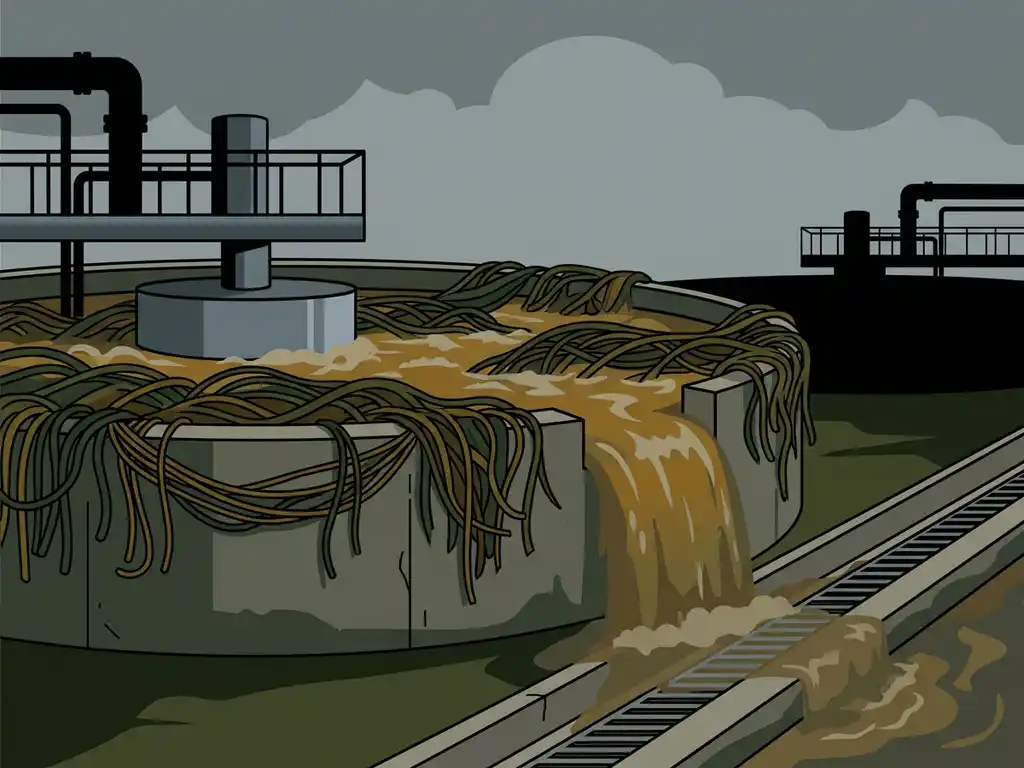
Yes, sludge bulking can directly cause a discharge limit violation. When filamentous bacteria dominate the activated sludge, the biomass loses its ability to settle, solids carry over into the effluent, and suspended solids concentrations in the final discharge spike well above permitted levels. For industrial wastewater systems already operating close to compliance margins, a bulking episode can trigger a regulatory exceedance within days. The sections below address the most common questions operators ask when sludge problems in wastewater treatment escalate toward a violation.
How does sludge bulking affect effluent quality?
Sludge bulking degrades effluent quality by preventing the biomass from settling properly in the secondary clarifier. When sludge does not compact, a layer of poorly settled flocs overflows into the treated effluent, raising suspended solids concentrations, increasing turbidity, and carrying biological oxygen demand (BOD) and nutrients directly into the discharge point.
The mechanism is straightforward: activated sludge treatment depends on two linked steps, biological degradation in the aeration tank and physical separation in the clarifier. Bulking disrupts the second step entirely. Even if the biology is performing well, a clarifier loaded with poorly settling sludge cannot produce clean effluent. The sludge volume index (SVI) climbs, the sludge blanket rises, and eventually biomass washes out. In industrial systems with tight discharge permits, this sequence can move from a warning signal to a confirmed violation in a matter of hours during peak loading periods.
Get in Touch
Let’s Talk Microbial Solutions
Book a conversation with Stijn, our CEO, or send us your request.
| Book an Appointment | Request Information |
What causes sludge bulking in activated sludge systems?
Sludge bulking in activated sludge systems is most commonly caused by the overgrowth of filamentous microorganisms. These bacteria form long thread-like structures that create a loosely knit, voluminous sludge mass that settles poorly. The underlying trigger is nearly always an imbalance in operating conditions rather than a random biological event.
The most frequent root causes include:
- Low dissolved oxygen (DO): Filamentous bacteria have a competitive advantage at low oxygen concentrations. Insufficient aeration selects for them over floc-forming organisms.
- Nutrient imbalance: A carbon-to-nitrogen-to-phosphorus ratio that is out of balance, particularly excess carbon relative to nitrogen, promotes filamentous growth.
- Low organic loading or feast-famine extremes: Systems that experience sudden shifts in influent load, common in food processing facilities with seasonal production cycles, are particularly vulnerable.
- Low pH or temperature fluctuations: These stress floc-forming bacteria more than filamentous species, shifting the competitive balance.
- Poorly designed selector zones: The absence of a contact or selector zone at the inlet of the aeration tank removes a key mechanism for suppressing filamentous growth.
In industrial wastewater systems, the combination of variable influent composition and the absence of dedicated microbiological monitoring creates the conditions for excess sludge problems to develop unnoticed until they are already serious. A microbiological audit of the biological treatment system can identify which filamentous species are dominant and which operating parameter is driving their proliferation.
What are the warning signs of sludge bulking before a violation occurs?
The earliest warning signs of sludge bulking appear in the clarifier and in routine process measurements before effluent quality deteriorates. Catching these signals gives operators a window to correct the problem without reaching a discharge limit violation.
Watch for the following indicators:
- Rising sludge volume index (SVI): An SVI above 150 mL/g is a standard warning threshold. Values above 200 mL/g indicate severe bulking.
- Climbing sludge blanket level: If the blanket in the secondary clarifier rises steadily over several days, settling capacity is being lost.
- Foaming on the aeration tank surface: Certain filamentous organisms, particularly Microthrix parvicella, produce persistent stable foam that is visible before effluent quality declines.
- Increasing effluent turbidity: A gradual rise in treated effluent turbidity, even if still within limits, signals that fine solids are beginning to carry over.
- Microscopic examination showing filament dominance: A simple microscopy check of mixed liquor samples can confirm filamentous overgrowth days before it becomes a compliance issue.
Industrial operators who do not have in-house microbiology capability often miss the microscopy signal entirely, which is why sludge problems in wastewater treatment plants frequently go undetected until effluent quality is already compromised.
Can sludge bulking cause nitrogen or phosphorus limit exceedances?
Yes, sludge bulking can indirectly cause nitrogen and phosphorus limit exceedances, even when the biological nutrient removal process itself is functioning. The connection runs through biomass washout: when sludge is lost over the clarifier weir, the active microbial populations responsible for nitrification and biological phosphorus removal are depleted faster than they can recover.
Nitrifying bacteria are slow-growing and particularly sensitive to washout. If bulking causes a significant loss of biomass from the system, nitrification capacity drops, ammonia concentrations in the effluent rise, and total nitrogen limits are breached. Biological phosphorus removal, which depends on specific polyphosphate-accumulating organisms, is similarly vulnerable to population loss.
For industrial facilities in the food, chemical, or pharmaceutical sectors, where nitrogen and phosphorus loads can spike after production cycles, this combination of bulking and nutrient exceedance creates a compounding compliance risk. Seasonal production patterns that generate high-strength wastewater in short periods are among the most common triggers for exactly this scenario. Addressing the nutrient side of the problem separately, for example through biological nutrient recovery approaches, can reduce the peak load pressure that feeds the bulking cycle.
How can sludge bulking be corrected without shutting down the system?
Sludge bulking can be corrected without shutting down the system in the majority of cases, provided the root cause is identified quickly and targeted interventions are applied. A full system shutdown is rarely necessary and is generally counterproductive because it destroys the remaining active biomass.
Effective corrective actions, applied while the plant remains operational, include:
- Increase dissolved oxygen concentration: Raising aeration capacity reduces the competitive advantage of filamentous organisms and favors floc-forming bacteria.
- Adjust the sludge retention time (SRT): Controlled wasting of excess sludge can reduce the proportion of filamentous biomass over several days, though this must be balanced against the risk of further washout.
- Correct nutrient dosing: Rebalancing the carbon-to-nitrogen-to-phosphorus ratio removes the nutritional driver for filamentous overgrowth.
- Introduce a selector zone: Adding a high-load contact zone at the inlet creates conditions that favor floc-formers over filamentous species.
- Inoculate with active biomass: Introducing a concentrated inoculum of healthy, well-settling sludge accelerates recovery of the floc-forming population.
The timeline for recovery depends on the severity of the bulking episode and the speed of the intervention. Mild cases can stabilize within one to two weeks. Severe washout situations may require several weeks of careful management before the SVI returns to acceptable levels. Technologies such as the ABIL bioaugmentation approach, developed by Avecom, are specifically designed to accelerate the restart or rebalancing of biological treatment systems without requiring a full shutdown.
When should you call in a specialist for a bulking problem?
You should call in a specialist when standard process adjustments have not reversed the bulking trend within one to two weeks, when effluent quality is already approaching or breaching permit limits, or when the root cause of the bulking episode is not clear from routine process data. At that point, continuing to adjust parameters without a firm diagnosis risks making the situation worse.
Specialist intervention is also warranted in the following situations:
- The system has experienced repeated bulking episodes without a clear pattern, suggesting a structural process design issue rather than an operational one.
- Microscopy or molecular analysis is needed to identify which filamentous species are dominant, since different species respond to different corrective strategies.
- The facility lacks in-house microbiological expertise and needs external support to interpret process data and design a recovery plan.
- A regulatory inspection is imminent and documented corrective action is required.
Avecom works with industrial operators across the food, chemical, and pharmaceutical sectors to diagnose and resolve sludge problems in wastewater treatment systems. The approach combines molecular monitoring of microbial communities with practical process adjustments, moving from lab-scale analysis to on-site implementation without disrupting ongoing operations. For facilities dealing with recurring compliance pressure, the starting point is typically a structured microbiological audit rather than an immediate product recommendation. If your system is showing early warning signs or has already triggered an exceedance, the Avecom team can assess the situation and outline a concrete recovery plan.