

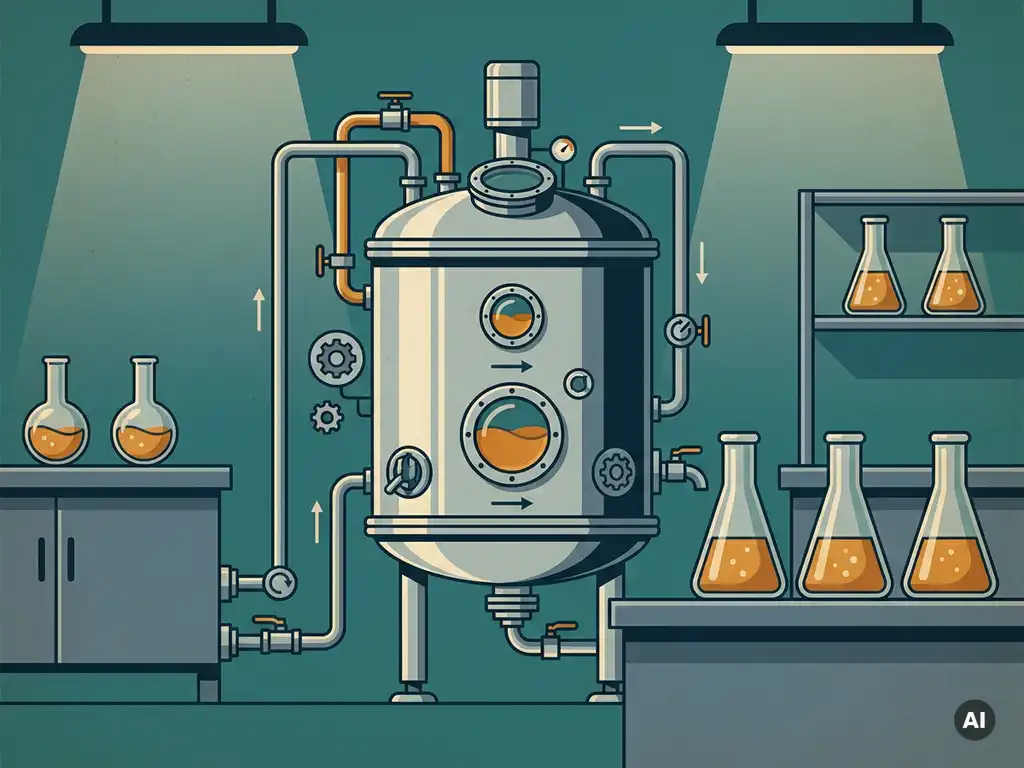
Pilot-scale fermentation is an intermediate stage of process development where a fermentation process is tested in reactors larger than a laboratory bench but smaller than full production scale, typically ranging from tens to thousands of liters. It is the critical bridge between a promising lab result and a commercially viable process. The sections below unpack what happens at this stage, why it matters, and how to approach it effectively.
How does pilot-scale fermentation differ from lab-scale work?
Pilot-scale fermentation operates in reactors that are orders of magnitude larger than lab equipment, and that size difference changes nearly everything about how a process behaves. Where a lab experiment might run in a 1 to 5 liter bioreactor under tightly controlled conditions, a pilot fermentation process typically runs in reactors from 50 to 2,000 liters, introducing physical and biological dynamics that simply do not appear at bench scale.
The most significant differences involve mixing, oxygen transfer, heat distribution, and mass transport. In a small flask or bench-top reactor, a magnetic stirrer can homogenize the contents in seconds and temperature stays uniform throughout. In a larger vessel, achieving the same degree of mixing requires carefully engineered impeller systems, and gradients in pH, dissolved oxygen, and substrate concentration can develop across different zones of the tank. These gradients are not just engineering inconveniences; they directly influence microbial behavior and, ultimately, product yield and quality.
Lab-scale work is designed to answer whether a process is biologically feasible. Pilot-scale fermentation answers whether it is physically and economically reproducible at a meaningful volume. Both questions are essential, but they require different equipment, different analytical tools, and different expertise.
What happens during the scale-up process in fermentation?
Fermentation scale-up is the systematic transfer of a process from lab conditions to larger reactors while preserving the biological performance observed at small scale. It is not a simple matter of using a bigger tank. Each increase in reactor volume requires deliberate re-optimization of process parameters to maintain the conditions that the microbial culture needs to perform consistently.
During scale-up, engineers typically focus on maintaining key dimensionless ratios and physical parameters, such as the volumetric oxygen transfer coefficient in aerobic processes, agitation power per unit volume, and mixing time. Feeding strategies, pH control loops, and temperature management all need to be re-evaluated because the dynamics of a large vessel respond more slowly and less uniformly than a small one.
For processes involving mixed microbial cultures rather than single strains, scale-up adds another layer of complexity. The composition and activity of a microbial community can shift in response to subtle environmental changes, so monitoring tools such as amplicon sequencing and qPCR become important for tracking whether the community structure at pilot scale matches what was established in the lab. This kind of microbiome monitoring is central to the fermentation development work carried out at Avecom, where mixed cultures are a deliberate design choice rather than a complication to be avoided.
Scale-up typically proceeds in stages rather than one large jump, with each intermediate scale providing data that informs the next step. This staged approach reduces risk and generates the process understanding needed to move confidently toward production.
{div style=”box-sizing: border-box !important; margin: 32px 0 !important; padding: 28px 32px !important; background-color: #004070 !important; background-image: linear-gradient(135deg, #004070 0%, #003057 100%) !important; border: none !important; border-left: 4px solid #36a9e1 !important; font-family: ‘Exo’, sans-serif !important; text-align: center !important; line-height: normal !important;”}
{p style=”margin: 0 0 6px 0 !important; padding: 0 !important; font-family: ‘Exo’, sans-serif !important; font-size: 12px !important; font-weight: 500 !important; color: #36a9e1 !important; text-transform: uppercase !important; letter-spacing: 1.5px !important; line-height: 16px !important;”}Get in Touch{/p}
{p style=”margin: 0 0 8px 0 !important; padding: 0 !important; font-family: ‘Exo’, sans-serif !important; font-size: 20px !important; font-weight: 500 !important; color: #ffffff !important; line-height: 26px !important;”}Let’s Talk Microbial Solutions{/p}
{p style=”margin: 0 0 20px 0 !important; padding: 0 !important; font-family: ‘Exo’, sans-serif !important; font-size: 14px !important; font-weight: 300 !important; color: #ffffff !important; line-height: 20px !important;”}Book a conversation with Stijn, our CEO, or send us your request.{/p}
{table style=”border-collapse: collapse !important; border-spacing: 0 !important; margin: 0 auto !important; padding: 0 !important; width: auto !important;” cellpadding=”0″ cellspacing=”0″ role=”presentation”}
{tr style=”margin: 0 !important; padding: 0 !important;”}
{td style=”margin: 0 !important; padding: 0 6px 0 0 !important; white-space: nowrap !important;”}
{a href=”https://avecom.be/contact-2/” style=”display: inline-block !important; box-sizing: border-box !important; margin: 0 !important; padding: 11px 24px !important; background-color: #95c11f !important; color: #ffffff !important; font-family: ‘Exo’, sans-serif !important; font-size: 14px !important; font-weight: 500 !important; text-transform: uppercase !important; text-decoration: none !important; border: none !important; line-height: 18px !important; letter-spacing: 0.3px !important; white-space: nowrap !important;”}Book an Appointment{/a}
{/td}
{td style=”margin: 0 !important; padding: 0 !important; white-space: nowrap !important;”}
{a href=”https://avecom.callista.be/contactus” style=”display: inline-block !important; box-sizing: border-box !important; margin: 0 !important; padding: 9px 24px !important; background-color: transparent !important; color: #ffffff !important; font-family: ‘Exo’, sans-serif !important; font-size: 14px !important; font-weight: 500 !important; text-transform: uppercase !important; text-decoration: none !important; border: 2px solid #ffffff !important; line-height: 18px !important; letter-spacing: 0.3px !important; white-space: nowrap !important;”}Request Information{/a}
{/td}
{/tr}
{/table}
{/div}
Why do fermentation processes fail when scaled up?
Fermentation scale-up failures most commonly occur because process parameters that were incidentally controlled at lab scale become uncontrolled at larger volumes. The lab environment is forgiving in ways that are easy to overlook, and those hidden assumptions surface as performance problems the moment the process moves to a larger reactor.
The most frequent root causes include:
- Oxygen transfer limitations: In aerobic fermentations, supplying sufficient dissolved oxygen becomes progressively harder as reactor volume increases. If the oxygen transfer rate cannot keep pace with microbial demand, productivity drops or the culture shifts toward undesirable metabolic pathways.
- Mixing and gradient formation: Larger vessels develop concentration gradients in substrate, pH, and temperature. Microorganisms experience fluctuating local conditions rather than the uniform environment they encountered in the lab, which can suppress growth or alter the product profile.
- Insufficient process understanding: Many lab-scale processes are optimized empirically without a mechanistic understanding of why they work. Without that understanding, there is no reliable basis for predicting how the process will behave when physical conditions change at larger scale.
- Inoculum quality and consistency: The seed culture used to start a fermentation must be robust and reproducible. At lab scale, small inconsistencies in inoculum quality are often masked by the short run times and small volumes involved. At pilot scale, they become significant sources of variability.
- Contamination control: Maintaining sterility or selective conditions becomes more challenging as vessel size and process duration increase, particularly for processes that rely on open or mixed microbial systems.
Understanding which of these factors is most likely to limit a specific process is one of the core tasks of pilot-scale fermentation. Running experiments at intermediate scale, with proper instrumentation and analytical support, generates the data needed to diagnose and address these issues before they cause costly failures at production scale.
What data does pilot-scale fermentation generate?
Pilot-scale fermentation generates the process characterization data required to define robust operating conditions and to build a credible case for scale-up to production. These data cover both the physical performance of the reactor system and the biological performance of the microbial culture.
On the engineering side, key measurements include dissolved oxygen profiles, pH trajectories, temperature gradients, agitation power draw, gas flow rates, and substrate consumption over time. These parameters reveal how well the reactor delivers the conditions the microorganisms need and where the process is sensitive to variation.
On the biological side, pilot runs provide data on growth kinetics, product formation rates, yield coefficients, and, for mixed culture processes, community composition over time. Molecular tools such as amplicon sequencing allow researchers to track shifts in microbial community structure and link them to changes in process performance, providing a level of process insight that offline sampling alone cannot deliver.
Together, this dataset serves multiple practical purposes. It supports process optimization by identifying which parameters have the greatest influence on yield and consistency. It provides the technical documentation needed for regulatory submissions, patent applications, and investor due diligence. And it gives engineering teams the confidence to specify equipment and operating procedures for a production-scale facility, knowing that the process has been validated under realistic conditions.
When should a company invest in pilot-scale fermentation?
A company should invest in pilot-scale fermentation when lab results are sufficiently reproducible to justify the cost of larger-scale validation, and when the commercial or technical stakes of moving directly to production are too high to accept without intermediate proof. In practice, this moment typically arrives after a stable, productive process has been demonstrated at bench scale across multiple independent runs.
For companies developing new fermentation-based products, the decision is also shaped by external pressures. Investors and commercial partners increasingly expect proof of concept at meaningful scale before committing to further funding or offtake agreements. A robust pilot dataset is often the deciding factor in those conversations.
Pilot-scale investment is particularly warranted when:
- The process involves complex or sensitive microbial systems where scale-up behavior is difficult to predict from first principles
- The target product has strict quality or purity requirements that must be demonstrated under realistic production conditions
- The process uses novel substrates or feedstocks whose behavior at scale is not well characterized
- Regulatory approval or certification requires documented process validation at a defined scale
- The company needs to establish process IP before entering licensing or partnership discussions
For organizations without their own fermentation infrastructure, partnering with a contract fermentation facility is usually the most time- and cost-efficient path. Building dedicated pilot plant capacity internally carries significant capital and operational costs, and the expertise required to run it effectively takes years to develop. An external partner with existing infrastructure and specialist knowledge can compress the timeline considerably.
What should you look for in a pilot-scale fermentation partner?
A strong pilot-scale fermentation partner combines the right physical infrastructure with genuine process expertise and a track record of translating lab concepts into scalable, well-characterized processes. The facility matters, but the scientific depth behind it matters more.
When evaluating a contract fermentation partner, consider the following criteria:
- Reactor range and flexibility: The partner should operate bioreactors that span the scale you need, with the ability to run aerobic and anaerobic processes, batch and continuous modes, and a range of temperature conditions. Flexibility in reactor configuration reduces the need to switch partners as your process evolves.
- Analytical capability: Pilot-scale work only generates value if it is accompanied by rigorous measurement. Look for partners with in-house capacity for process analytics and, where relevant, molecular microbiology tools such as qPCR and sequencing for community characterization.
- Scientific engagement: The best partners do not simply run your protocol and report results. They bring process knowledge to the collaboration, identify potential failure modes in advance, and contribute to experimental design. This is especially important when the process involves mixed microbial cultures or novel substrates where established protocols do not exist.
- IP and confidentiality practices: Pilot-scale development involves sharing sensitive process information. A reputable partner will have clear contractual frameworks for IP ownership and confidentiality, and will be transparent about how your data and process knowledge are handled.
- Regulatory and quality credentials: Depending on your target application, the partner may need relevant certifications. For food and feed applications, for example, quality management systems and appropriate feed chain certifications are important indicators of process discipline.
Avecom operates as this kind of specialist partner, running aerobic and anaerobic fermenters up to 2,000 liters alongside dedicated downstream processing equipment, and bringing over 30 years of experience in mixed microbial culture processes. As a Ghent University spin-off, the team combines academic rigor with practical industrial experience, which is a combination that matters when a process is genuinely novel and the path to scale-up is not yet mapped.
Related Articles
- What is the biggest risk of ignoring sludge bulking in a wastewater plant?
- What does a contract fermentation manufacturer actually do?
- How do you compare fermentation partners before signing a contract?
- What does a soil contamination assessment involve?
- What methods are used to assess soil contamination?