

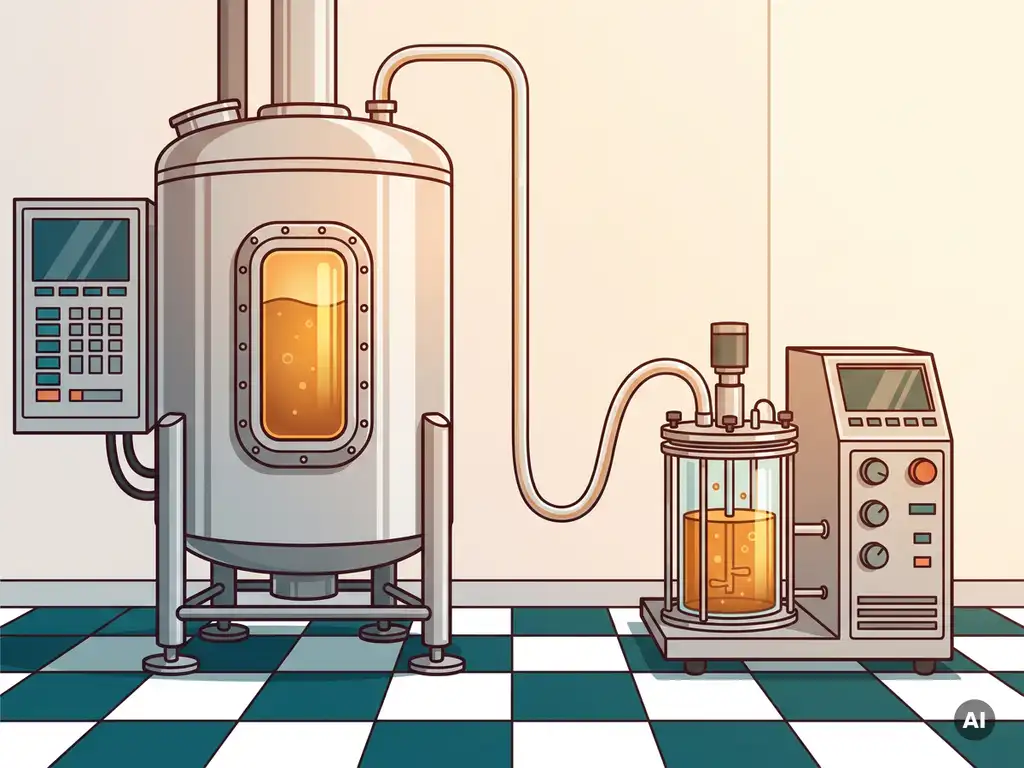
Technology transfer in fermentation scale-up is the structured process of moving a microbial process from one development stage to the next, typically from laboratory to pilot scale, or from pilot to production, while preserving the biological performance and product quality established at the smaller scale. It involves far more than simply running the same process in a bigger vessel. Every parameter that influenced microbial behavior at lab scale must be understood, documented, and deliberately re-established under new physical and engineering conditions. The sections below address the most common questions companies face when navigating this process.
What actually happens during a fermentation technology transfer?
A fermentation technology transfer is the systematic handover of a defined microbial process from one team, facility, or scale to another. It encompasses the documentation of process parameters, the qualification of receiving equipment, the execution of comparative runs, and the verification that the transferred process performs within agreed specifications at its new location or scale.
In practice, a transfer begins with a thorough characterization of the sending process. Every variable that affects microbial behavior, temperature, pH, dissolved oxygen, feeding strategy, inoculum preparation, and more, must be captured in a process description that is both complete and reproducible. Without this foundation, the receiving team is essentially starting from scratch.
Once documentation is in place, the receiving facility runs a series of qualification batches. These runs confirm that the new equipment can replicate the critical conditions established at the source scale. Deviations are investigated, process parameters are adjusted where necessary, and the results are compared against predefined acceptance criteria. Only when those criteria are consistently met is the transfer considered complete.
For companies working with microbial fermentation processes, this handover phase is often where the complexity of mixed microbial cultures becomes apparent. Unlike pure-culture systems, mixed consortia respond to subtle shifts in process conditions in ways that require both molecular monitoring tools and deep process understanding to interpret correctly.
{div style=”box-sizing: border-box !important; margin: 32px 0 !important; padding: 28px 32px !important; background-color: #004070 !important; background-image: linear-gradient(135deg, #004070 0%, #003057 100%) !important; border: none !important; border-left: 4px solid #36a9e1 !important; font-family: ‘Exo’, sans-serif !important; text-align: center !important; line-height: normal !important;”}
{p style=”margin: 0 0 6px 0 !important; padding: 0 !important; font-family: ‘Exo’, sans-serif !important; font-size: 12px !important; font-weight: 500 !important; color: #36a9e1 !important; text-transform: uppercase !important; letter-spacing: 1.5px !important; line-height: 16px !important;”}Get in Touch{/p}
{p style=”margin: 0 0 8px 0 !important; padding: 0 !important; font-family: ‘Exo’, sans-serif !important; font-size: 20px !important; font-weight: 500 !important; color: #ffffff !important; line-height: 26px !important;”}Let’s Talk Microbial Solutions{/p}
{p style=”margin: 0 0 20px 0 !important; padding: 0 !important; font-family: ‘Exo’, sans-serif !important; font-size: 14px !important; font-weight: 300 !important; color: #ffffff !important; line-height: 20px !important;”}Book a conversation with Stijn, our CEO, or send us your request.{/p}
{table style=”border-collapse: collapse !important; border-spacing: 0 !important; margin: 0 auto !important; padding: 0 !important; width: auto !important;” cellpadding=”0″ cellspacing=”0″ role=”presentation”}
{tr style=”margin: 0 !important; padding: 0 !important;”}
{td style=”margin: 0 !important; padding: 0 6px 0 0 !important; white-space: nowrap !important;”}
{a href=”https://avecom.be/contact-2/” style=”display: inline-block !important; box-sizing: border-box !important; margin: 0 !important; padding: 11px 24px !important; background-color: #95c11f !important; color: #ffffff !important; font-family: ‘Exo’, sans-serif !important; font-size: 14px !important; font-weight: 500 !important; text-transform: uppercase !important; text-decoration: none !important; border: none !important; line-height: 18px !important; letter-spacing: 0.3px !important; white-space: nowrap !important;”}Book an Appointment{/a}
{/td}
{td style=”margin: 0 !important; padding: 0 !important; white-space: nowrap !important;”}
{a href=”https://avecom.callista.be/contactus” style=”display: inline-block !important; box-sizing: border-box !important; margin: 0 !important; padding: 9px 24px !important; background-color: transparent !important; color: #ffffff !important; font-family: ‘Exo’, sans-serif !important; font-size: 14px !important; font-weight: 500 !important; text-transform: uppercase !important; text-decoration: none !important; border: 2px solid #ffffff !important; line-height: 18px !important; letter-spacing: 0.3px !important; white-space: nowrap !important;”}Request Information{/a}
{/td}
{/tr}
{/table}
{/div}
Why do fermentation processes fail when scaled up?
Fermentation scale-up failures most commonly occur because physical conditions inside a larger bioreactor are fundamentally different from those in a lab flask or benchtop fermenter, even when the nominal process settings appear identical. Mixing efficiency, oxygen transfer rates, heat distribution, and shear forces all change as vessel volume increases, and microorganisms respond to those changes in ways that can significantly alter productivity or product quality.
Several specific mechanisms drive these failures:
- Oxygen transfer limitations: A lab shaker or small stirred-tank fermenter can maintain dissolved oxygen levels that a larger vessel struggles to replicate without substantial engineering adjustments to agitation speed and aeration rate.
- Mixing gradients: At larger scales, nutrients and pH-correcting agents do not distribute instantaneously. Microorganisms in different zones of the reactor may experience very different local conditions, leading to inconsistent performance.
- Heat management: Metabolic heat generated by microbial activity becomes harder to remove efficiently as volume increases, causing temperature fluctuations that stress the culture.
- Inoculum quality: An inoculum preparation protocol that works reliably at lab scale may not translate directly to a larger seed fermenter, resulting in poor growth kinetics from the outset.
- Underdefined process parameters: If the lab-scale process was never fully characterized, the team transferring it has no reliable baseline to compare against at pilot scale.
The last point is particularly important. Scale-up challenges are often attributed to engineering factors when the real problem is that the process was never sufficiently understood at the smaller scale. A thorough bioprocess characterization before any scale transition is the most effective way to reduce the risk of failure during fermentation development.
{div style=”box-sizing: border-box !important; margin: 32px 0 !important; padding: 28px 32px !important; background-color: #004070 !important; background-image: linear-gradient(135deg, #004070 0%, #003057 100%) !important; border: none !important; border-left: 4px solid #36a9e1 !important; font-family: ‘Exo’, sans-serif !important; text-align: center !important; line-height: normal !important;”}
{p style=”margin: 0 0 6px 0 !important; padding: 0 !important; font-family: ‘Exo’, sans-serif !important; font-size: 12px !important; font-weight: 500 !important; color: #36a9e1 !important; text-transform: uppercase !important; letter-spacing: 1.5px !important; line-height: 16px !important;”}Get in Touch{/p}
{p style=”margin: 0 0 8px 0 !important; padding: 0 !important; font-family: ‘Exo’, sans-serif !important; font-size: 20px !important; font-weight: 500 !important; color: #ffffff !important; line-height: 26px !important;”}Let’s Talk Microbial Solutions{/p}
{p style=”margin: 0 0 20px 0 !important; padding: 0 !important; font-family: ‘Exo’, sans-serif !important; font-size: 14px !important; font-weight: 300 !important; color: #ffffff !important; line-height: 20px !important;”}Book a conversation with Stijn, our CEO, or send us your request.{/p}
{table style=”border-collapse: collapse !important; border-spacing: 0 !important; margin: 0 auto !important; padding: 0 !important; width: auto !important;” cellpadding=”0″ cellspacing=”0″ role=”presentation”}
{tr style=”margin: 0 !important; padding: 0 !important;”}
{td style=”margin: 0 !important; padding: 0 6px 0 0 !important; white-space: nowrap !important;”}
{a href=”https://avecom.be/contact-2/” style=”display: inline-block !important; box-sizing: border-box !important; margin: 0 !important; padding: 11px 24px !important; background-color: #95c11f !important; color: #ffffff !important; font-family: ‘Exo’, sans-serif !important; font-size: 14px !important; font-weight: 500 !important; text-transform: uppercase !important; text-decoration: none !important; border: none !important; line-height: 18px !important; letter-spacing: 0.3px !important; white-space: nowrap !important;”}Book an Appointment{/a}
{/td}
{td style=”margin: 0 !important; padding: 0 !important; white-space: nowrap !important;”}
{a href=”https://avecom.callista.be/contactus” style=”display: inline-block !important; box-sizing: border-box !important; margin: 0 !important; padding: 9px 24px !important; background-color: transparent !important; color: #ffffff !important; font-family: ‘Exo’, sans-serif !important; font-size: 14px !important; font-weight: 500 !important; text-transform: uppercase !important; text-decoration: none !important; border: 2px solid #ffffff !important; line-height: 18px !important; letter-spacing: 0.3px !important; white-space: nowrap !important;”}Request Information{/a}
{/td}
{/tr}
{/table}
{/div}
What process parameters must be defined before technology transfer begins?
Before a microbial process transfer can begin, the following parameters must be clearly defined and documented: temperature setpoint and acceptable range, pH control strategy, dissolved oxygen target and control method, agitation profile, aeration rate, feeding regime (for fed-batch processes), inoculum preparation protocol, and the criteria used to assess process performance and product quality.
Beyond these operational parameters, two additional categories of information are essential. First, the process must have defined critical process parameters, those variables whose deviation from the setpoint directly affects the outcome, distinguished from parameters that are monitored but have less impact on performance. This distinction guides where engineering effort should be focused during scale-up.
Second, the process needs clearly stated acceptance criteria: measurable targets for yield, productivity, product concentration, or microbial community composition that define what “success” looks like at the receiving scale. Without these, qualification runs at pilot scale have no objective endpoint, and the transfer process can drag on indefinitely.
For processes involving mixed microbial cultures, the characterization work is more demanding. Community composition, functional stability across repeated batches, and response to perturbations all need to be understood before scale transition. Molecular tools such as amplicon sequencing and qPCR play a practical role here, providing quantitative data on community dynamics that visual or chemical measurements alone cannot capture.
What’s the difference between lab-scale, pilot-scale, and production-scale fermentation?
Lab-scale fermentation typically takes place in vessels ranging from a few hundred milliliters to roughly 10 liters. It is used for process development, parameter screening, and feasibility testing. Pilot-scale fermentation bridges lab and production, usually operating between 50 and 2,000 liters, and is used to validate that a process performs consistently under conditions closer to industrial reality. Production scale refers to the full commercial volume at which a product is manufactured for market.
Each scale serves a distinct purpose in the development pathway:
- Lab scale is where the process concept is proven and parameters are explored. Speed and flexibility matter here; reproducibility and documentation become important as the process matures.
- Pilot scale is where engineering reality meets biology. The goal is to demonstrate that the process can be controlled reliably in equipment that resembles, in design if not in volume, what production will use. This is also where process economics become visible for the first time.
- Production scale is where the process must perform consistently, batch after batch, within regulatory and quality constraints.
The transition between each scale is not automatic. Each step up introduces new engineering variables, and the assumptions valid at one scale often need revision at the next. This is why pilot-scale validation is not a formality, it is the stage where scale-up challenges surface before they become costly production failures.
When should a company use a contract development organization for scale-up?
A company should consider working with a contract development organization (CDO) for fermentation scale-up when it lacks the bioreactor infrastructure, analytical capabilities, or process expertise to execute the scale transition internally within a realistic timeframe. This situation is common for biotech scale-ups, food ingredient producers, and industrial companies that have developed a promising microbial concept in-house but do not have a pilot plant available.
Several specific triggers indicate that external support is the right choice:
- The internal lab can handle small-scale experiments but has no fermenters above 10 liters
- The team has strong scientific expertise but limited bioprocess engineering experience
- Investors or customers require a proof-of-concept at pilot scale within 6 to 12 months
- The process involves complex microbial communities that require specialized monitoring tools
- Building or acquiring pilot-scale infrastructure would delay the project by one to two years
Working with an experienced partner allows a company to access validated infrastructure immediately, compress the development timeline, and generate the data needed for investor presentations, regulatory submissions, or patent applications. The arrangement works best when the CDO operates as a genuine extension of the internal R&D team rather than a black-box service provider, sharing data, discussing results openly, and adapting the experimental strategy as the process evolves.
Avecom operates in exactly this way, functioning as an external fermentation expertise center for companies that need pilot-scale capability without the capital investment of building their own facility.
How long does a fermentation technology transfer typically take?
A fermentation technology transfer typically takes between three and twelve months, depending on how well the process is characterized at the outset, the complexity of the microbial system involved, and the number of scale transitions required. A straightforward transfer of a well-documented single-organism process to an already-qualified facility can be completed in a matter of weeks. Transfers involving mixed cultures, novel substrates, or poorly defined processes take considerably longer.
The main factors that extend timelines are:
- Incomplete process documentation: If the sending team cannot provide a complete process description, the receiving team must reverse-engineer the critical parameters before transfer can begin.
- Process instability: A process that is not yet robust at lab scale will not become more robust simply by moving to a larger vessel. Stability issues must be resolved before transfer.
- Equipment qualification gaps: If the receiving facility’s bioreactors have not been qualified for the specific process conditions required, qualification work adds time before comparative runs can begin.
- Acceptance criteria that are too broad or undefined: Without clear targets, it is difficult to declare the transfer complete with confidence.
In practice, the most reliable way to compress the timeline is to invest in thorough process characterization before the transfer begins. Companies that arrive at the pilot stage with well-documented lab-scale data, defined critical parameters, and clear acceptance criteria consistently complete their scale-up faster than those that attempt to resolve process understanding issues at pilot scale, where experiments are more expensive and turnaround times are longer.