

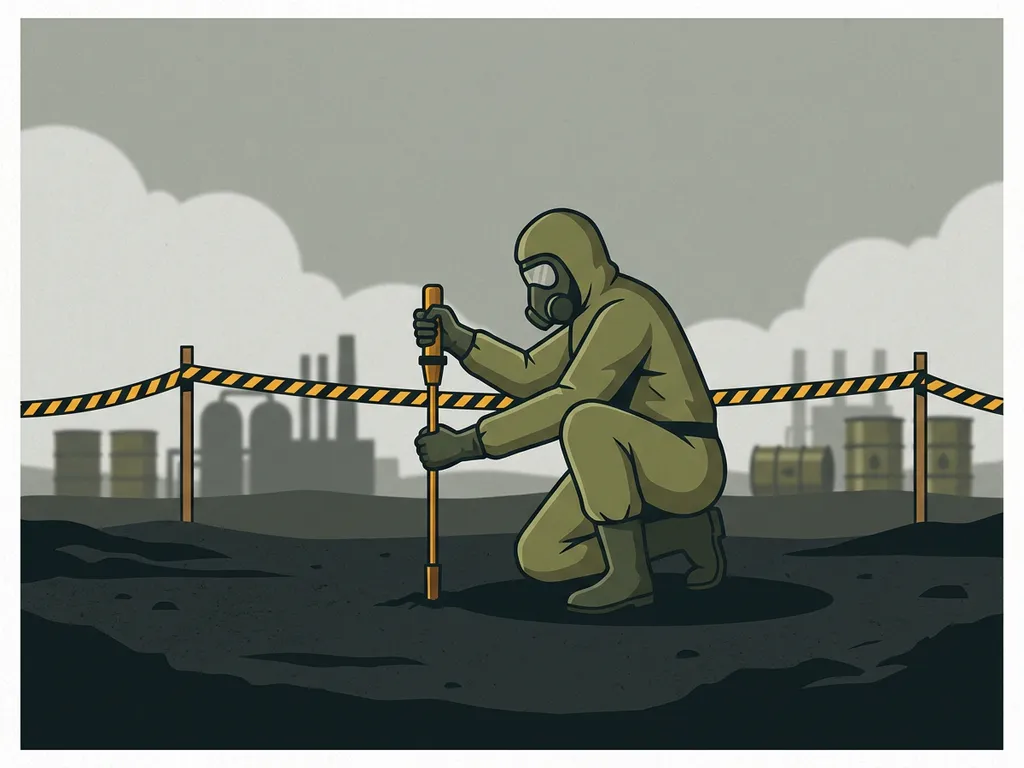
When contamination is found on a site in Flanders, the landowner or the party responsible for the pollution has a legal obligation to report it, commission a soil investigation, and, depending on the findings, develop and execute a remediation plan in accordance with VLAREBO and OVAM requirements. These obligations apply regardless of whether you intend to develop, sell, or simply hold the land.
The Flemish soil decree (Bodemdecreet) and its implementing regulation VLAREBO set out a structured process that moves from notification through investigation to remediation. The timeline and specific duties depend on the type of contamination, the risk it poses, and the intended land use. The sections below walk through each of the most common legal questions site owners and project managers face once contamination has been confirmed.
Who is legally responsible when contamination is discovered on a site?
Under Flemish soil law, legal responsibility for contaminated soil rests primarily with the polluter – the party whose activities caused the contamination. If the polluter cannot be identified or held accountable, the obligation shifts to the current owner or user of the land. In practice, this means that purchasing a contaminated site can transfer significant legal and financial liability to the new owner.
This distinction matters enormously in real estate transactions and brownfield redevelopment. A buyer who acquires a site without a proper soil investigation may inherit remediation obligations that were not priced into the deal. Developers, municipalities, and industrial companies that take ownership of previously used land should treat a soil status check as a non-negotiable step in due diligence.
There is also a category of risk-based responsibility: even a landowner who did not cause the pollution may be required to take protective measures if the contamination poses an immediate risk to human health or the environment. OVAM can intervene directly if a responsible party fails to act.
Get in Touch
Let’s Talk Microbial Solutions
Book a conversation with Stijn, our CEO, or send us your request.
| Book an Appointment | Request Information |
What must you report to OVAM after finding contamination?
If contamination is discovered unexpectedly during construction, excavation, or any ground-disturbing activity, you are legally required to notify OVAM without undue delay. The notification must describe the nature and apparent extent of the contamination, the circumstances of the discovery, and any immediate measures taken to prevent further spread.
OVAM will assess the notification and determine whether an exploratory soil investigation (oriënterend bodemonderzoek) is required, or whether the situation warrants more urgent action. Failing to report known contamination is a regulatory violation and can result in enforcement action, including fines and compulsory remediation orders.
For sites that are already registered in the OVAM soil register (grondeninformatieregister), the reporting obligations are often triggered earlier, for example, when a change of use, a transfer of ownership, or a building permit application is initiated. In those cases, a soil certificate must be obtained before the transaction or permit can proceed.
What is a soil investigation and when is it legally required?
A soil investigation is a structured assessment of the type, concentration, and spatial distribution of contaminants in the soil and groundwater of a site. Under Flemish law, two levels of investigation are defined: an exploratory soil investigation (oriënterend bodemonderzoek), which establishes whether contamination is present and whether it exceeds threshold values, and a descriptive soil investigation (beschrijvend bodemonderzoek), which maps the contamination in detail and assesses the associated risks.
A soil investigation is legally required in several situations:
- When a site with a history of potentially polluting activities is transferred or sold
- When a building permit is requested for a site that appears in the OVAM risk register
- When contamination is discovered during works
- When OVAM issues an obligation based on a site’s risk classification
- When a change of land use is planned for a historically industrial or commercial parcel
To determine whether soil is contaminated, the investigation typically involves soil sampling at defined depths, groundwater monitoring wells, and laboratory analysis for relevant contaminants – such as heavy metals, mineral oils, or chlorinated solvents. The choice of analytical parameters depends on the historical use of the site and the suspected contamination profile.
How long do you have to start remediation after contamination is confirmed?
Once a descriptive soil investigation confirms that contamination exceeds the intervention values set by VLAREBO, the responsible party must submit a remediation project (bodemsaneringsproject) to OVAM within a legally defined timeframe. In most cases, this is within three years of the date on which the obligation to remediate was formally established, though OVAM can impose shorter deadlines when the contamination poses an acute risk.
The remediation project must be developed by a certified soil remediation expert (bodemsaneringsdeskundige) and must demonstrate that the proposed approach will achieve the applicable cleanup standards within a reasonable and agreed timeframe. OVAM reviews and approves the project before works can begin.
It is worth noting that the clock does not always start at the moment contamination is physically discovered. For sites already in the OVAM register, obligations may have been triggered earlier, for example, at the time of a soil certificate request. Project managers and site owners should verify the status of their parcel in the register as early as possible to avoid unexpected deadline pressure.
What remediation methods are accepted under Flemish soil law?
Flemish soil law does not prescribe a single remediation technology. The remediation project must demonstrate that the chosen method is technically feasible, proportionate to the risk, and capable of achieving the applicable cleanup targets. Both in-situ (treating contamination in place) and ex-situ (excavation and off-site treatment) approaches are accepted, provided they meet these criteria.
Commonly accepted methods include excavation and disposal, soil washing, pump-and-treat systems for groundwater, thermal treatment, chemical oxidation, and biological remediation. For contaminated soil where excavation is technically impossible or disproportionately expensive, for example, beneath existing structures or in areas with high groundwater tables, in-situ biological remediation is increasingly applied and accepted by OVAM, provided its feasibility is demonstrated.
For persistent contaminants such as chlorinated solvents (VOCl), biological degradation through a process called reductive dechlorination is a well-established approach. Avecom’s biological soil remediation services are specifically designed for these complex contamination profiles, combining microcosm feasibility testing with in-situ bioaugmentation and molecular monitoring. The key requirement from a regulatory standpoint is that the chosen method is supported by site-specific data, which is precisely what a microcosm test provides before full-scale works begin.
Whatever method is selected, the remediation project must include a monitoring plan that tracks progress against agreed milestones and reports results to OVAM at defined intervals.
What happens if remediation targets are not met on time?
If a remediation project fails to achieve its targets within the agreed timeframe, the responsible party must notify OVAM and submit a revised plan. OVAM will assess whether the delay is due to technical limitations, changed site conditions, or a failure to implement the approved approach, and will determine the appropriate response accordingly.
In cases where the contamination continues to pose a risk and the responsible party is not making adequate progress, OVAM has the authority to intervene directly – commissioning remediation works at the expense of the responsible party, or imposing administrative enforcement measures. Persistent non-compliance can also affect the ability to obtain future permits or transfer the site.
This regulatory exposure is one reason why the choice of remediation method matters beyond technical performance. A method that looks cost-effective on paper but fails to deliver results on schedule can generate significant downstream costs, in monitoring, revised project submissions, and potential enforcement. For complex contamination, such as contamination found on industrial sites with deep chlorinated solvent plumes, specialist biological approaches that are grounded in prior feasibility testing tend to carry lower execution risk than methods applied without site-specific validation.
If you are managing a site where the steps after soil contamination was found have stalled, whether due to technical obstacles, inconclusive investigations, or methods that have not delivered, Avecom offers an independent scientific perspective and practical remediation expertise. With more than 30 years of experience in microbial process management, the team at Avecom works with project managers, environmental coordinators, and site owners to assess what is technically feasible and what the regulatory path forward looks like, before committing to a full remediation programme.