

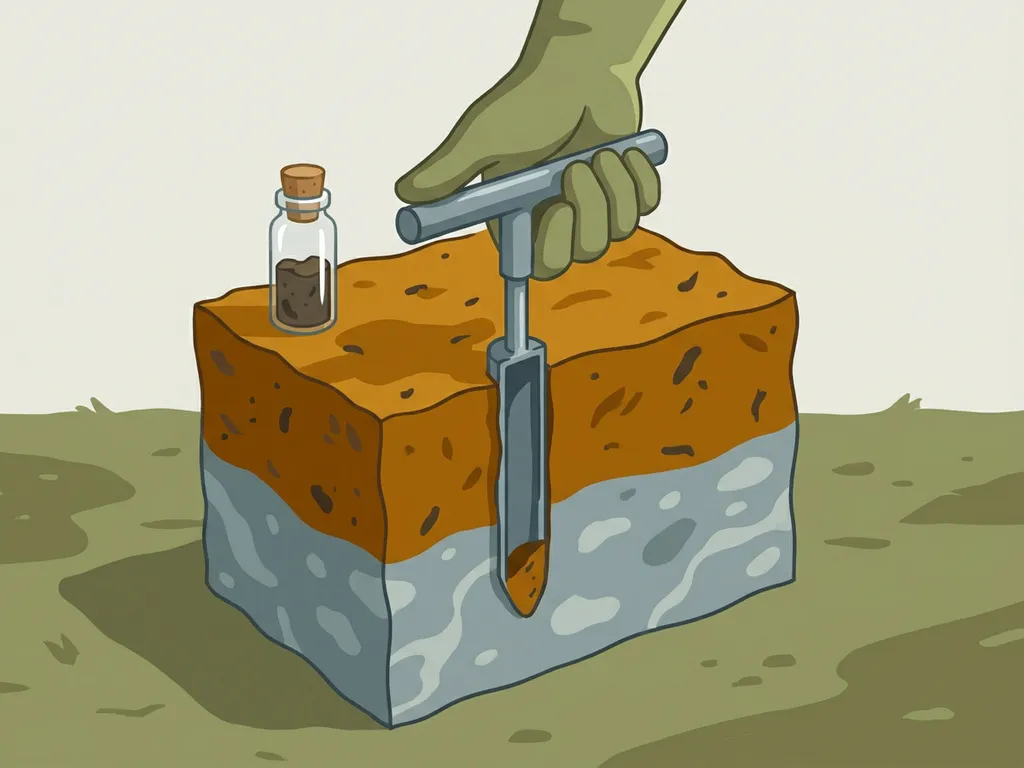
You should test your land for soil contamination before any development, sale, or change of use — and immediately if you have reason to believe the site has an industrial history or visible signs of pollution. For property developers, municipalities, and brownfield owners, testing is not optional: it is the legal and financial foundation of any responsible land transaction or construction project. This article walks through the key questions every site owner or project manager needs answered before breaking ground.
What are the most common signs of soil contamination on a site?
The most common signs of soil contamination include discolored or stained soil, unusual odors, dead or stunted vegetation in localized patches, oily sheens on standing water, and a history of industrial or chemical activity on the site. Any one of these indicators warrants professional investigation before proceeding with development or sale.
Visual and olfactory clues are often the first warning. Soil that appears dark, oily, or inconsistent in color compared to surrounding areas may indicate petroleum products, heavy metals, or chemical solvents. A sharp chemical smell — particularly near drainage channels or former storage areas — is a serious red flag.
Site history is equally important. Land that previously hosted a dry cleaner, petrol station, factory, or waste disposal operation carries a significantly elevated contamination risk, even if no visible signs remain. Chlorinated solvents, for instance, are colorless and odorless in groundwater, making them undetectable without laboratory testing. These compounds, known as volatile organochlorines (VOCl), are among the most persistent and legally consequential contaminants found in European brownfield sites today.
If you are assessing a site with any industrial past, do not rely on visual inspection alone. Subsurface contamination often shows no surface symptoms until it has migrated into groundwater or adjacent properties.
Get in Touch
Let’s Talk Microbial Solutions
Book a conversation with Stijn, our CEO, or send us your request.
| Book an Appointment | Request Information |
Who is legally responsible for testing contaminated land?
Legal responsibility for testing contaminated land typically falls on the current landowner, the party seeking a permit or change of land use, or — depending on jurisdiction — the original polluter. In Flanders, Belgium, the VLAREBO decree and OVAM regulations place a clear obligation on landowners and developers to demonstrate soil quality before construction, sale, or rezoning can proceed.
In practice, this means that if you are purchasing a brownfield site, commissioning a new building, or applying for a change of use, you are legally required to obtain a soil investigation report. Ignorance of prior contamination does not exempt a buyer from liability once ownership transfers.
For municipalities and intercommunal agencies managing public land, the obligation is equally firm. Any remediation plan must be documented, monitored, and reported to the competent authority. Failing to comply can block planning permissions, delay sales, and expose responsible parties to significant financial and legal consequences.
If you are uncertain about your specific obligations, a qualified environmental consultant or a specialist in biological soil remediation can help you map the regulatory requirements for your site and jurisdiction before you commit to any remediation pathway.
What happens if you build on contaminated land without testing?
Building on contaminated land without prior testing exposes developers and landowners to serious legal liability, financial penalties, and the risk of having construction halted or reversed. Beyond regulatory consequences, undetected contamination can compromise the structural integrity of buildings, endanger occupants, and create long-term groundwater pollution that spreads to neighboring properties.
From a legal standpoint, regulators can require full remediation at the developer’s cost — even after construction is complete. In some cases, buildings must be demolished to access and treat contamination beneath the foundations. These costs routinely exceed the original savings made by skipping the investigation phase.
There are also commercial risks. Property valuations, mortgage approvals, and insurance policies are increasingly contingent on clean soil certification. A site with unknown contamination status is effectively unsellable in many markets. Investors and public-sector partners are now conducting their own due diligence, and a missing or inadequate soil report will surface during that process.
The financial logic is straightforward: a soil investigation conducted before development costs a fraction of the remediation bill that follows a regulatory enforcement action or a post-construction discovery.
How does a soil contamination test actually work?
A soil contamination test involves systematic sampling of soil and groundwater across a site, followed by laboratory analysis to identify and quantify pollutants. The process typically begins with a desk study of the site’s history, followed by field sampling at targeted locations, and concludes with a laboratory report that maps contaminant types, concentrations, and spatial distribution.
Phase 1: Desk study and site reconnaissance
Before any drilling begins, investigators review historical maps, aerial photographs, planning records, and industrial registers to identify potential contamination sources. This phase defines where sampling is most likely to reveal problems and helps prioritize resources efficiently.
Phase 2: Field sampling and laboratory analysis
Soil cores are extracted from multiple depths at strategic locations across the site. Groundwater monitoring wells are installed where subsurface migration is a concern. Samples are sent to an accredited laboratory for chemical analysis, which may include tests for heavy metals, petroleum hydrocarbons, chlorinated solvents, pesticides, or other site-specific compounds.
For sites suspected of VOCl contamination — such as former dry cleaners or metal degreasing operations — specialized molecular analysis can identify not just the presence of contaminants but the microbial activity already occurring in the soil. Tools like qPCR and amplicon sequencing, used by environmental biotechnology specialists such as Avecom, can determine whether natural biodegradation is already underway and whether biological remediation is a viable path forward.
When is biological soil remediation a better option than excavation?
Biological soil remediation is a better option than excavation when contamination is deep, widespread, located beneath existing structures, or present in groundwater that cannot be physically removed. It is also preferable when excavation costs are disproportionate to the site’s value, or when the contaminant profile — particularly chlorinated solvents — is suited to microbial degradation.
Excavation, or dig-and-dump, is the default approach many project managers reach for because it is familiar and delivers visible results quickly. But it has significant limitations. It is disruptive, expensive for large volumes, and often impractical when contamination sits beneath buildings, infrastructure, or the water table. For deep plume contamination, excavation is frequently not technically feasible at all.
Biological remediation works by stimulating or introducing specialized microorganisms that break down contaminants in place. For VOCl contamination specifically, certain microbial consortia can achieve complete dechlorination of compounds like tetrachloroethylene (PCE) and trichloroethylene (TCE) into harmless end products. This process, known as reductive dechlorination, occurs naturally in some soils but can be significantly accelerated through targeted bioaugmentation.
The key question for any site is whether biological degradation is feasible given the specific soil matrix, contaminant concentration, and groundwater conditions. This is where a microcosm test adds real value: it screens your specific soil sample under controlled laboratory conditions to confirm whether biological remediation will work before you commit to a full-scale approach. Avecom’s soil remediation services are built around exactly this kind of evidence-based feasibility screening, combined with molecular monitoring tools that provide continuous, data-backed insight into remediation progress.
For project managers under pressure to demonstrate results to regulators or investors, biological remediation also offers a measurable advantage: molecular monitoring generates concrete data at every stage, which directly supports OVAM reporting requirements and gives stakeholders the transparency they need to maintain confidence in the project timeline.
If your site has contamination that classical techniques have failed to resolve, or if excavation is simply not on the table, Avecom’s team of environmental engineers and microbiologists can assess whether a biological approach is right for your situation. With over 27 years of experience in microbial process management and a track record across complex European brownfield sites, the team offers an initial screening that gives you a clear, science-backed answer before any major investment is made.