

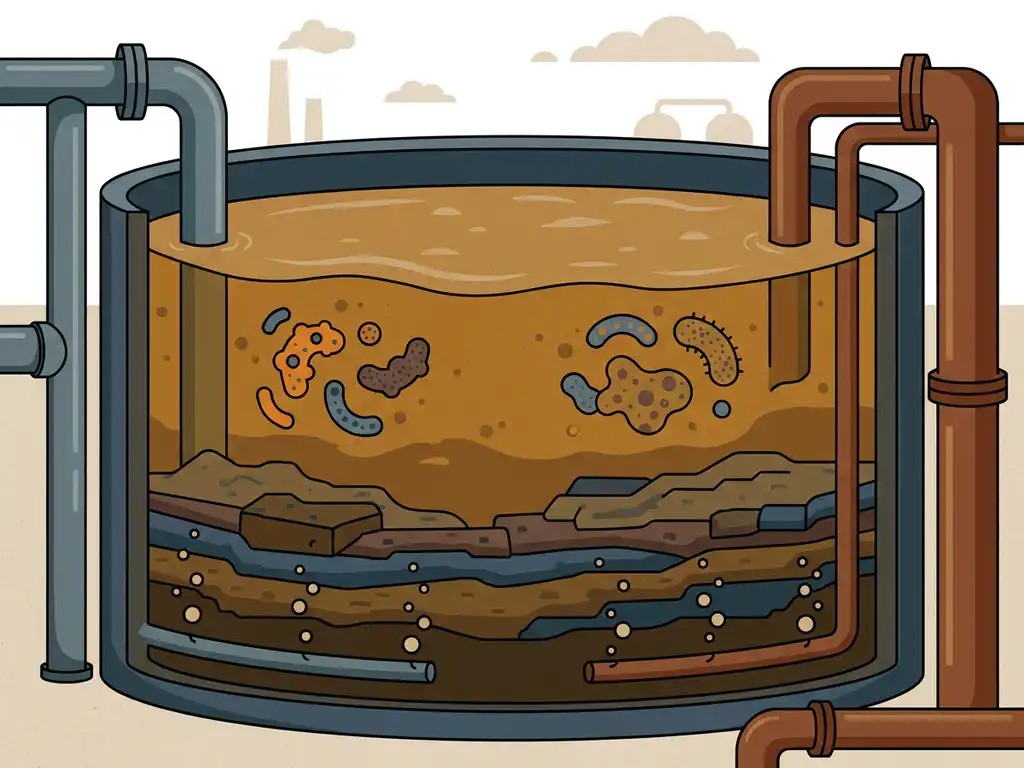
When a biological wastewater treatment system stops performing, the consequences arrive fast: effluent quality drops, discharge limits are breached, and the pressure to fix things immediately intensifies. In many of these situations, the visible symptom is sludge failure. The activated sludge that should be settling cleanly in the clarifier begins to float, foam, or wash out entirely. For environmental and production managers already navigating tightening regulations, a sludge problem is not just an operational nuisance. It is a compliance risk with real financial consequences. Understanding what actually causes these failures is the first step toward solving them sustainably.
Sludge problems in wastewater treatment rarely appear without warning. They develop gradually, driven by shifts in microbial community composition, changes in influent characteristics, or operational decisions that disturb the biological balance. The challenge is that by the time the problem becomes visible, the underlying cause may have been building for days or weeks. This article breaks down the core mechanisms behind sludge failure and explains why industrial effluents are particularly vulnerable.
How microbial imbalances trigger sludge failure
Activated sludge is not a chemical process. It is a living ecosystem, and its performance depends entirely on the structure and stability of the microbial community within it. When that community is balanced, floc-forming bacteria aggregate into dense, settleable particles. When the balance shifts, the entire settling behavior of the sludge can collapse.
The most common microbial trigger is the overgrowth of filamentous bacteria. These organisms grow in long, thread-like structures that extend beyond the floc matrix, preventing compaction and causing the sludge to become light and difficult to settle. Filamentous overgrowth does not happen randomly. It is typically a response to specific environmental pressures: low dissolved oxygen, nutrient deficiencies, low pH, or a substrate composition that selectively favors filamentous species over floc formers. In other words, the microbiology is responding rationally to the conditions it encounters. The problem lies in those conditions, not simply in the organisms themselves.
A secondary microbial imbalance involves the loss of key functional guilds. In systems designed for nitrogen removal, for example, nitrifying bacteria are slow-growing and sensitive to disturbance. A sudden temperature drop, a toxic shock, or an overload event can wipe out a significant portion of the nitrifying population. Recovery takes time, and in the interim, ammonia accumulates and compliance targets are missed. These failures are often misread as sludge problems when they are actually microbial community collapse events, with sludge as one of several symptoms.
Get in Touch
Let’s Talk Microbial Solutions
Book a conversation with Stijn, our CEO, or send us your request.
| Book an Appointment | Request Information |
Operational conditions that worsen sludge settling
Even a well-balanced microbial community can be pushed into dysfunction by poor operational management. Several process parameters have a direct and measurable impact on sludge settleability.
Sludge retention time (SRT) is one of the most influential. An SRT that is too short favors fast-growing, poorly aggregating organisms. An SRT that is too long leads to over-oxidized, deflocculated sludge that also settles poorly. Finding the right SRT depends on the specific microbial community being cultivated and the type of wastewater being treated. There is no universal optimum.
Dissolved oxygen (DO) concentration is equally critical. Zones of low DO within an aeration basin create selective pressure for filamentous bacteria, which are better adapted to low-oxygen environments than most floc-forming species. Inadequate mixing can create these low-DO pockets even when overall oxygen supply appears sufficient. Similarly, fluctuations in organic loading, particularly sudden peaks after production shutdowns or seasonal campaigns, can overwhelm the system’s buffering capacity and destabilize the sludge structure before the microbial community can adapt.
Nutrient balance also plays a role that is frequently underestimated. Biological treatment requires a minimum ratio of carbon, nitrogen, and phosphorus to sustain healthy microbial growth. When industrial effluents are carbon-rich but nutrient-poor, or when nitrogen and phosphorus concentrations fluctuate significantly, the microbial community shifts in ways that impair settling. Correcting these imbalances often requires more than chemical dosing. It requires understanding the biology well enough to know which organisms are being favored and why.
Sludge bulking and foaming: distinct problems, shared roots
Sludge bulking and biological foaming are the two most disruptive manifestations of sludge problems in wastewater treatment, and while they look different, they often share the same underlying cause.
Bulking refers to the failure of sludge to settle and compact in the secondary clarifier. The sludge volume index (SVI) rises, the clarifier fills with low-density floc, and solids begin washing out with the effluent. Filamentous bulking, caused by the overgrowth of filamentous organisms, is the most common form. Non-filamentous bulking, sometimes called viscous bulking, occurs when bacteria produce excessive extracellular polymers that trap water within the floc, again preventing compaction. Both types result in poor effluent quality and can lead directly to discharge limit violations.
Foaming is a separate but related problem. Stable, persistent foam on the surface of aeration tanks is typically caused by specific hydrophobic filamentous bacteria that produce biosurfactant-like compounds. This foam can overflow tank walls, create safety hazards, and carry biological solids into areas of the plant where they do not belong. Like bulking, foaming is a symptom of a microbial community that has shifted toward organisms that thrive under the prevailing conditions. Spraying water or adding defoamers addresses the symptom. Correcting the underlying microbial imbalance addresses the cause.
Why industrial effluents are especially prone to sludge issues
Municipal wastewater is relatively consistent in composition. Industrial effluents are not. This variability is the core reason why wastewater treatment systems at food processing plants, chemical facilities, and pharmaceutical manufacturers experience sludge problems at a higher rate than municipal systems.
Industrial processes generate effluents with high and variable concentrations of specific compounds: fats, proteins, sugars, solvents, or pharmaceutical intermediates, depending on the sector. These substrates can selectively enrich particular microbial groups at the expense of others. High-fat effluents, for example, are strongly associated with foaming caused by lipid-metabolizing filamentous organisms. High-sugar effluents at low dissolved oxygen can rapidly drive filamentous bulking. The microbial community adapts to what it is fed, and when the feed changes suddenly, the community that had established itself may no longer be appropriate for the new conditions.
Seasonal production patterns compound the problem. A food manufacturer that processes fruit in summer and vegetables in winter delivers fundamentally different effluents to the same biological treatment system across the year. Each transition is a potential destabilization event. Systems that appear stable during steady-state operation can fail rapidly when the influent composition shifts. This is a core challenge that biological wastewater treatment specialists encounter repeatedly in industrial contexts, and it requires a fundamentally different approach than simply scaling up a municipal treatment design.
Diagnosing the root cause before choosing a fix
Treating sludge failure without diagnosing its root cause is one of the most common and costly mistakes in industrial wastewater management. The same symptom, poor settling, can result from filamentous overgrowth, viscous bulking, toxic inhibition, or nutrient deficiency. Each requires a different intervention, and applying the wrong one wastes time and money while the compliance clock keeps running.
Effective diagnosis begins with microscopy. Examining the sludge under a microscope reveals the morphology of the dominant organisms and whether filamentous bacteria are present, and if so, which types. Different filamentous species respond to different corrective measures, so identification matters. Beyond microscopy, molecular tools such as 16S rRNA sequencing now allow a detailed picture of the entire microbial community, identifying not just who is present but in what proportions and whether key functional groups are underrepresented.
Process data analysis runs in parallel. Trends in SVI, mixed liquor suspended solids (MLSS), oxygen uptake rate, and effluent quality over time often reveal the moment when conditions shifted and point toward the operational or influent variable that drove the change. Combining biological insight with process data is what separates a genuine diagnosis from guesswork. Avecom’s team of engineers and microbiologists applies exactly this combined approach when auditing underperforming biological treatment systems, using molecular monitoring to identify what the microbial community is doing and why.
How targeted microbiome management prevents recurring sludge problems
Fixing a sludge problem once is valuable. Preventing it from recurring is the real goal. Sustainable performance in biological wastewater treatment depends on actively managing the microbial community rather than simply reacting when things go wrong.
Microbiome management starts with understanding which microbial consortium performs best for a specific effluent type and set of operating conditions. This is not a one-size-fits-all answer. A food processing plant with high-protein effluent needs a different community composition than a facility treating solvent-laden chemical wastewater. Establishing the right community from the outset, through targeted inoculation or selective enrichment, reduces the time it takes for a system to reach stable performance and lowers the risk of competitive displacement by undesirable organisms.
Ongoing molecular monitoring allows operators to detect shifts in community composition before they translate into visible performance problems. If the relative abundance of filamentous bacteria begins to rise, or if nitrifier populations start declining, corrective action can be taken early rather than after a compliance breach has already occurred. This kind of proactive management requires analytical capability that most industrial operators do not maintain in-house, which is why external microbiological expertise plays a critical role in high-performing industrial treatment systems.
Avecom has built its industrial water treatment services around this philosophy of active microbiome management, combining lab and pilot-scale feasibility work with operational support and molecular monitoring. For facilities where sludge problems have become recurring rather than exceptional, this integrated approach offers a path toward genuine stability rather than repeated crisis management. The goal is a biological system that is understood well enough to be steered, not just watched. For industrial operators facing tightening discharge standards in 2026 and beyond, that level of control is no longer optional. It is a competitive and regulatory necessity.