

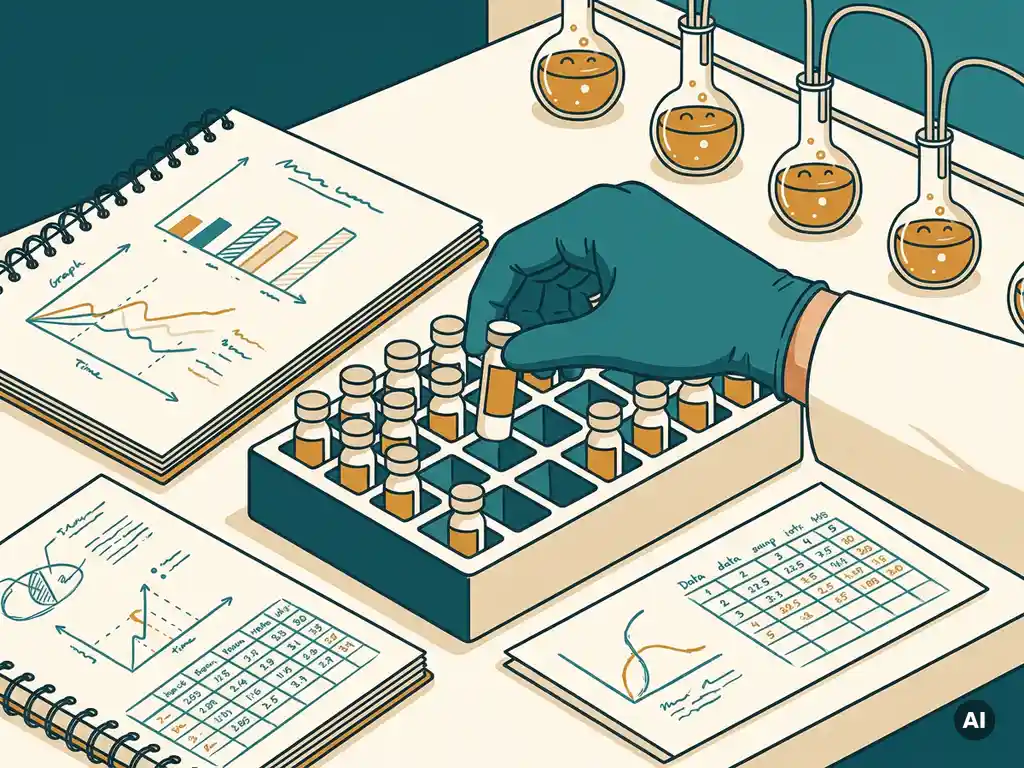
A fermentation R&D partner should deliver structured scientific reports that document experimental conditions, microbial performance data, analytical results, and clear decision-relevant conclusions at every stage of the project. Good reporting is not a formality – it is the mechanism by which you retain control of your process knowledge, protect your intellectual property, and make defensible scale-up decisions. The sections below address the most common questions R&D and technical leaders ask when evaluating a contract fermentation partner’s reporting standards.
What data should a fermentation R&D partner document in each experiment?
At a minimum, a fermentation R&D partner should document all process parameters, inoculation conditions, substrate composition, and performance outcomes for every experimental run. This includes temperature, pH, dissolved oxygen or redox potential, agitation speed, feed rates, and sampling intervals – recorded with sufficient resolution to reconstruct what happened if results are unexpected.
Beyond the raw process log, each experiment should include a clear statement of the hypothesis being tested, the variables that were changed relative to the previous run, and a concise interpretation of the results. Without that interpretive layer, a data log is just numbers. The partner’s value lies in connecting process observations to microbial behavior – for example, explaining why a drop in productivity correlates with a shift in community composition rather than a substrate limitation.
For projects involving mixed microbial cultures, documentation should also capture any observable changes in culture morphology, foam behavior, or off-gas profile. These qualitative observations often flag process instability before quantitative metrics do, and they are easy to lose if the reporting culture treats them as informal notes rather than structured data.
How should interim progress reports be structured during a contract R&D project?
Interim reports in a fermentation contract R&D project should follow a consistent structure: a brief summary of work completed since the last report, a comparison of actual results against the agreed milestones, an interpretation of what the data means for the next experimental phase, and a clear statement of any risks or deviations from the original plan.
The reporting cadence matters as much as the structure. Monthly or milestone-triggered reports give you enough time to course-correct without losing weeks to a direction that is not working. A good partner does not wait until the next scheduled report to flag a problem – interim communication should be the norm when something unexpected occurs.
Interim reports should also be written for an audience that includes non-laboratory stakeholders. If you need to present progress to investors or a board, you should be able to share the executive summary section of an interim report without extensive translation. A partner who writes only for their own technical team creates an unnecessary information bottleneck on your side.
Get in Touch
Let’s Talk Microbial Solutions
Book a conversation with Stijn, our CEO, or send us your request.
| Book an Appointment | Request Information |
Get in Touch
Let’s Talk Microbial Solutions
Book a conversation with Stijn, our CEO, or send us your request.
| Book an Appointment | Request Information |
What’s the difference between lab-scale and pilot-scale reporting requirements?
Lab-scale reports focus on establishing process feasibility and identifying the key variables that drive performance. Pilot-scale reports shift focus to process robustness, reproducibility across runs, and the operational parameters that will govern production. The data sets are larger at pilot scale, and the reporting must address variability between runs – not just average performance.
At lab scale, it is acceptable to report on a small number of replicate experiments because the goal is directional: does this microbial system perform as expected under controlled conditions? At pilot scale, the question changes to whether the process holds up when reactor volume increases, when mixing dynamics change, and when substrate quality varies as it would in a real supply chain.
Pilot-scale reports should also begin addressing engineering parameters that are not relevant at bench scale – energy consumption per unit of product, cleaning and sterilization cycle effectiveness, and sensor calibration drift over longer runs. These details are not scientific formalities; they are the inputs your engineering team needs to design a production facility or brief a contract manufacturer. A fermentation partner who treats pilot-scale reporting the same way they treat lab-scale reporting is not preparing you for the next step.
How should a fermentation partner handle IP and confidentiality in their reports?
A fermentation R&D partner should handle intellectual property and confidentiality by clearly separating your proprietary process information from any pre-existing knowledge or methods the partner brings to the project. Reports should be structured so that your specific formulations, microbial selections, and process innovations are documented in a way that supports future patent applications without inadvertently disclosing background IP that belongs to the partner.
Before any experimental work begins, the partner should operate under a signed confidentiality agreement that covers not only the results but also the existence of the project itself. Reports should be stored and transmitted in a way that restricts access to named individuals on both sides, and the partner should have a clear policy on data retention and deletion at project end.
In practice, this means reports should avoid referencing client-specific process details in any internal documents that circulate more broadly within the partner organization. A partner with a strong confidentiality culture will have reporting templates that are designed with this separation built in, rather than treating it as an afterthought. When evaluating a potential partner, asking directly how they handle IP attribution in their reports is a reasonable and revealing question.
Which analytical methods should appear in a fermentation R&D report?
A fermentation R&D report should specify the analytical methods used for every key measurement, including the instrument or assay type, the detection limits, and the sampling protocol. For microbial fermentation projects, this typically covers biomass quantification, substrate and product concentration assays, and microbial community characterization where mixed cultures are involved.
For projects working with complex microbial consortia, community-level analysis is particularly important. Methods such as amplicon sequencing and quantitative PCR allow the partner to track shifts in microbial population structure over time and link those shifts to changes in process performance. Without this layer of analysis, it is difficult to distinguish between a process that is working as designed and one that is producing acceptable results for the wrong reasons – a distinction that matters enormously when you try to reproduce the process at larger scale.
Product quality analytics should also be clearly documented. If the fermentation produces a biomass-based product, the report should specify how protein content, moisture, contamination levels, and stability were measured. For clients pursuing regulatory approval or feed certification, method traceability is not optional – it forms part of the dossier that regulators and auditors will review. Microbial biomass fermentation projects in particular benefit from partners who already operate within certified quality frameworks, since the analytical methods are then aligned with recognized standards from the outset.
What should a final fermentation R&D report include before scale-up decisions?
A final fermentation R&D report prepared ahead of a scale-up decision should include a consolidated summary of all experimental phases, a clearly defined process envelope (the range of operating conditions within which the process performs reliably), an assessment of the critical process parameters, and an explicit recommendation on readiness for the next scale. It should also identify the residual risks and the conditions under which scale-up may fail.
The process envelope is the most practically important element. It tells your engineering team not just what the optimal conditions are, but how much deviation the process can tolerate before performance degrades. A report that only documents the best-case run gives you an incomplete picture and sets you up for surprises when real-world variability enters the equation.
The final report should also include a technology transfer section: a summary of the knowledge, methods, and materials that need to move with the process to the next facility or production partner. This covers inoculum preparation protocols, critical raw material specifications, and any analytical methods that must be replicated at the receiving site. Without this section, scale-up becomes a knowledge reconstruction exercise rather than a controlled handover.
For clients who need to present scale-up decisions to investors or internal leadership, the final report should be structured so that the executive summary and recommendation sections can stand alone as a briefing document. A partner with experience in fermentation contract research will understand that the report serves multiple audiences simultaneously and will write accordingly.
Related Articles
- Why does the type of soil affect remediation outcomes?
- Can contaminated soil be cleaned without digging it up?
- How do stricter discharge limits affect sludge management decisions?
- What happens if excess sludge is not removed from a wastewater plant?
- Is biological soil remediation cheaper than excavation?