

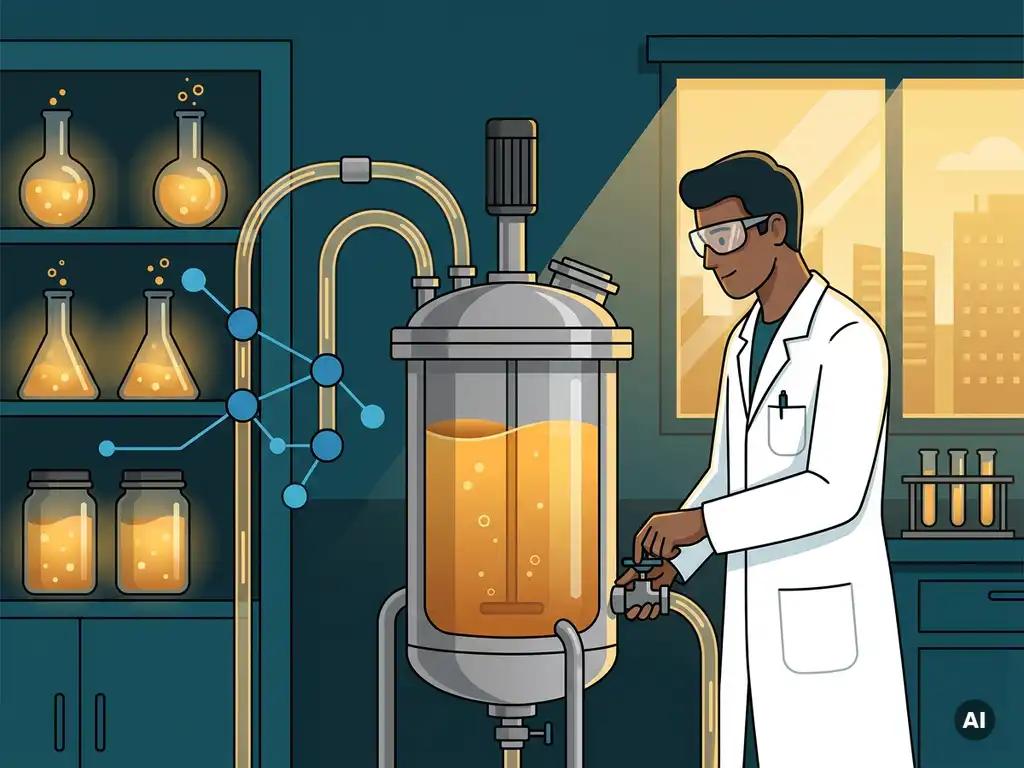
A fermentation expert contributes scientific and technical depth that most innovation consortia lack internally. They translate biological principles into scalable, reproducible processes, bridging the gap between a promising concept and a validated, manufacturable product. For any consortium working with microbial systems, biotransformation, or bio-based production, this expertise is not peripheral; it sits at the core of whether the project succeeds.
The specific value a fermentation specialist brings depends on the consortium’s composition and stage of development, but the pattern is consistent: projects that integrate fermentation expertise early move faster, encounter fewer costly surprises at scale, and produce more defensible intellectual property. The sections below address the most common questions companies ask before bringing a fermentation partner into a collaborative R&D structure.
What does a fermentation expert actually contribute to a consortium?
A fermentation expert contributes process knowledge, infrastructure, and analytical capability that translate biological concepts into technically grounded, scalable outcomes. Their core contribution is not just running bioreactors, it is understanding how microbial systems behave under changing conditions, how to control those variables, and how to design experiments that generate meaningful, reproducible data.
In practical terms, this means a fermentation expert can assess whether a microbial process is technically feasible before significant resources are committed, identify the process parameters that most influence yield or product quality, and design scale-up strategies that account for real-world constraints rather than idealized lab conditions.
Within a consortium, this role often includes:
- Designing and executing fermentation feasibility studies at lab scale
- Developing process monitoring protocols using molecular tools such as amplicon sequencing or qPCR
- Translating lab-scale results into pilot-scale process specifications
- Producing technical documentation that supports patent applications, regulatory submissions, or investor dossiers
- Flagging biological risks early, contamination susceptibility, microbial instability, substrate inhibition, before they become project-level failures
Consortia benefit most when the fermentation partner is treated as a technical co-investigator rather than a subcontractor executing predefined tasks. The difference in outcome is significant: a co-investigator shapes experimental design from the start, while a subcontractor often inherits flawed assumptions too late to correct them.
Get in Touch
Let’s Talk Microbial Solutions
Book a conversation with Stijn, our CEO, or send us your request.
| Book an Appointment | Request Information |
How does a fermentation partner fit into the consortium structure?
A fermentation partner typically enters a consortium as a specialist work package leader or technical subcontractor, responsible for all activities related to microbial process development, bioreactor operation, and downstream processing. Their position in the consortium structure depends on whether the fermentation process is central to the project or one component among several.
When microbial fermentation is the core technology, for example, in bio-based ingredient production or waste stream valorisation, the fermentation partner often co-leads the technical work packages alongside the project coordinator. When fermentation is one enabling step within a broader value chain, the partner operates in a defined technical lane while interfacing with adjacent partners handling feedstock supply, product formulation, or regulatory affairs.
Effective integration requires clear definition of deliverables, data sharing protocols, and escalation paths when experimental results deviate from projections. Consortia that treat the fermentation partner as an isolated service provider rather than a connected team member tend to lose time at hand-off points, when results need to be interpreted jointly before the next phase can begin.
Get in Touch
Let’s Talk Microbial Solutions
Book a conversation with Stijn, our CEO, or send us your request.
| Book an Appointment | Request Information |
When should a company bring a fermentation expert into the consortium?
A fermentation expert should be brought into a consortium at the project design stage, before the technical work plan is finalized. Involving a fermentation specialist early ensures that the experimental roadmap is built around biological realities rather than assumptions that may not survive contact with an actual bioreactor.
Late involvement is one of the most common and costly mistakes in biotech consortia. When a fermentation expert joins after the project plan is locked, they inherit timelines and deliverables that were set without understanding the complexity of the microbial system. This creates pressure to skip validation steps, compress scale-up timelines, or redefine success criteria mid-project.
The right moment to engage a fermentation partner is when the consortium can answer three questions: What is the target product or outcome? What biological system is expected to produce it? What scale does the project need to reach by the end of the funding period? With those answers in hand, a fermentation expert can design a technically credible work plan rather than retrofitting one.
What’s the difference between an academic fermentation lab and an industrial fermentation partner?
The key difference is that an academic fermentation lab optimizes for scientific knowledge generation, while an industrial fermentation partner optimizes for process robustness, reproducibility, and scalability. Both produce valuable work, but they answer different questions and operate under different constraints.
Academic labs excel at fundamental research: characterizing novel organisms, exploring metabolic pathways, and publishing findings that advance the field. Their infrastructure is typically designed for small-scale, highly controlled experiments. Timelines are driven by research cycles, and outputs are primarily scientific publications and proof-of-concept data.
An industrial fermentation partner, by contrast, is oriented toward transferable results. Their infrastructure spans lab scale through pilot scale, and their processes are designed with downstream manufacturing in mind from the beginning. They work under quality management frameworks, maintain traceability of materials and methods, and produce documentation that can support regulatory submissions, patent filings, and investor due diligence.
For an innovation consortium with a commercialization objective, both types of partners can add value at different stages. Academic partners are well suited to early-stage exploration; industrial partners become essential when the project needs to demonstrate that a process works reliably at a scale that matters for the market.
How does IP ownership work when a fermentation expert joins a consortium?
IP ownership in a consortium involving a fermentation expert is governed by the consortium agreement, which should specify who owns foreground IP generated during the project, how background IP contributed by each partner is protected, and under what conditions results can be commercialized. There is no default arrangement, it must be negotiated explicitly before work begins.
The most common structures allocate foreground IP to the partner whose contribution was decisive in generating it, with joint ownership applying to results that emerge from the combined work of multiple partners. Fermentation experts who contribute process know-how, proprietary analytical methods, or novel microbial management techniques will typically seek to protect that background IP through explicit carve-outs in the consortium agreement.
Confidentiality is a parallel concern. A fermentation partner working with multiple clients and consortium projects needs clear boundaries around what information can be shared, with whom, and under what circumstances. Companies entering a consortium with a fermentation specialist should treat the IP and confidentiality clauses of the consortium agreement with the same rigor they would apply to a bilateral licensing deal.
What fermentation capabilities should a consortium look for in a specialist partner?
A consortium should look for a fermentation partner with infrastructure that spans multiple scales, experience with the relevant type of microbial system, and the analytical capacity to monitor and control the process in real time. Technical capability alone is not sufficient, the partner also needs to demonstrate process documentation practices and a track record of delivering results that hold up under scrutiny.
Specific capabilities worth evaluating include:
- Scale range: Can the partner operate from lab-scale feasibility testing through pilot-scale validation without requiring a change of facility or team?
- Process flexibility: Does the infrastructure support both aerobic and anaerobic fermentation, batch and continuous operation, and a range of temperature and pH conditions?
- Microbial systems expertise: Is the partner experienced with the type of organism or community relevant to the project, pure cultures, mixed consortia, or complex environmental microbiomes?
- Analytical tools: Does the partner have access to molecular monitoring methods such as amplicon sequencing or qPCR, which are essential for understanding and controlling complex microbial processes?
- Downstream processing: Can the partner handle post-fermentation steps such as centrifugation, pasteurization, or product concentration, or will these require additional partners?
- Documentation and reporting: Does the partner produce scientific reports suitable for use in subsidy applications, patent filings, or regulatory dossiers?
Avecom’s fermentation R&D and contract manufacturing services cover this full capability stack, from initial lab-scale feasibility studies through pilot-scale validation and small-scale contract production. For consortia working with complex microbial systems in particular, access to mixed culture expertise and high-throughput molecular analysis tools can be the deciding factor in whether a project delivers results within the funding window.
When evaluating a potential fermentation partner, ask for examples of how they have handled scale-up challenges in past projects, how they manage process deviations, and what their approach is to protecting partner confidentiality. The answers will reveal as much about their suitability as any equipment list.
Related Articles
- What is technology transfer in the context of fermentation scale-up?
- What is anaerobic fermentation used for in industry?
- Can a small biotech company access pilot-scale fermentation without building it?
- What are the risks of leaving contaminated soil untreated?
- What is a soil remediation feasibility study?