

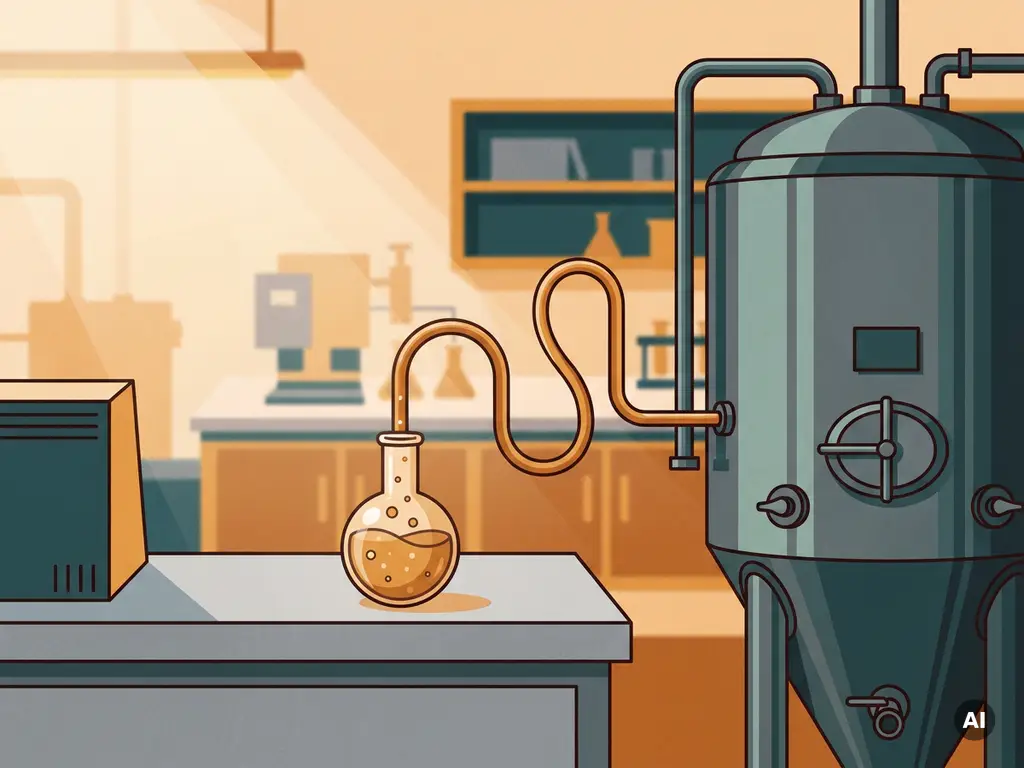
Scaling up a fermentation process from lab to pilot scale requires systematically re-evaluating every process parameter that changes when reactor volume increases, typically from a few liters to hundreds or thousands of liters. The core challenge is that microbial behavior is highly sensitive to physical and chemical gradients that barely exist at lab scale but become significant in larger vessels. The sections below address the most common questions engineers and R&D teams face during fermentation scale-up.
What are the biggest challenges when moving from lab to pilot scale?
The biggest challenges in lab-to-pilot-scale fermentation are mixing uniformity, oxygen or gas transfer efficiency, heat management, and maintaining the microbial community composition under changed physical conditions. These factors interact in ways that are difficult to predict from lab data alone, and they are the primary reason why processes that perform well at bench scale can fail or underperform when transferred to a pilot reactor.
At lab scale, a small stirred flask or benchtop bioreactor is relatively easy to keep homogeneous. Temperature is stable, dissolved oxygen responds quickly to agitation changes, and pH gradients are minimal. When you move to a vessel of 200 liters or more, the same agitation speed no longer guarantees uniform mixing. Zones of poor oxygen transfer can develop, substrate gradients emerge near feed points, and shear stress from impellers may affect sensitive microbial cells or flocs.
For processes based on mixed microbial cultures rather than single strains, these gradients carry an additional risk: they can selectively favor or suppress specific community members, shifting the microbial balance and altering product output. This is one reason why thorough microbiome monitoring during scale-up is not optional but essential for understanding what is actually happening inside the reactor.
How do you maintain microbial performance at larger fermentation volumes?
Maintaining microbial performance during fermentation scale-up requires controlling the key environmental drivers that microorganisms respond to: dissolved oxygen, pH, temperature, shear stress, and substrate availability. The goal is to recreate, as closely as possible, the local conditions experienced by cells at lab scale, even though the global geometry and hydrodynamics of the reactor have changed substantially.
In practice, this means shifting focus from instrument settings to measurable outcomes. Rather than replicating the same agitation speed or aeration rate, engineers target the same dissolved oxygen concentration, the same volumetric mass transfer coefficient (kLa), and the same mixing time. These are the parameters microorganisms actually respond to, and they serve as the functional bridge between scales.
For complex microbial consortia, molecular monitoring tools add a critical layer of insight. Techniques such as amplicon sequencing and quantitative PCR allow you to track shifts in community composition throughout the scale-up process, not just at the start and end. If a key functional group begins to decline, you can intervene before it affects process performance rather than discovering the problem only when product titers drop.
Get in Touch
Let’s Talk Microbial Solutions
Book a conversation with Stijn, our CEO, or send us your request.
| Book an Appointment | Request Information |
What process parameters must be re-optimized at pilot scale?
At pilot scale, the process parameters that most consistently require re-optimization are oxygen transfer rate, mixing intensity and homogeneity, feeding strategy, temperature control, and pH management. These parameters behave differently at larger volumes because the ratio of surface area to volume decreases, reactor geometry changes, and the time required to achieve homogeneous mixing increases.
- Oxygen transfer rate (OTR): Aerobic fermentations are particularly sensitive to this. The kLa value must be measured and adjusted at pilot scale rather than assumed from lab conditions.
- Mixing and agitation: Impeller design, tip speed, and the number of mixing stages may all need revision to avoid both poor mixing and excessive shear.
- Feeding strategy: Batch, fed-batch, and continuous feeding behave differently in larger vessels where substrate gradients near feed inlets are more pronounced.
- Temperature control: Heat generated by microbial metabolism scales with biomass volume, while cooling capacity depends on heat exchanger surface area, which scales differently.
- pH control: Acid and base addition must be recalibrated to avoid local pH spikes near dosing points, which can stress or kill microbial cells in the immediate vicinity.
For anaerobic processes, gas handling becomes a central concern. Biogas production rates increase with volume, and pressure management, gas-liquid separation, and foam control all require attention at pilot scale that may have been negligible in the lab.
Get in Touch
Let’s Talk Microbial Solutions
Book a conversation with Stijn, our CEO, or send us your request.
| Book an Appointment | Request Information |
When should you involve a contract R&D partner in fermentation scale-up?
You should involve a contract R&D partner in fermentation scale-up when your internal lab lacks the bioreactor infrastructure, analytical capacity, or process engineering expertise needed to systematically bridge the gap between bench and pilot scale. The earlier you bring in a specialized partner, the lower the risk of costly failures during scale-up, because process problems are far cheaper to resolve at 50 liters than at 500.
There are several specific situations where external expertise adds the most value:
- Your internal team has validated a concept at flask or benchtop scale but has no access to controlled bioreactors above 10 to 20 liters.
- Previous scale-up attempts have failed and the root cause is unclear, suggesting a need for deeper process characterization.
- Your process relies on a mixed microbial community that requires molecular monitoring to manage reliably at scale.
- You are operating under time pressure, for example with investor milestones or regulatory timelines, and cannot afford to build infrastructure from scratch.
- You need documented, scientifically rigorous data to support a patent application, subsidy dossier, or investor presentation.
A contract fermentation partner with its own pilot facilities and analytical tools functions as an extension of your R&D team rather than a service provider executing a fixed protocol. For companies developing novel microbial fermentation processes, this distinction matters: the partner needs to think alongside you, not just run your experiment.
How long does a fermentation scale-up typically take?
A fermentation scale-up from lab to pilot scale typically takes between three and twelve months, depending on the complexity of the microbial system, the maturity of the lab-scale process, and how many optimization cycles are needed at pilot scale. Straightforward processes with well-characterized microorganisms and stable performance at lab scale can move faster; novel mixed-culture systems or poorly understood processes require more iteration.
A realistic timeline for a structured scale-up project generally follows this progression:
- Process characterization at lab scale (four to eight weeks): Before scaling, critical process parameters are identified and their operating ranges defined. This phase is often underinvested, which is a leading cause of scale-up failures.
- First pilot runs and parameter mapping (six to twelve weeks): Initial runs at pilot scale reveal how the process responds to the new reactor geometry. Multiple runs are typically needed to establish stable operating conditions.
- Optimization and robustness testing (eight to sixteen weeks): Once baseline performance is established, the process is stress-tested and refined to demonstrate reproducibility across multiple batches.
- Documentation and knowledge transfer (two to four weeks): Process data, operating procedures, and analytical results are compiled for internal use, regulatory purposes, or technology transfer.
Investor-driven timelines of six to twelve months for proof of concept at pilot scale are achievable, but they require a well-prepared lab-scale dataset and a partner with ready-to-use infrastructure. Starting scale-up without that foundation almost always extends the timeline rather than compressing it.