

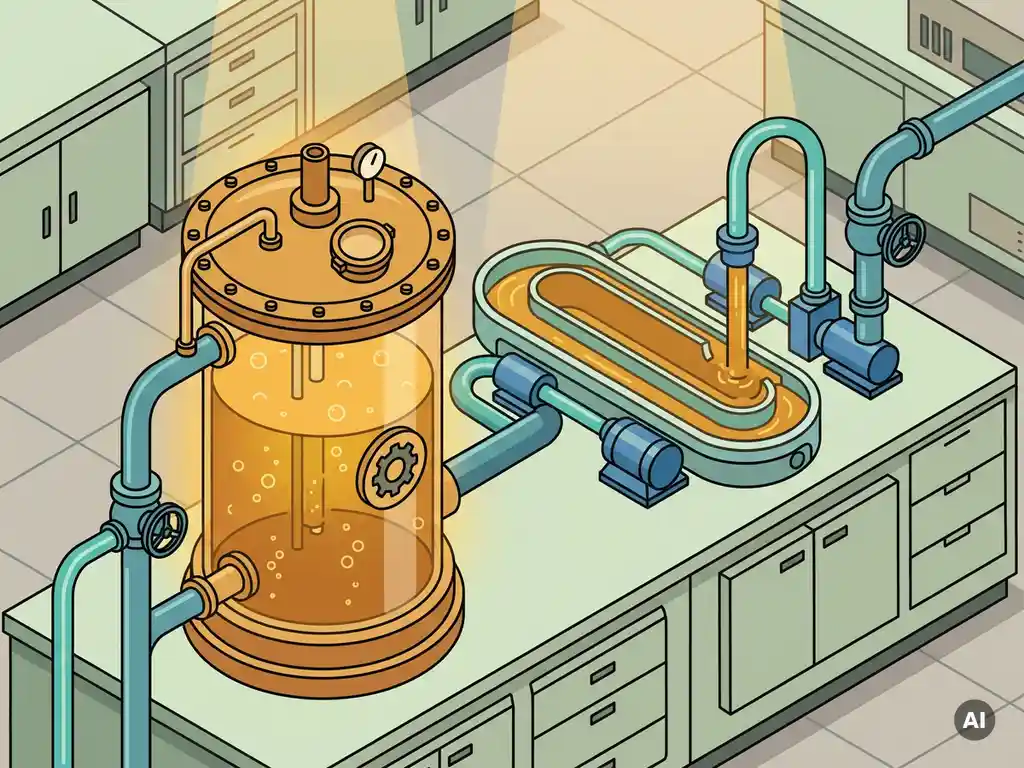
Batch fermentation and continuous fermentation are two distinct modes of running a fermentation process. In batch fermentation, all substrates are loaded at the start and the process runs to completion before the vessel is emptied and cleaned. In continuous fermentation, fresh medium is fed in and culture is withdrawn at a matching rate, keeping the system running indefinitely. The right choice depends on your product, your organism, and your scale-up goals, and the sections below unpack each of those dimensions.
Which fermentation mode produces higher yields?
Neither mode is universally superior for yield. Batch fermentation typically achieves higher volumetric product concentrations at the end of a run because the culture is pushed to exhaustion. Continuous fermentation tends to deliver higher overall productivity per unit time because the system runs without downtime between cycles. The best mode for yield depends on whether your product accumulates during growth or after it.
For primary metabolites, compounds produced during active cell growth, such as many amino acids and organic acids, continuous operation often wins on productivity because cells are kept in their most active growth phase. For secondary metabolites, which accumulate after growth slows, batch or fed-batch modes are usually more effective because they allow the culture to transition through distinct physiological phases. Understanding where your target compound sits in the cell’s metabolic timeline is the first step toward choosing the right fermentation mode.
How does continuous fermentation maintain a steady state?
Continuous fermentation maintains a steady state by balancing the rate at which fresh medium enters the bioreactor against the rate at which culture broth is removed. This is controlled through the dilution rate, the ratio of feed flow to reactor volume. When dilution rate equals the specific growth rate of the microorganism, cell density, substrate concentration, and product concentration all stabilize at constant values.
This steady state is the defining feature of a chemostat, the most common continuous fermentation configuration. Because environmental conditions inside the reactor remain constant, microbial physiology is reproducible from one hour to the next. That consistency is valuable for studying microbial behavior and for producing compounds that require tightly controlled conditions. However, maintaining a true steady state demands precise process control: any drift in feed composition, temperature, or pH will shift the equilibrium and potentially wash out the culture if the dilution rate exceeds the maximum growth rate of the organism.
Get in Touch
Let’s Talk Microbial Solutions
Book a conversation with Stijn, our CEO, or send us your request.
| Book an Appointment | Request Information |
What are the main advantages of batch fermentation?
Batch fermentation offers operational simplicity, flexibility, and a lower risk of contamination compared to continuous processes. Because each run is a closed, time-limited operation, the vessel can be thoroughly cleaned and sterilized between batches, making it easier to switch between products and to meet regulatory requirements for pharmaceutical or food-grade production.
The key practical advantages include:
- Flexibility: The same equipment can handle different substrates, organisms, and products across different batches.
- Contamination control: Each batch starts with a fresh, sterile environment, limiting the window of exposure to unwanted microorganisms.
- Regulatory acceptance: Batch records are well-understood by food and pharmaceutical regulators, making documentation and quality assurance more straightforward.
- Lower process complexity: No continuous feed system, no real-time dilution rate control, and no risk of washout.
- Easier troubleshooting: If a batch fails, the problem is contained and the next run can begin with adjusted parameters.
For early-stage process development, batch fermentation is almost always the starting point. It generates clear data on growth kinetics, substrate consumption, and product formation without the added complexity of continuous feeding, making it easier to understand the process before optimizing it.
When does continuous fermentation become the better choice?
Continuous fermentation becomes the better choice when high throughput, process consistency, and long production runs outweigh the need for operational flexibility. It is particularly well-suited to commodity biochemicals, single-cell protein production, and any application where the product is a growth-associated metabolite that benefits from cells being held in a defined, stable physiological state.
Specific conditions that favor a continuous fermentation process include:
- Large production volumes where downtime between batches represents a meaningful cost
- Products with tight quality specifications that benefit from constant environmental conditions
- Organisms with stable, well-characterized growth kinetics that are unlikely to evolve or be outcompeted over long run times
- Processes where substrate and product concentrations need to be held below inhibitory thresholds
The trade-off is operational complexity and contamination risk. A continuous system running for weeks or months is exposed to potential contamination for the entire duration. For mixed microbial cultures, communities of multiple species working together rather than a single purified strain, continuous operation can actually be an advantage, because the steady-state conditions select for a stable community composition over time. This is one reason continuous and semi-continuous formats are often used in wastewater treatment and biomass fermentation applications where community stability matters more than strain purity.
What is fed-batch fermentation and how does it differ from both?
Fed-batch fermentation is a hybrid mode in which substrate or nutrients are added incrementally during the run, but nothing is removed until the batch ends. It differs from standard batch fermentation by extending the productive phase of the culture, and it differs from continuous fermentation by retaining all the culture broth inside the reactor rather than maintaining a steady-state outflow.
The fed-batch approach solves a specific problem: many substrates are inhibitory at high concentrations, meaning that loading everything at the start would slow or kill the culture. By feeding substrate gradually, the process keeps concentrations in a range the organism can handle while still achieving high final product titers. This makes fed-batch the dominant mode in industrial fermentation for high-value products such as enzymes, vitamins, and recombinant proteins.
From a practical standpoint, fed-batch requires a feeding strategy, a profile that determines how much substrate to add and when. Getting this right is a significant part of process development work. The feeding profile often needs to be re-optimized when moving between scales, which is one reason that fed-batch processes can be challenging to scale up without a thorough understanding of the underlying kinetics.
How does the choice of fermentation mode affect scale-up?
The fermentation mode has a direct impact on how predictably a process transfers from lab to pilot to production scale. Batch fermentation is generally the easiest to scale because the key variables, inoculum size, initial substrate concentration, temperature, and pH, are set at the start and the process follows a defined trajectory. Continuous and fed-batch modes introduce additional variables that can behave differently at larger volumes.
In continuous fermentation, mixing and mass transfer become critical at scale. A chemostat that performs cleanly in a 10-liter vessel may develop concentration gradients in a 1,000-liter reactor, meaning that different parts of the culture experience different substrate and oxygen levels. This can shift the steady state or select for unwanted subpopulations. Engineering the bioreactor to maintain homogeneous conditions at scale is a non-trivial challenge.
For fed-batch processes, the feeding strategy developed at lab scale rarely translates directly to larger vessels. Oxygen transfer rates, heat removal, and mixing times all change with scale, and the feeding profile often needs to be re-derived rather than simply multiplied. This is where pilot-scale validation becomes essential, it is the step that reveals whether the process parameters understood at bench scale actually hold when reactor geometry and volume change.
Organizations working through these scale-up questions without dedicated fermentation infrastructure typically benefit from partnering with a specialist. Avecom’s fermentation R&D services cover this transition from lab-scale feasibility through pilot-scale validation, using aerobic and anaerobic bioreactors up to 2,000 liters alongside molecular monitoring tools to track how microbial communities respond as conditions change. The goal is to understand the process well enough at pilot scale that the move to production carries predictable, manageable risk rather than uncertainty.
Related Articles
- How do you turn a food processing waste stream into a valuable product?
- How do biotech scale-ups benefit from external fermentation infrastructure?
- How do you compare fermentation partners before signing a contract?
- How do you know if groundwater is affected by soil contamination?
- What causes sludge problems in biological wastewater treatment?