

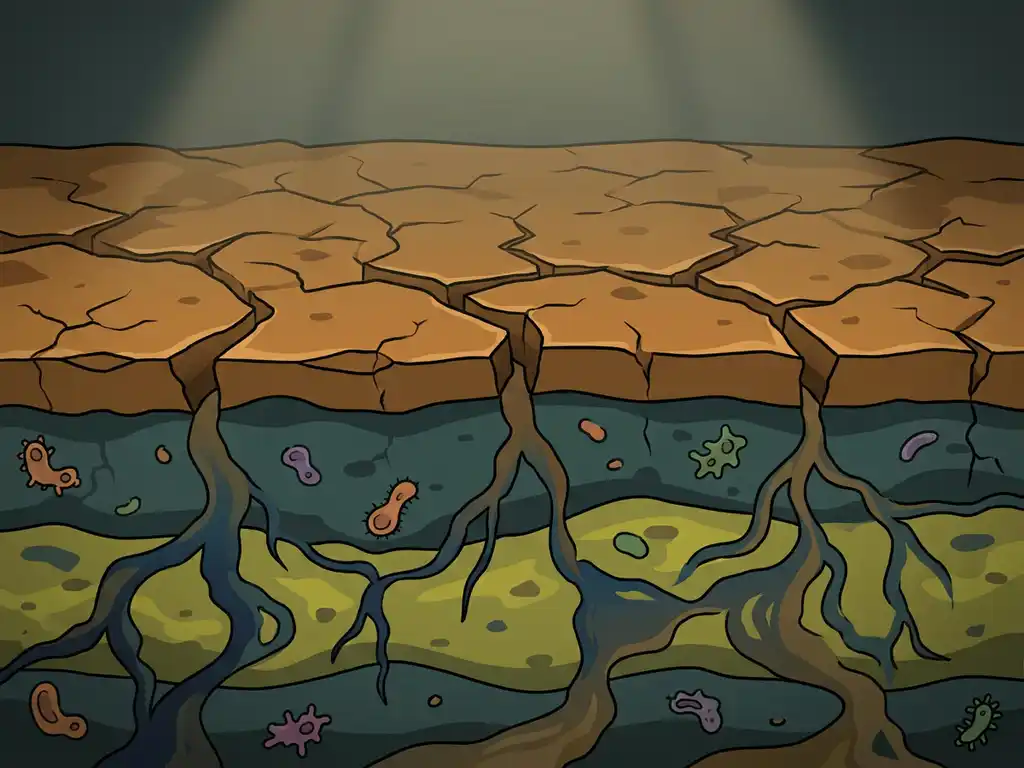
Groundwater is affected by soil contamination when pollutants migrate downward through the soil profile and reach the saturated zone below. This happens because many contaminants dissolve in rainwater or infiltrating surface water, which carries them deeper over time. The speed and extent of that migration depend on the type of contaminant, soil permeability, and local hydrogeology.
Understanding whether your site has reached that point requires more than a visual inspection. The sections below walk through how contamination spreads, what signs to look for, and what testing and remediation options exist for affected groundwater.
How does soil contamination spread to groundwater?
Soil contamination spreads to groundwater primarily through leaching — the process by which water-soluble or water-mobilized pollutants move downward through the unsaturated soil zone until they reach the water table. Once there, contaminants dissolve into groundwater and can travel significant distances in the direction of groundwater flow, forming what is known as a contamination plume.
Several factors determine how quickly and how far contamination spreads. Highly permeable soils such as sand and gravel allow faster downward movement, while clay-rich soils can slow migration considerably. The chemical properties of the contaminant matter too: some substances bind tightly to soil particles and move slowly, while others, particularly chlorinated solvents, are dense and mobile enough to sink well below the water table. Rainfall intensity, seasonal groundwater fluctuations, and proximity to drainage infrastructure all influence the rate of spread.
For sites with a history of industrial activity, this migration may already be well advanced by the time contamination is discovered. That is why understanding the subsurface conditions of a specific site is a necessary first step before drawing any conclusions about groundwater impact.
Get in Touch
Let’s Talk Microbial Solutions
Book a conversation with Stijn, our CEO, or send us your request.
| Book an Appointment | Request Information |
What are the signs that groundwater may be contaminated?
The most direct sign that groundwater may be contaminated is the detection of pollutants in monitoring wells installed at or near the site. Beyond laboratory results, practical indicators include discoloration or unusual odors in well water, the presence of a sheen on standing water, or vegetation die-off in areas above the saturated zone. However, many contaminants have no visible or odor-based signature at all.
On industrial or brownfield sites, the absence of obvious signs should not be taken as confirmation that groundwater is clean. Chlorinated solvents, for example, are colorless and odorless at concentrations well above regulatory thresholds. The only reliable way to determine whether groundwater has been affected is through targeted sampling and chemical analysis. Monitoring wells placed at strategic depths and distances from a suspected source provide the spatial data needed to map the extent of any plume.
Site history is also a useful indicator. If a site has operated as a dry cleaner, metal degreasing facility, or chemical storage location, groundwater impact should be assumed as a working hypothesis until sampling proves otherwise.
What types of soil contaminants most commonly reach groundwater?
The soil contaminants most commonly found in groundwater are volatile chlorinated compounds (VOCl) such as tetrachloroethylene (PCE) and trichloroethylene (TCE), petroleum hydrocarbons, heavy metals, and nitrates. Among these, chlorinated solvents are particularly problematic because they are denser than water, meaning they can sink through the aquifer and accumulate at depth, making them difficult to detect and even harder to remove.
Petroleum hydrocarbons from fuel leaks or underground storage tanks are also frequently encountered in groundwater investigations. These tend to float on the water table rather than sink, which makes their plume behavior different from chlorinated compounds. Heavy metals such as lead, arsenic, and cadmium can leach from contaminated fill material or industrial waste, though their mobility in groundwater depends heavily on soil pH and organic matter content.
Nitrates from agricultural runoff or sewage represent a different category of contamination, more diffuse and often affecting larger areas. The type of contaminant present directly determines which testing methods are appropriate and which remediation approaches are feasible.
How is groundwater tested for contamination from soil?
Groundwater is tested for contamination by installing monitoring wells at targeted locations and depths, extracting water samples, and submitting those samples to an accredited laboratory for chemical analysis. The selection of which parameters to test for is guided by the site’s history and the contaminants already identified in the soil. A phased approach, starting with site characterization and progressing to targeted sampling, is standard practice in most regulatory frameworks.
Monitoring well design and placement
The positioning of monitoring wells is critical. Wells placed too far from the source, or screened at the wrong depth, can produce misleading results. Hydrogeological mapping of the site, including groundwater flow direction and depth to the water table, informs where wells should be placed to capture both the core of any plume and its leading edge. Multiple sampling rounds over time are often required to account for seasonal variation in groundwater levels.
Laboratory analysis and molecular tools
Standard chemical analysis covers parameters such as volatile organic compounds, heavy metals, and anions, depending on the suspected contamination type. For sites where biological degradation is already occurring or is being considered as a remediation pathway, molecular monitoring tools add a further layer of insight. Quantitative PCR (qPCR) analysis can identify and quantify the specific microorganisms responsible for breaking down chlorinated solvents in groundwater, providing data on whether natural attenuation is active and at what rate. Avecom’s molecular soil analysis services use exactly this approach to support both site assessment and ongoing remediation monitoring.
What’s the difference between soil contamination and groundwater contamination?
Soil contamination refers to the presence of harmful substances in the solid and unsaturated portion of the ground, above the water table. Groundwater contamination refers to pollutants that have reached the saturated zone and are present in the water itself. The two are related but distinct: soil contamination is the source, and groundwater contamination is a consequence of that source migrating downward.
From a regulatory and remediation standpoint, this distinction matters considerably. Soil contamination can sometimes be managed in place if it is stable and not leaching further. Groundwater contamination, once established, is far more mobile and difficult to contain because it moves with the flow of the aquifer. A site assessment that only evaluates soil without investigating groundwater may significantly underestimate the full extent of the problem.
In practice, many contaminated sites require separate but coordinated remediation strategies for the soil source zone and the groundwater plume. Addressing only one without the other risks ongoing recontamination of the cleaned medium.
Can contaminated groundwater be cleaned up with biological methods?
Yes, contaminated groundwater can be cleaned up using biological methods, and for certain contaminant types, particularly chlorinated solvents, biological approaches are among the most effective options available. The process relies on specialized microorganisms that break down pollutants through metabolic activity, converting toxic compounds into less harmful or harmless end products. This can occur naturally (monitored natural attenuation) or be actively stimulated through bioaugmentation and biostimulation.
Bioaugmentation involves introducing specific microbial consortia capable of degrading the target contaminant into the subsurface. For chlorinated solvents such as PCE and TCE, certain bacterial strains perform a process called reductive dechlorination, progressively removing chlorine atoms until the compound is fully broken down. The feasibility of this approach depends on site-specific conditions including the presence of electron donors, pH, temperature, and the existing microbial community.
A microcosm feasibility test is the standard method for determining whether biological degradation is viable for a specific soil and groundwater matrix before committing to a full-scale intervention. This laboratory-scale test uses actual site material to simulate subsurface conditions and assess whether the right microbial activity can be established. It is a cost-efficient way to reduce uncertainty before investing in field-scale remediation.
Avecom, based in Ghent, specializes in the biological decontamination of volatile chlorinated compounds and has developed both the microbial consortia and the molecular monitoring tools needed to support this type of remediation from initial screening through to OVAM-compliant reporting. For sites where excavation is not feasible or has already failed to resolve the contamination, in-situ biological remediation offers a science-based alternative that works with the subsurface rather than against it.
If you are managing a contaminated site and are uncertain whether groundwater has been affected or whether biological remediation is a viable path, contact Avecom for an initial screening. The starting point is always the specific conditions of your site, not a standard solution.