

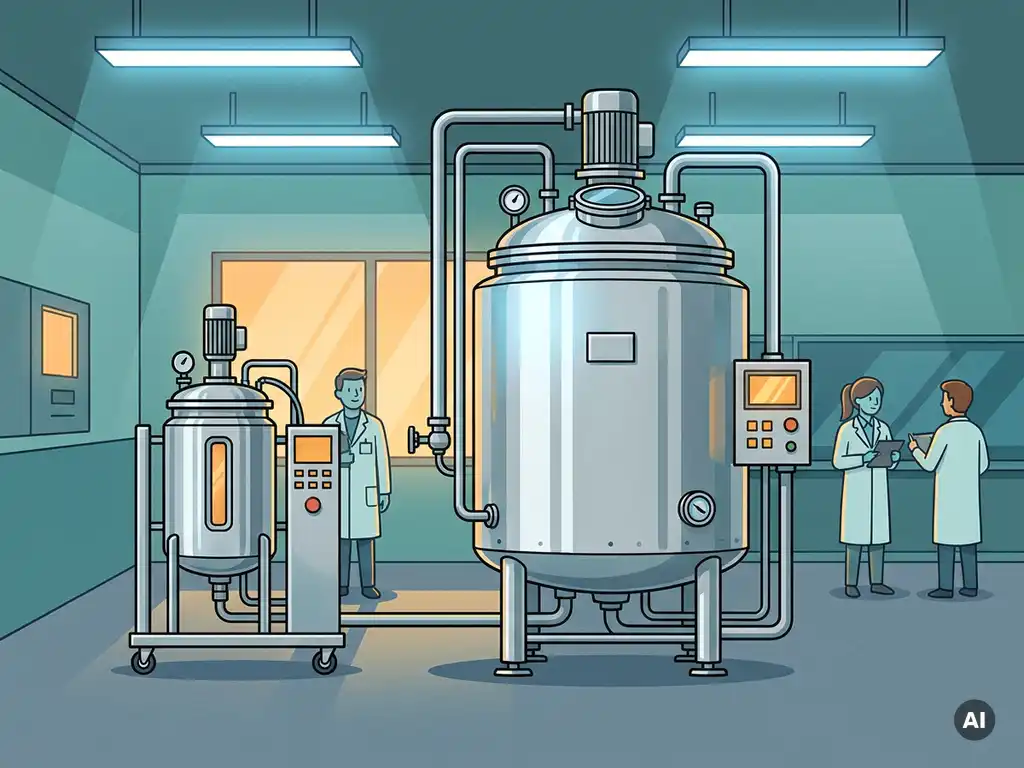
Building fermentation infrastructure in-house typically costs several hundred thousand to several million euros when you account for capital equipment, facility modifications, and staffing, before a single experiment runs. Outsourcing fermentation R&D and contract manufacturing, by contrast, converts that fixed capital into a variable cost tied directly to project milestones. For most scale-ups and industrial companies without existing fermentation capacity, outsourcing is faster, cheaper, and lower risk at the early and mid stages of development. The sections below break down each cost layer in detail, from capital expenditure to hidden operational overhead, and help you decide which model fits your situation.
What does it actually cost to build fermentation infrastructure in-house?
Setting up dedicated fermentation infrastructure in-house requires a capital investment that typically ranges from several hundred thousand euros for a basic lab-scale setup to several million euros for a functioning pilot plant. The exact figure depends on reactor volume, process type, and the level of analytical instrumentation required, but the baseline is rarely as low as internal budget estimates suggest.
The core equipment alone accounts for a substantial share of the budget. Bioreactors capable of handling pilot-scale volumes (500 to 2,000 liters) carry significant price tags, and that cost multiplies when you need redundancy or multiple reactor configurations to test aerobic versus anaerobic conditions, batch versus continuous processes, or different temperature ranges. Add to that:
- Facility modifications: cleanroom requirements, ventilation, utility connections (water, gas, steam), drainage, and biosafety compliance
- Analytical instrumentation: pH, dissolved oxygen, gas analyzers, HPLC, and molecular tools such as qPCR for process monitoring
- Downstream processing equipment: centrifuges, filtration systems, pasteurization units if end products require safety certification
- Regulatory and certification costs: feed- or food-grade certification, environmental permits, and safety audits
Construction and commissioning timelines add another constraint. A purpose-built pilot fermentation facility typically takes 18 to 36 months from planning to first operational run. For a company under investor pressure to deliver proof-of-concept within 12 months, that timeline alone can make in-house infrastructure a non-starter.
What are the hidden operational costs of running fermentation in-house?
The hidden operational costs of running fermentation infrastructure in-house often exceed the initial capital investment over a three- to five-year horizon. These costs are less visible in budget proposals but become significant quickly: specialized staffing, consumables, maintenance contracts, and the overhead of managing a facility that is not yet running at full utilization.
Staffing and expertise
Fermentation processes require continuous monitoring and expert intervention. You need at minimum a process engineer with fermentation experience, lab technicians for daily operations, and access to microbiological expertise for troubleshooting. Recruiting this team in a competitive biotech market takes time and commands salaries that are hard to justify when the facility runs at low utilization during early development phases.
Maintenance, consumables, and downtime
Bioreactors require regular sterilization, calibration, and replacement of consumable parts: sensors, seals, membranes. Unplanned downtime caused by equipment failure can halt a project for weeks. Maintenance contracts for specialized equipment add recurring costs that rarely appear in initial business cases. Utilities, water, compressed air, gas supply, energy, also contribute meaningfully to monthly operating costs at pilot scale.
Beyond the direct costs, there is an opportunity cost: every hour your scientific team spends troubleshooting infrastructure is an hour not spent on the core R&D problem. This is a particularly acute issue for scale-ups where the team is small and every person’s time is strategically valuable.
Get in Touch
Let’s Talk Microbial Solutions
Book a conversation with Stijn, our CEO, or send us your request.
| Book an Appointment | Request Information |
How much does outsourcing fermentation R&D and contract manufacturing cost?
Outsourcing fermentation R&D typically costs a fraction of what in-house infrastructure requires, structured as project-based or milestone-based fees rather than fixed capital. A lab-scale feasibility study at a contract research organization generally runs in the range of tens of thousands of euros; pilot-scale validation projects are more substantial but remain a variable cost tied to defined deliverables rather than ongoing overhead.
The key financial advantage of contract fermentation is that you pay for outcomes, not infrastructure. You are not carrying the depreciation of bioreactors, the salaries of a full fermentation team, or the cost of a facility sitting idle between experiments. This structure is particularly well suited to the early and mid phases of development, where the process is still being defined and capital commitment would be premature.
Contract manufacturing arrangements, where a partner produces defined quantities of a microbial product under controlled conditions, add a layer of quality and regulatory compliance that would otherwise require significant internal investment. Facilities that hold certifications such as Feed Chain Alliance (FCA) accreditation, for example, enable clients to bring animal feed or ingredient products to market without building their own certified production environment.
For companies working on microbial fermentation and biomass production, the ability to access aerobic and anaerobic fermenters, downstream processing equipment, and molecular monitoring tools on a project basis dramatically reduces the financial threshold for testing a new process concept.
When does building in-house fermentation capacity make financial sense?
Building in-house fermentation capacity makes financial sense when a process is fully validated, production volumes are predictable and sustained, and the fermentation process represents a core and proprietary competitive advantage that cannot be safely delegated. At that stage, the economics of ownership begin to outweigh the flexibility premium of outsourcing.
The clearest trigger points for in-house investment are:
- The process has been validated at pilot scale and is ready for continuous production at defined volumes
- The annual production volume justifies dedicated capacity, typically when contract manufacturing costs exceed the annualized cost of owned infrastructure
- Intellectual property considerations require full operational control over every process parameter
- Regulatory requirements mandate in-house certified production for a specific market
Before any of these conditions are met, in-house investment carries disproportionate risk. Most fermentation processes require significant optimization between lab and pilot scale: process parameters that work at 10 liters frequently behave differently at 500 liters. Investing in production-scale infrastructure before that optimization is complete is one of the most common and costly mistakes in biotech scale-up.
What are the non-financial risks of building fermentation infrastructure too early?
The non-financial risks of premature fermentation infrastructure investment include strategic inflexibility, talent misallocation, and process lock-in before the science is ready. These risks can be more damaging than the capital cost itself, because they constrain the company’s ability to pivot, iterate, or respond to new data.
When a company builds infrastructure around a specific process configuration before that process is fully understood, it creates organizational pressure to make the existing setup work, even when the data suggests a different approach would be better. This is sometimes called infrastructure-driven decision-making, and it is particularly dangerous in early-stage fermentation development where the optimal microbial system, reactor type, or operating conditions are still being discovered.
There is also a talent risk. Hiring a fermentation team to operate internal infrastructure shifts the company’s identity from an R&D-focused organization to a facility-operating one. Managing a pilot plant is a distinct operational challenge that can distract leadership and dilute scientific focus at exactly the moment when concentrated R&D effort matters most.
Finally, regulatory and safety risks compound quickly when a team without deep fermentation operations experience manages complex biological processes. Contamination events, batch failures, or compliance gaps in a self-operated facility can set projects back by months and damage credibility with investors or partners.
Which fermentation processes are best suited for outsourcing versus in-house development?
Fermentation processes that are early-stage, exploratory, or require specialized analytical capabilities are best suited for outsourcing. Processes that are fully validated, high-volume, and strategically central to the company’s proprietary position are better candidates for in-house development, but only once those conditions are confirmed.
Best suited for outsourcing
Processes involving mixed microbial cultures, novel substrates, or complex microbiome dynamics benefit most from external expertise. These systems require deep analytical capability, amplicon sequencing, microbiome monitoring, molecular diagnostics, that is expensive to build internally and rarely justified for a single project. Similarly, any process where the optimal organism, reactor configuration, or operating conditions are still unknown is better explored in a partner facility where iterative testing does not carry the overhead of internal infrastructure.
Best suited for in-house development
Processes using well-characterized pure cultures at defined, repeatable conditions, where the science is settled and the challenge is purely operational scale-up, are more amenable to in-house production once the volume economics justify it. If the fermentation process is the company’s primary commercial product and long-term production continuity is essential, building proprietary capacity eventually becomes the right move. The key word is eventually: even these processes typically benefit from external validation before internal infrastructure is committed.
For companies at the concept-to-pilot stage, working with a specialist partner like Avecom, with fully equipped labs, pilot-scale bioreactors, and molecular monitoring tools already in place, means that process understanding can be built without infrastructure risk. That knowledge then informs any future in-house investment with a much higher degree of confidence.