

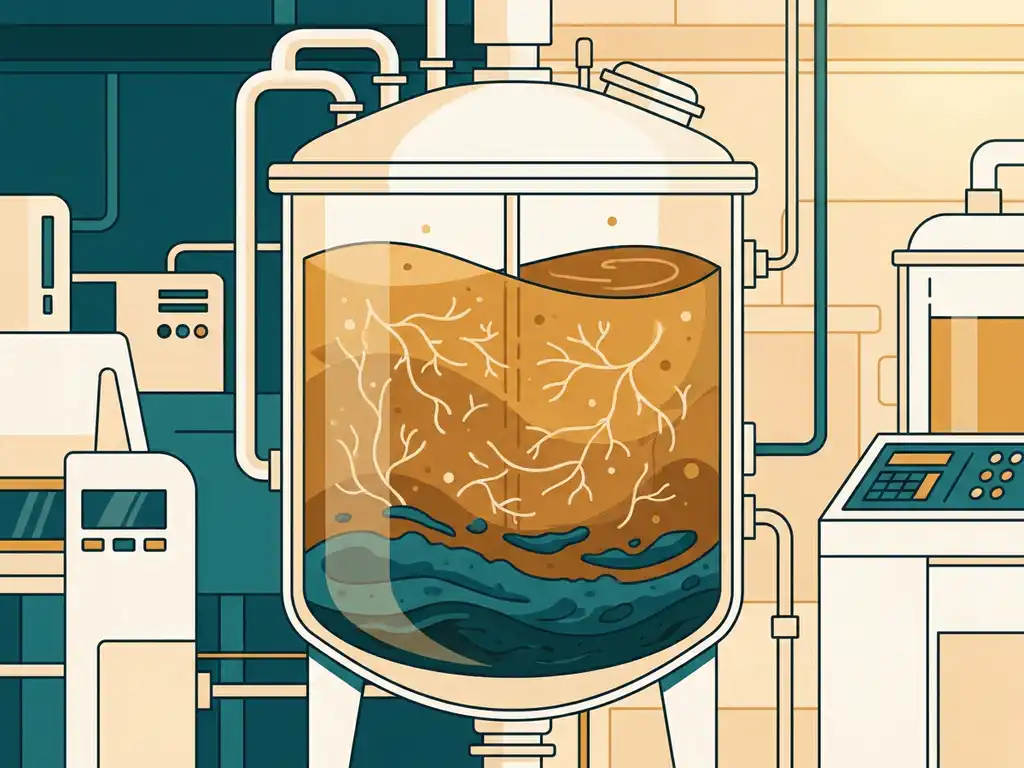
You can stabilize a biological reactor with recurring sludge issues by identifying the root cause first — whether biological, operational, or driven by load fluctuations — and then applying targeted interventions such as adjusting sludge retention time, correcting nutrient ratios, or inoculating with specialized microbial consortia. A one-size-fits-all approach rarely works. The sections below address the most common diagnostic questions and practical solutions for sludge instability in industrial wastewater treatment.
What causes recurring sludge problems in a biological reactor?
Recurring sludge problems in a biological reactor are most commonly caused by an imbalance between the microbial community and the conditions it operates in — including fluctuating organic loads, insufficient or excess nutrients, and suboptimal sludge retention times. When these conditions shift faster than the microbial population can adapt, sludge structure breaks down and settleability deteriorates.
In practice, the most frequent triggers fall into three categories. The first is nutritional imbalance: biological treatment depends on a stable carbon-to-nitrogen-to-phosphorus ratio. When the incoming wastewater deviates from this balance — which happens regularly in food processing or seasonal production facilities — the microbial community responds by changing its composition, often in ways that favor filamentous organisms or poorly settling flocs.
The second trigger is hydraulic and organic load variability. Reactors designed for average loads struggle when peak flows arrive. Sudden increases in COD or suspended solids can overwhelm the active biomass, leading to incomplete treatment and sludge washout. The third is poor sludge age management: if sludge is wasted too aggressively or too infrequently, the balance between growth and decay shifts, and the reactor loses its biological stability. Understanding these mechanisms is the starting point for any effective intervention in sludge problems in wastewater treatment.
Get in Touch
Let’s Talk Microbial Solutions
Book a conversation with Stijn, our CEO, or send us your request.
| Book an Appointment | Request Information |
How do you know if your sludge problem is biological or operational?
You can distinguish a biological sludge problem from an operational one by examining the sludge’s physical characteristics alongside the reactor’s process parameters. Biological problems typically show up as filamentous bulking, foaming, or poor floc structure under microscopy. Operational problems more often present as sludge washout, rising sludge, or poor settleability without visible filament overgrowth.
Signs of a biological root cause
Filamentous bulking is one of the clearest indicators of a microbial imbalance. Filamentous bacteria such as Microthrix parvicella or certain Thiothrix species thrive when conditions favor them — typically low dissolved oxygen, low food-to-microorganism ratios, or high concentrations of slowly biodegradable substrates. A sludge volume index (SVI) consistently above 150 mL/g, combined with visible filaments under a microscope, points to a biological diagnosis. Persistent foaming, particularly a stable brown or grey foam, often signals the presence of specific hydrophobic filamentous organisms.
Signs of an operational root cause
When settleability deteriorates rapidly after a process change — a new batch of raw material, a shift in production schedule, a pump failure — the problem is more likely operational. Rising sludge, caused by denitrification in the secondary settler, is a classic operational issue linked to nitrate accumulation and insufficient mixing. Similarly, if sludge settleability improves quickly after correcting a dissolved oxygen setpoint or adjusting the return activated sludge rate, the underlying microbial community was probably healthy, but the process conditions were not. A microbiological audit of your installation can make this distinction with precision, rather than relying on trial and error.
What are the most effective interventions for sludge bulking?
The most effective interventions for sludge bulking depend on whether filamentous or non-filamentous bulking is the cause, but the core strategies include optimizing dissolved oxygen levels, correcting nutrient dosing, adjusting sludge retention time, and in persistent cases, introducing targeted microbial inoculants to shift the community composition.
For filamentous bulking, the first step is removing the selective advantage that filamentous organisms hold. This usually means increasing dissolved oxygen in the aeration zone, introducing a selector (a small high-load zone at the inlet where floc-forming bacteria outcompete filaments), and reviewing the sludge age. Filamentous bacteria often dominate at long sludge ages combined with low substrate concentrations — adjusting the wasting rate can tip the balance back.
Nutrient correction is frequently underestimated. Nitrogen and phosphorus deficiencies encourage the growth of organisms that store substrates internally rather than contributing to a dense, settleable floc. Dosing the correct ratio of nitrogen and phosphorus relative to BOD is a straightforward operational fix that often produces rapid results.
In cases where the microbial community has been severely disrupted — after a toxic shock, a prolonged shutdown, or a major load change — passive recovery can take weeks. Inoculating the reactor with a well-adapted microbial consortium can significantly shorten this recovery period. Avecom has developed bioaugmentation approaches specifically for these situations, using mixed microbial cultures rather than single-strain products, which tend to be more resilient under variable industrial conditions.
How do seasonal production peaks trigger sludge instability?
Seasonal production peaks trigger sludge instability because they introduce sudden increases in organic load, nitrogen, or phosphorus that the existing biomass is not sized or conditioned to handle. The microbial community in a biological reactor adapts to the load it regularly receives — when that load doubles or triples in a short period, the system is effectively operating outside its design envelope.
This is a particularly common challenge in the food and beverage sector, where campaigns for fruit processing, dairy production, or starch manufacturing generate wastewater with very different characteristics than the off-season baseline. During peak production, COD concentrations can spike sharply, and nitrogen loads from protein-rich streams can push an otherwise compliant system into permit exceedance.
The biological response to this overload is predictable: the sludge floc structure weakens as organisms shift their metabolism under stress, filamentous species may proliferate if dissolved oxygen becomes limiting, and settleability drops. By the time the problem is visible in the effluent, the microbial community may already be significantly destabilized.
Anticipating these peaks operationally — by pre-adapting the biomass, adjusting sludge inventory ahead of the campaign, or using temporary bioaugmentation during the transition period — is far more effective than reacting after the fact. Molecular monitoring of the microbial community before and during peak periods can provide early warning signals before settleability visibly deteriorates.
When should you call in external expertise for sludge stabilization?
You should call in external expertise for sludge stabilization when in-house adjustments have not resolved the problem within two to three weeks, when permit exceedances are occurring or imminent, or when the root cause of the instability is unclear despite operational changes. Recurring problems that return after each intervention are a strong signal that the diagnosis — not just the treatment — needs external input.
Internal teams in production environments are typically skilled at operating equipment and managing process parameters, but diagnosing a complex microbial community problem requires a different toolkit. Microscopy, molecular analysis (such as 16S rRNA sequencing to identify which organisms are present and in what proportions), and experience with a wide range of industrial wastewater types are not standard competencies in most production facilities.
External expertise adds the most value in three situations: first, when a system needs to be restarted or fundamentally rebalanced without extended downtime; second, when a new wastewater stream is being introduced and the existing biology needs to adapt; and third, when regulatory pressure is increasing and the margin for error has narrowed. In these situations, a partner who can move from lab-scale feasibility testing through to operational implementation reduces both technical risk and the time to resolution.
Avecom’s approach to these engagements starts with an analysis of the specific wastewater composition and the existing microbial community, rather than applying a standard product or protocol. With more than 30 years of applied experience in microbial process optimization, the team works in the language of compliance and operational continuity — which is ultimately what matters most to the managers responsible for keeping a plant within permit. If excess sludge in your wastewater plant has become a persistent problem, a structured diagnostic process is the most reliable starting point for lasting stabilization.
Related Articles
- How do stricter discharge limits affect sludge management decisions?
- How do you seed a biological wastewater plant with the right bacteria?
- How do you diagnose sludge problems in biological treatment?
- Why does sludge bulking happen in activated sludge systems?
- What is excess sludge in wastewater treatment?