

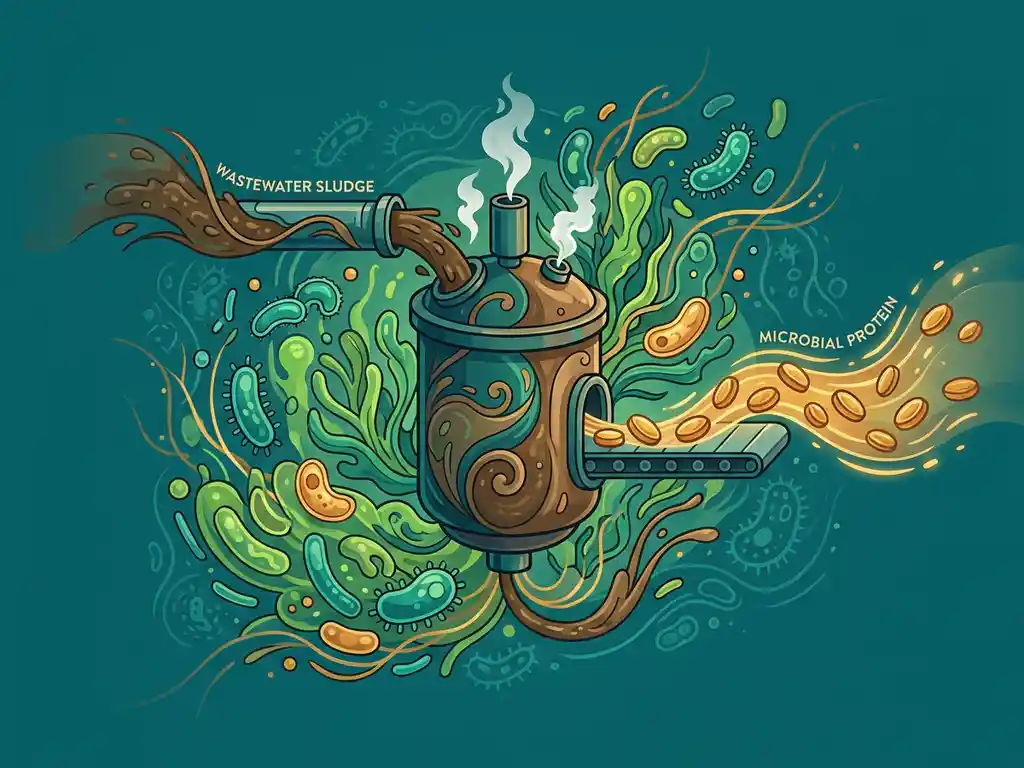
Wastewater sludge can be turned into useful byproducts including biogas, compost, soil amendments, and — under the right conditions — microbial protein suitable for animal feed. The key is matching the treatment approach to the composition of the sludge and the regulatory context in which it will be reused. For industrial producers dealing with excess sludge, the question is rarely whether valorisation is possible, but which pathway makes the most technical and economic sense for their specific situation.
The sections below work through the most common questions industrial environmental and production managers ask when exploring sludge valorisation for the first time.
What types of byproducts can wastewater sludge produce?
Wastewater sludge can produce biogas (via anaerobic digestion), digestate for soil application, compost, construction materials such as bricks or cement additives, and microbial biomass for use as fertilizer or animal feed. The specific byproduct depends on the origin of the sludge, its organic load, and the treatment technology applied.
Industrial sludge from food processing, for example, tends to be rich in organic matter and nutrients, making it well-suited for energy recovery through anaerobic digestion. The biogas produced can be used to generate heat and electricity on-site, reducing energy costs. The remaining digestate, if it meets quality standards, can be applied to agricultural land as a soil conditioner.
Sludge from chemical or pharmaceutical processes requires more careful handling. Contamination with trace compounds may limit reuse options and push the valorisation pathway toward thermal treatment or controlled disposal rather than biological recovery. Understanding the composition of your sludge is therefore the starting point for any valorisation strategy.
In recent years, a fourth category has gained traction in industrial biotechnology: converting the microbial biomass itself, particularly the nitrogen-rich fraction in reject water, into single-cell protein. This approach is discussed in more detail below.
Get in Touch
Let’s Talk Microbial Solutions
Book a conversation with Stijn, our CEO, or send us your request.
| Book an Appointment | Request Information |
How does biological treatment change the value of sludge?
Biological treatment changes the value of sludge by breaking down complex organic compounds into stabilized biomass, reducing pathogens, and concentrating nutrients in a form that can be recovered or reused. Without biological treatment, raw sludge is largely a waste disposal problem. After treatment, it becomes a more manageable and potentially valuable material.
In aerobic biological systems, microorganisms consume organic matter and produce new biomass. This excess sludge, sometimes called secondary sludge, contains significant quantities of nitrogen, phosphorus, and carbon. The challenge with excess sludge in wastewater plants is that it accumulates continuously and must be handled at a cost. Biological stabilization through aerobic or anaerobic digestion reduces volume and makes the remaining material safer to handle.
Anaerobic digestion goes a step further by converting organic sludge into biogas while producing a nutrient-rich digestate. This is one of the most established routes for sludge valorisation in industrial wastewater treatment. The energy recovered through biogas can partially offset the operating costs of the treatment plant itself.
The quality of biological treatment also affects downstream options. Well-managed microbial communities produce more consistent, higher-quality sludge. This is where microbiome engineering plays a role: by steering the composition of the microbial consortium in the treatment system, operators can influence both the treatment performance and the characteristics of the resulting biomass.
Can wastewater sludge be turned into animal feed or protein?
Yes, under specific conditions, the microbial biomass fraction of wastewater sludge can be processed into single-cell protein suitable for use in animal feed. This applies particularly to reject water streams rich in ammonium nitrogen, where specialized microorganisms can convert dissolved nutrients into protein-rich biomass. The resulting product must meet strict quality and safety requirements before it can enter the feed chain.
This pathway is distinct from composting or digestion. Rather than treating sludge as a waste stream to be stabilized, it reframes the nutrient-rich reject water as a feedstock for controlled microbial fermentation. Microorganisms are cultivated under defined conditions to produce biomass with a high protein content, which is then harvested, processed, and certified for use as a feed ingredient.
Avecom’s water treatment expertise includes the ProMic platform, which does exactly this: it recovers nitrogen from reject water streams and converts it into microbial protein through a controlled fermentation process. The process has been validated at pilot scale, and the company holds Feed Chain Alliance certification for small-scale commercial production. This is not a theoretical concept but an operational route that changes the economics of wastewater treatment by creating a new revenue stream from what was previously a cost.
Not all sludge streams are suitable for this pathway. The reject water must have a sufficiently high and consistent ammonium load, and the absence of inhibitory compounds is important. A feasibility assessment is always the first step.
What determines whether sludge valorisation is economically viable?
The economic viability of sludge valorisation depends on four main factors: the volume and composition of the sludge, the cost of current disposal, the value of the byproduct produced, and the capital and operating cost of the valorisation process. When disposal costs are high and byproduct value is meaningful, the business case can be strong even at moderate scale.
For many industrial producers, sludge disposal is a significant and growing cost. Tightening regulations on landfilling and incineration, combined with rising transport and handling fees, push the baseline disposal cost upward. This makes valorisation routes more attractive even when the recovered value is modest.
The composition of the sludge matters because it determines which valorisation pathways are technically feasible. High organic loads favor biogas production. High nitrogen content in reject water favors protein recovery. Contaminated sludge from chemical processes may foreclose biological reuse entirely and require thermal treatment, which typically has no positive revenue stream.
Scale is also a factor. Many valorisation technologies require a minimum throughput to justify the investment. For smaller producers, shared infrastructure or contract processing arrangements may be more practical than on-site installation. Pilot-scale validation before committing to full-scale investment is strongly advisable, both to confirm technical performance and to sharpen the financial model.
What are the regulatory requirements for reusing wastewater sludge?
Regulatory requirements for reusing wastewater sludge vary by application and jurisdiction, but generally cover contaminant limits, pathogen reduction standards, and end-use restrictions. In Belgium and the broader EU, sludge applied to agricultural land must comply with the Sewage Sludge Directive and national implementing legislation. Sludge used in animal feed applications faces additional requirements under EU feed hygiene and safety regulations.
For land application, the main concerns are heavy metals, organic pollutants, and pathogen levels. Industrial sludge from food processing is often cleaner in terms of heavy metals than municipal sludge, but each batch must be characterized and documented. Operators must maintain records and obtain permits from the relevant regional authority, and in Flanders this falls under VLAREM and the applicable sector conditions.
For protein recovery applications, the regulatory picture is more complex. Microbial biomass intended for animal feed must be produced under controlled conditions, undergo appropriate processing such as pasteurization, and meet the compositional and safety standards set by EU feed legislation. Certification by a recognized feed chain quality scheme is typically required before the product can be marketed or used commercially.
The regulatory landscape is evolving. Nutrient recovery and circular economy objectives in EU policy are gradually creating clearer pathways for sludge-derived products, but the compliance burden remains significant. Working with a partner who understands both the technical and regulatory dimensions reduces the risk of investing in a valorisation route that cannot be brought to market.
How do you get started with a sludge valorisation project?
Getting started with a sludge valorisation project begins with characterizing your sludge streams: volume, composition, variability, and current disposal costs. This baseline assessment determines which valorisation pathways are technically feasible and provides the data needed to build a credible business case. From there, a lab or pilot-scale feasibility test confirms whether the chosen approach performs as expected under real conditions.
The practical sequence typically looks like this:
- Stream characterization: Analyze the composition of your sludge and reject water, including organic load, nitrogen and phosphorus content, and any potentially inhibitory or contaminating compounds.
- Pathway selection: Based on composition and volume, identify the most promising valorisation routes and assess their regulatory feasibility in your jurisdiction.
- Feasibility testing: Run lab-scale or pilot-scale trials to validate technical performance before committing to full-scale investment.
- Business case development: Quantify the avoided disposal costs, potential revenue from byproducts, and capital and operating costs of the chosen process.
- Permitting and compliance: Identify the regulatory requirements for your chosen end-use and initiate the permitting process in parallel with technical development.
- Implementation and monitoring: Commission the process with appropriate monitoring of both performance and output quality.
The feasibility testing phase is where many projects either advance or stall. Sludge composition varies between industries and even between production campaigns within the same facility. A solution that works for one food processor may not transfer directly to another. This is why Avecom structures its engagement around site-specific assessment rather than off-the-shelf solutions: the starting point is always the client’s actual water composition and operational constraints.
For producers dealing with sludge problems in wastewater treatment, whether that means excess sludge accumulation, sludge bulking in biological treatment, or nutrient peaks that cause discharge violations, the valorisation conversation often starts with a compliance problem and ends with a redesigned process that performs better on both dimensions. The two goals are not in conflict: a well-managed biological system produces more consistent, lower-volume sludge and creates better conditions for downstream recovery.
If you are at the early stages of evaluating what your sludge streams could become, Avecom’s biological water treatment services include feasibility studies, microbiological audits of existing installations, and pilot-scale validation. The team works from your specific situation rather than a standard product offering, which matters when the sludge you are dealing with does not fit neatly into a textbook category. You can learn more about Avecom’s background and approach before reaching out for an initial consultation.