

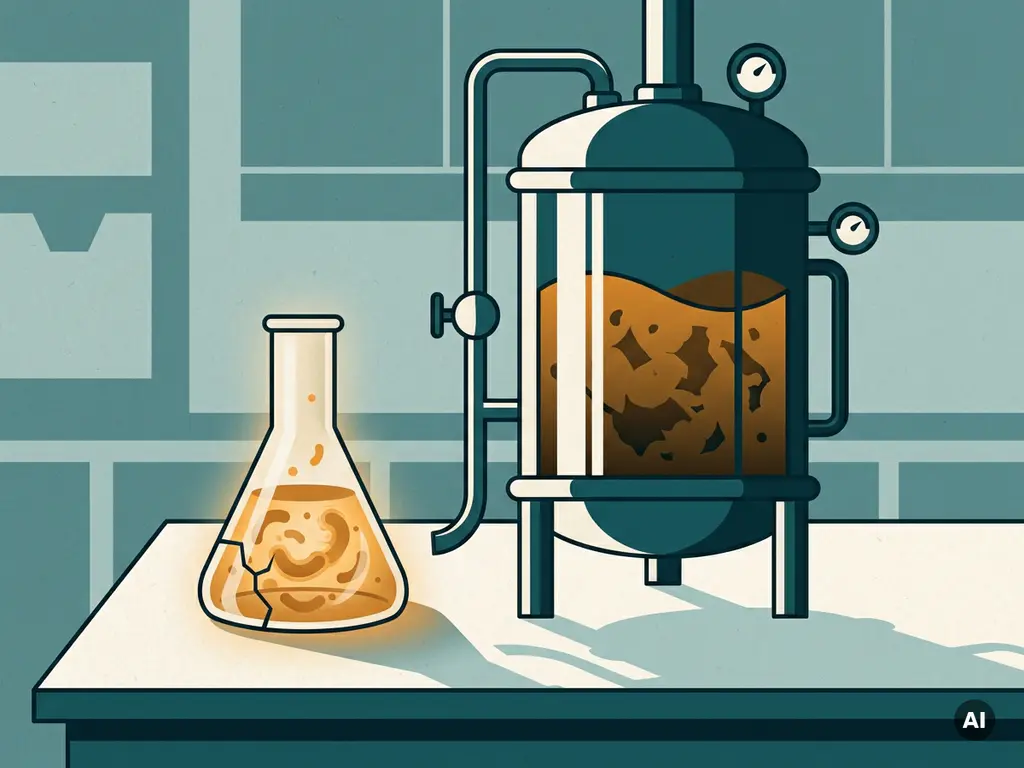
Fermentation processes fail during scale-up primarily because the physical and biological conditions that worked at lab scale cannot be replicated at larger volumes without deliberate engineering effort. Heat transfer, oxygen distribution, mixing uniformity, and microbial community dynamics all behave differently when reactor size increases by an order of magnitude. The sections below address the most common causes, warning signs, and decision points that determine whether a scale-up succeeds or stalls.
Why do fermentation parameters behave differently at pilot scale?
At pilot scale, the relationship between reactor volume and surface area changes fundamentally, which means that parameters like heat transfer, mass transfer, and mixing can no longer be assumed to behave as they did in a benchtop system. A process that appears stable at one or two liters often reveals hidden sensitivities when moved to a 100-liter or 500-liter vessel. This is the core reason why lab-to-pilot scale fermentation is one of the most technically demanding transitions in bioprocess development.
In a small flask or bench-top bioreactor, agitation is relatively uniform and oxygen reaches microbial cells quickly. At pilot scale, the geometry of the vessel creates zones of varying shear stress, oxygen concentration, and temperature. Microorganisms in different parts of the reactor may experience entirely different microenvironments, even when bulk measurements suggest the process is running normally. The result is inconsistent product yield, unexpected metabolite profiles, or outright process failure.
Dissolved oxygen gradients are a particularly well-documented source of discrepancy. In a lab reactor, a single impeller can maintain near-uniform dissolved oxygen throughout the culture. In a pilot vessel, the same impeller-to-volume ratio often fails to achieve this, leading to localized anaerobic zones that shift microbial metabolism in ways that were never observed at small scale.
What are the most common causes of scale-up failure in fermentation?
The most common causes of fermentation scale-up failure are inadequate oxygen transfer, poor mixing homogeneity, uncontrolled heat accumulation, pH gradients, and an incomplete understanding of how the microbial community responds to these changed conditions. Most scale-up failures can be traced to one or more of these factors acting in combination, often in ways that were not anticipated during lab-scale development.
- Oxygen transfer rate (OTR) mismatch: The volumetric mass transfer coefficient (kLa) is difficult to maintain at larger scales without significantly increasing agitation energy or adjusting sparger design. Insufficient oxygen delivery is one of the fastest routes to process failure in aerobic fermentation.
- Mixing time increases: As vessel volume grows, the time required for a nutrient or pH correction to distribute uniformly throughout the reactor increases sharply. Local concentration spikes can inhibit or stress microbial populations before bulk conditions normalize.
- Heat management: Microbial metabolism generates heat. At lab scale, the surface-area-to-volume ratio is high enough that ambient cooling is often sufficient. At pilot scale, active cooling becomes essential, and temperature excursions during high-activity phases can suppress growth or shift metabolic pathways.
- pH control lag: The response time of pH control systems increases with reactor size. Acid or base additions may overshoot before the system equilibrates, creating transient stress conditions that accumulate over time.
- Inoculum quality and scaling: The proportion of active, healthy inoculum relative to total reactor volume must be maintained. Poorly scaled inoculation strategies introduce lag phases or competitive disadvantages that compound as the process progresses.
Understanding which of these failure modes is most likely for a given process requires systematic characterization work before the scale-up attempt, not during it. This is where structured fermentation process development at an intermediate scale adds significant value.
Get in Touch
Let’s Talk Microbial Solutions
Book a conversation with Stijn, our CEO, or send us your request.
| Book an Appointment | Request Information |
Get in Touch
Let’s Talk Microbial Solutions
Book a conversation with Stijn, our CEO, or send us your request.
| Book an Appointment | Request Information |
How does microbial community composition affect scale-up success?
Microbial community composition directly determines how resilient a fermentation process is to the environmental fluctuations that inevitably occur at pilot scale. A well-characterized community with appropriate functional redundancy can absorb transient stress and maintain productivity. A poorly understood or fragile community can collapse rapidly when conditions deviate from the narrow window established at lab scale.
This is especially relevant for processes that rely on mixed microbial cultures rather than a single defined strain. Mixed cultures are common in industrial fermentation, particularly in applications involving complex substrates, anaerobic digestion, or microbial protein production. Their behavior at scale is harder to predict precisely because multiple species interact, compete, and shift in relative abundance in response to environmental changes.
When oxygen gradients develop in a pilot reactor, for example, facultative anaerobes within a mixed community may proliferate at the expense of obligate aerobes, fundamentally altering the metabolic output of the process. Without molecular monitoring tools such as amplicon sequencing or quantitative PCR, these shifts are invisible until they manifest as yield loss or product quality problems.
Conversely, well-engineered mixed cultures can offer advantages over pure cultures at scale precisely because their diversity provides a buffer against environmental perturbation. The key is understanding the community well enough to know which species perform which functions, and which conditions favor or suppress each. This level of characterization requires analytical capacity that most internal R&D labs do not routinely maintain.
Which process parameters are hardest to control during scale-up?
The process parameters most difficult to control during fermentation scale-up are dissolved oxygen, mixing homogeneity, and temperature, in that order. Each of these becomes progressively harder to manage as reactor volume increases, and each has a direct impact on microbial performance and product formation.
Dissolved oxygen and mass transfer
Maintaining adequate dissolved oxygen levels requires that the oxygen transfer rate match the biological oxygen demand of the culture at every point in the process. At lab scale, this is relatively straightforward. At pilot scale, the kLa value of the system depends on agitation rate, sparger design, and vessel geometry in ways that are not linearly scalable. Increasing agitation to compensate introduces shear stress, which can damage sensitive cell types or disrupt community structure in mixed-culture systems.
Mixing and nutrient distribution
Mixing time in a stirred-tank reactor scales roughly with the square or cube of the vessel diameter, depending on geometry and impeller configuration. This means that a process with a two-second mixing time at lab scale may require twenty seconds or more at pilot scale. During that interval, localized substrate depletion or pH excursions can occur. For processes where microbial metabolism is sensitive to substrate concentration, this alone can be enough to cause a fermentation process failure.
How can fermentation scale-up failures be detected early?
Early detection of fermentation scale-up problems relies on monitoring a combination of process signals and biological indicators in real time, rather than relying solely on end-point measurements like yield or product titer. The earlier a deviation is detected, the more options remain available to correct it without abandoning the run.
On the process side, key indicators include dissolved oxygen trends, pH drift rate, carbon dioxide evolution rate, and temperature profiles across different zones of the reactor. A dissolved oxygen level that drops faster than expected, or a pH that requires unusually high correction volumes, often signals that the biological activity in the reactor has shifted from the intended trajectory.
On the biological side, periodic sampling combined with molecular analysis provides a much earlier warning than culture-based methods. Amplicon sequencing of community samples taken at defined intervals can reveal shifts in species composition before those shifts translate into measurable performance changes. Similarly, quantitative PCR targeting key functional genes can confirm whether the organisms responsible for a desired metabolic function are still present and active at the expected abundance.
Building these monitoring checkpoints into the experimental design from the start, rather than adding them reactively after problems emerge, is the most reliable way to protect a pilot-scale fermentation investment. It also generates the process understanding data needed to define robust operating ranges for subsequent scale-up steps.
When should a company use a contract fermentation partner for scale-up?
A company should engage a contract fermentation partner for scale-up when it lacks the physical infrastructure, analytical capability, or process expertise to de-risk the transition from lab to pilot scale internally. The decision is most urgent when time-to-proof-of-concept is constrained by investor or commercial timelines, and when building internal capacity would take longer or cost more than the scale-up project itself.
The most common situations where external partnership adds clear value include:
- The internal lab can generate promising results but has no access to controlled bioreactors above a few liters in volume
- Previous scale-up attempts have failed and the root cause has not been identified
- The process involves mixed microbial cultures or complex substrates that require specialized monitoring and steering expertise
- Molecular characterization of the microbial community is needed but is not available internally
- The company needs to demonstrate process robustness to investors or regulatory bodies within a defined timeframe
A capable partner brings not only the physical infrastructure but also the accumulated process knowledge to interpret what is happening biologically during a scale-up run. For companies working with novel fermentation concepts, this combination of pilot-scale equipment and scientific expertise can compress the development timeline considerably compared to building equivalent capability in-house.
Avecom operates as exactly this kind of external fermentation expertise center, offering aerobic and anaerobic bioreactors up to 2,000 liters alongside molecular monitoring tools and deep experience with mixed microbial systems. For companies evaluating whether contract R&D is the right path, the relevant question is not whether the partnership costs money, but whether the alternative, building infrastructure and expertise from scratch, costs more time than the project can afford. You can learn more about Avecom’s approach to science-driven bioprocess development and how the team works as an extension of your internal R&D function.
Related Articles
- What is centrifugation used for in fermentation downstream processing?
- What is a feasibility study for a fermentation process?
- What happens to groundwater if contaminated soil is left untreated?
- What is the difference between soil remediation and soil stabilization?
- Can contaminated soil be cleaned without digging it up?