

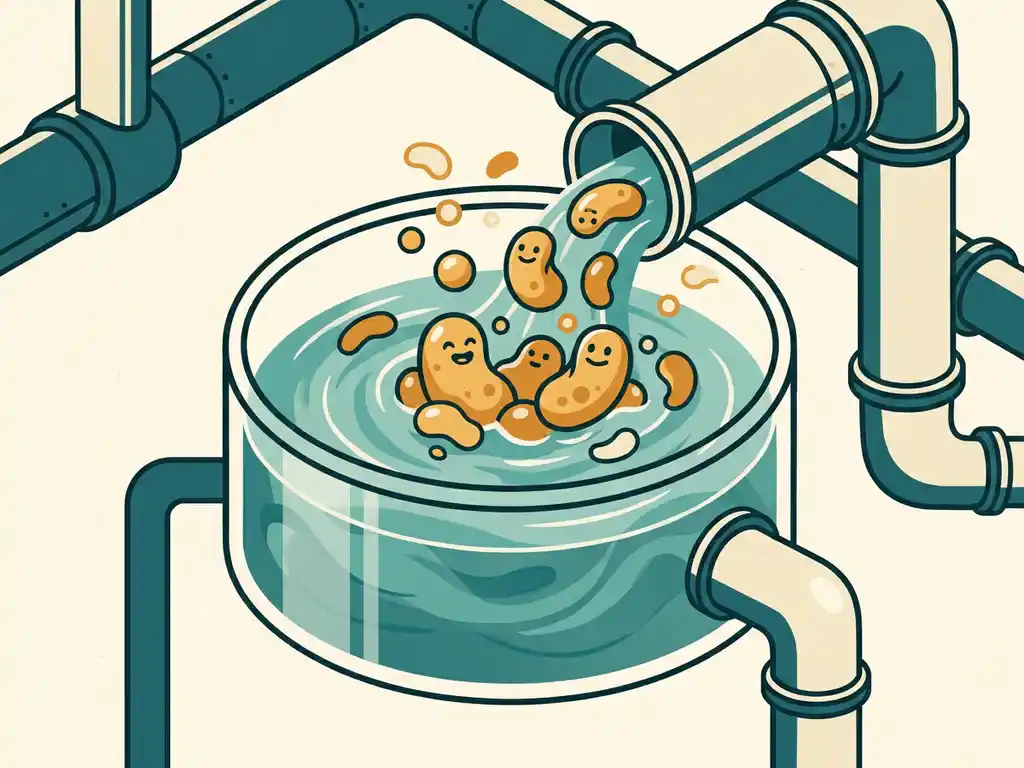
Bioaugmentation in wastewater treatment is the deliberate addition of selected microorganisms to a biological treatment system to improve its capacity to degrade specific pollutants. Rather than relying solely on the native microbial community already present in the sludge, bioaugmentation introduces strains or consortia that are better equipped to handle particular compounds, loading conditions, or environmental stressors. The sections below address the most common practical questions about how it works, when to use it, and how to evaluate results.
How does bioaugmentation actually work in a treatment system?
Bioaugmentation works by introducing targeted microorganisms directly into the biological reactor, where they integrate with the existing microbial community and contribute specific metabolic functions. The added organisms bring enzymatic capabilities that the native sludge either lacks or expresses too slowly to meet treatment demands. Over time, if conditions are suitable, these organisms establish themselves within the active biomass and shift the community’s overall degradation profile.
The practical mechanism depends on the system type. In an activated sludge reactor, introduced organisms must compete for substrate and survive hydraulic retention times. In biofilm systems, colonization of the carrier material is key. Either way, success depends on matching the inoculated strains to the actual chemical composition of the wastewater, the operating temperature, pH range, and organic loading. A blanket product applied without this diagnostic step rarely delivers consistent results.
This is why biological wastewater treatment at the industrial scale typically begins with a characterization phase before any microbial additions are made. Understanding what the existing community is doing, and where it is falling short, determines which organisms are worth introducing and in what quantity.
What is the difference between bioaugmentation and biostimulation?
Bioaugmentation adds new microorganisms to a system, while biostimulation modifies the existing environment to encourage the growth of microorganisms already present. Both approaches aim to improve biological treatment performance, but they operate through different mechanisms and are suited to different problems.
Biostimulation typically involves adjusting nutrient ratios, oxygen levels, pH, or temperature to favor specific metabolic pathways within the native community. It is most effective when the required degradation capacity is already present in the sludge but is being suppressed by suboptimal conditions. Bioaugmentation is the more appropriate choice when the target compound is genuinely absent from the microbial community’s repertoire, or when the native population has been disrupted by a toxic shock, a seasonal overload, or a process upset that has depleted key functional groups.
In practice, the two approaches are often combined. Introducing new organisms without addressing the conditions that caused the original problem will simply repeat the failure. Effective intervention usually means correcting the environmental conditions first, then reinforcing the community with targeted additions where gaps remain.
Get in Touch
Let’s Talk Microbial Solutions
Book a conversation with Stijn, our CEO, or send us your request.
| Book an Appointment | Request Information |
When should a facility consider bioaugmentation?
A facility should consider bioaugmentation when the biological treatment system is consistently failing to meet discharge standards despite correct operating conditions, or when a specific compound is not being degraded at the required rate. It is particularly relevant after process upsets, during seasonal loading peaks, or when the wastewater composition has changed significantly due to new production lines or formulation changes.
Common triggers include persistent sludge problems in wastewater treatment such as sludge bulking, poor settleability, or foam formation that does not respond to operational adjustments. These symptoms often indicate a community imbalance rather than a mechanical failure. Facilities dealing with excess sludge wastewater plant issues, where the system produces more biomass than can be efficiently managed, may also benefit from bioaugmentation if the root cause is an inefficient community composition rather than overloading alone.
Nitrogen and phosphorus peaks, which are common in food processing facilities with seasonal production cycles, are another scenario where targeted microbial additions can stabilize performance without requiring major infrastructure investment. The key criterion is that the problem has a biological root cause. If the issue is hydraulic overloading, insufficient aeration capacity, or a toxic influent concentration, bioaugmentation alone will not resolve it.
What types of microorganisms are used in bioaugmentation?
The microorganisms used in bioaugmentation range from single bacterial strains selected for a specific degradation function to complex mixed microbial consortia that replicate a balanced, functional community. The choice depends entirely on the target pollutant, the system conditions, and the stability required over time.
For industrial wastewater, mixed consortia are generally more robust than pure cultures. A consortium brings functional redundancy: if one organism is outcompeted or inhibited, others can compensate. Pure cultures can deliver high initial performance but are more vulnerable to process variability and may not persist once the selective pressure of the inoculation phase passes.
Organisms used in practice include nitrifiers and denitrifiers for nitrogen removal, specific heterotrophs for difficult organic compounds such as surfactants or pharmaceutical residues, and filamentous bacteria controllers where sludge bulking in biological treatment is caused by filament overgrowth. Selecting the right combination requires both microbiological expertise and a clear understanding of the wastewater chemistry. Avecom’s approach, developed over more than 30 years of applied microbiology, centers on engineering mixed microbial communities rather than relying on single-strain solutions, which tends to produce more durable results in variable industrial conditions.
Does bioaugmentation work for industrial wastewater specifically?
Yes, bioaugmentation is applicable to industrial wastewater, but its effectiveness depends on how well the microbial selection is matched to the specific chemical matrix of the effluent. Industrial wastewater is rarely uniform: it varies by sector, by production schedule, and by the cleaning and processing chemicals used. This variability is precisely why generic off-the-shelf bioaugmentation products often underperform in industrial settings.
Food and beverage producers, chemical manufacturers, and pharmaceutical facilities each generate wastewater with distinct organic profiles, nutrient loads, and inhibitory compounds. A consortium that performs well in municipal sludge may not survive or function in a high-salinity or low-pH industrial effluent. Effective bioaugmentation for industrial applications therefore requires lab- and pilot-scale feasibility testing before full-scale implementation.
The most reliable outcomes come from a process that starts with a microbiological audit of the existing system, identifies the functional gaps, and then selects or cultivates organisms specifically for those conditions. This is more resource-intensive than applying a packaged product, but it substantially reduces the risk of failed implementation and costly downtime. For facilities concerned about disruption during process adjustment, this staged approach also allows changes to be validated at small scale before any modifications are made to the live installation.
How do you measure whether bioaugmentation is working?
Measuring the success of bioaugmentation requires tracking both operational performance indicators and microbiological community composition. Operational metrics include effluent quality parameters such as chemical oxygen demand (COD), biological oxygen demand (BOD), ammonia, nitrate, and suspended solids against discharge limits. Improvements in these values over a defined period are the primary evidence that the intervention is working.
However, operational data alone can be misleading. A short-term improvement in effluent quality may reflect a temporary reduction in loading rather than a genuine shift in microbial community function. Molecular monitoring techniques, such as quantitative PCR or 16S rRNA sequencing, allow direct verification that the introduced organisms have established themselves in the sludge and are present at functionally relevant abundances.
Secondary indicators are also informative. Sludge settleability, measured by the sludge volume index (SVI), reflects community structure and is a reliable proxy for whether sludge bulking problems are being resolved. Oxygen uptake rates can indicate whether the active biomass has increased its degradation capacity. Foam and filament counts under microscopy provide early warning if the community balance is shifting in an undesirable direction.
A structured monitoring plan should be established before the bioaugmentation is applied, so that baseline values are available for comparison. Without a clear before-and-after dataset, it is difficult to attribute performance changes to the intervention with confidence. For facilities that lack in-house microbiological expertise, partnering with a specialist who can provide molecular monitoring of microbial communities alongside the treatment itself is the most reliable path to a defensible result.
If your facility is dealing with persistent sludge problems, compliance pressure, or a treatment system that is no longer keeping pace with production demands, a structured feasibility assessment is a practical starting point. Avecom works with industrial producers across the food, chemical, and pharmaceutical sectors to diagnose biological treatment failures and develop solutions grounded in applied microbiology rather than standardized products.
Related Articles
- What are the legal obligations when contamination is found on a site?
- What are the risks of leaving contaminated soil untreated?
- How do environmental engineers assess contamination risk?
- What are the signs of sludge bulking in a biological reactor?
- How do you measure sludge settleability in a wastewater plant?