

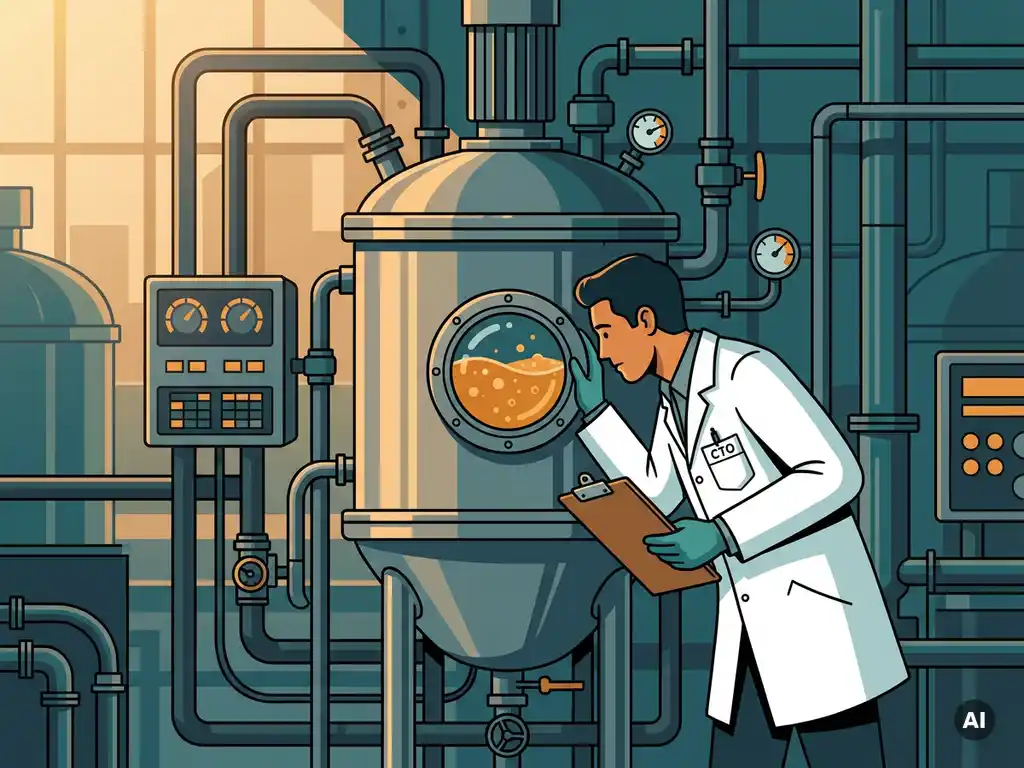
A CTO evaluating a fermentation contract manufacturer should ask about infrastructure depth, microbial expertise, IP protection practices, regulatory certifications, and how the partner handles the transition from lab to pilot scale. The right questions separate a capable development partner from a simple service provider. The sections below address each of these areas in turn.
What capabilities should a fermentation contract manufacturer have?
A fermentation contract manufacturer should have a full range of bioreactor configurations covering aerobic and anaerobic conditions, batch and continuous operation, and a temperature range spanning mesophilic to thermophilic processes. Equally important is access to analytical tools for process monitoring, downstream processing equipment, and the scientific staff to interpret results and adapt the process.
Infrastructure alone is not sufficient. The facility should be able to work across different microbial systems, including both defined cultures and complex mixed microbial communities. Many industrial fermentation challenges involve poorly characterized consortia rather than single strains, and a partner without experience in mixed cultures will struggle to deliver reliable results in those contexts.
On the analytical side, look for high-throughput molecular tools such as amplicon sequencing and qPCR. These techniques allow the partner to monitor and steer the microbial community with precision, which is especially important during scale-up when process conditions shift and microbial dynamics can change unexpectedly.
Downstream processing capabilities matter too. Centrifugation, pasteurization, and product concentration are often overlooked in early conversations but become critical when moving toward a marketable output. A partner that can handle end-to-end processing reduces handoff risk and keeps your development timeline intact.
How does a contract manufacturer handle IP protection and confidentiality?
A reputable fermentation contract manufacturer protects intellectual property through formal non-disclosure agreements signed before any technical exchange, clear contractual language on data ownership, and internal information barriers that prevent cross-project contamination. IP protection should be a standard operating procedure, not something you need to request specifically.
Before sharing process details, ask the manufacturer how they segregate data between clients, who within their organization has access to your project files, and whether they have a policy on publishing research derived from contract work. Academic spin-outs and research-affiliated organizations may have publication interests that need to be explicitly addressed in the contract.
Ownership of process improvements developed during the engagement is a frequent source of dispute. Clarify upfront whether any optimization work performed on your process remains your IP, whether the manufacturer retains rights to general methodological learnings, and how inventions made jointly are handled. These terms are negotiable but must be agreed on before work begins.
Confidentiality also extends to physical security. Ask whether client materials, strains, and data are stored separately, and whether the facility has access controls that limit exposure to only the personnel directly working on your project.
Get in Touch
Let’s Talk Microbial Solutions
Book a conversation with Stijn, our CEO, or send us your request.
| Book an Appointment | Request Information |
What’s the difference between lab-scale and pilot-scale fermentation services?
Lab-scale fermentation services focus on feasibility and process characterization, typically using reactors in the range of one to twenty liters. Pilot-scale fermentation validates that a process developed at lab scale behaves predictably at a larger volume, generally between fifty and two thousand liters, under conditions closer to industrial reality. The two serve different purposes and involve different risks.
At lab scale, the goal is to establish that the biological concept works: the right organisms, the right substrates, the right environmental conditions. Results at this stage are informative but not yet predictive of industrial behavior. Mixing dynamics, heat transfer, oxygen distribution, and foam management all change significantly when reactor volume increases, and these factors can destabilize a process that appeared robust at bench scale.
Pilot-scale work addresses these engineering variables. It generates the data needed to define critical process parameters, set control ranges, and identify failure modes before committing to full production. This stage is also where regulatory and quality documentation typically begins, since process data from pilot scale often forms the basis for product specifications and safety assessments.
When evaluating a fermentation partner, confirm that they can run both stages and that the same scientific team oversees the transition. Continuity of knowledge between lab and pilot scale is one of the most underrated factors in successful scale-up. Organizations like Avecom’s fermentation services are structured to carry a project from initial feasibility testing through pilot-scale validation without handing off to a different team at each stage.
How do you evaluate a fermentation partner’s microbial expertise?
Evaluate a fermentation partner’s microbial expertise by reviewing their publication record, the range of organisms and process types they have worked with, and their ability to work with mixed microbial cultures rather than only pure strains. Ask for examples of projects where they diagnosed and resolved a microbial instability problem during scale-up.
The distinction between pure culture and mixed culture expertise is practically significant. Pure culture fermentation, using a single defined organism, is the default in pharmaceutical and some food applications. Mixed culture fermentation, where a community of microorganisms performs the conversion, is common in waste valorization, single-cell protein production, and many environmental biotechnology applications. These systems behave differently and require different analytical and management approaches.
Ask specifically about their experience with microbiome monitoring. A partner who relies solely on classical culture-based methods will have limited visibility into what is happening in a complex fermentation. Molecular techniques, particularly amplicon sequencing, give a much more detailed picture of community composition and dynamics, which is essential for understanding why a process is behaving as it is and how to steer it.
Scientific credibility is also a practical asset beyond the laboratory. A partner with a strong publication record and academic connections can strengthen your R&D documentation for grant applications, patent filings, and investor due diligence. Avecom’s background as a Ghent University spin-out reflects this kind of scientifically grounded approach to industrial fermentation.
What quality and regulatory certifications should a contract fermentation facility hold?
The certifications a contract fermentation facility should hold depend on the intended application of the product, but at minimum the facility should operate under a documented quality management system, maintain traceability for all inputs and outputs, and hold any sector-specific certifications required for the product category you are developing.
For animal feed applications, Feed Chain Alliance (FCA) certification is a relevant benchmark. It demonstrates that the facility operates within an audited quality framework covering raw material sourcing, process hygiene, and product safety. For food-grade or pharmaceutical applications, the bar is higher and may require GMP compliance or specific food safety certifications.
Beyond certifications, ask about the facility’s approach to batch documentation, deviation management, and change control. A facility that cannot provide complete batch records or that handles process deviations informally will create problems downstream when you need to demonstrate process consistency to regulators or customers.
Also clarify how the partner handles regulatory questions that arise during development. If your product will require a novel food authorization, a feed additive dossier, or environmental release approval, a partner with experience navigating those processes is significantly more valuable than one that treats regulatory affairs as your problem alone.
How should a CTO structure the first engagement with a fermentation contract manufacturer?
Structure the first engagement as a defined, time-limited feasibility study with clear deliverables, a fixed scope, and a written agreement covering IP, confidentiality, and data ownership. A small, bounded first project lets both parties assess working compatibility and technical alignment before committing to a longer development program.
Before the first technical meeting, prepare a concise brief that describes your process concept, the biological system involved, the inputs and target outputs, and the key unknowns you need resolved. The more specific you are, the faster the partner can assess feasibility and propose a realistic scope. Vague briefs lead to vague proposals and mismatched expectations.
During the initial conversation, pay attention to how the partner responds to your unknowns. A strong fermentation R&D partner will ask clarifying questions, identify the critical risk factors in your process, and propose a logical experimental sequence. A weaker partner will move quickly to a price quote without engaging with the technical complexity.
Define success criteria for the feasibility phase before work begins. Agree on which parameters will be measured, what outcomes would constitute a positive result, and what decision points will determine whether to proceed to pilot scale. This discipline protects both parties and ensures that the data generated is actually useful for your next decision rather than simply demonstrating activity.
Finally, treat the first engagement as a mutual evaluation. You are assessing the partner’s scientific rigor, communication quality, and responsiveness under real working conditions. Those qualities matter as much as the technical results when you are deciding whether to deepen the relationship into a longer-term fermentation scale-up program.
Related Articles
- What is the difference between fermentation R&D and process development?
- What is microbiome monitoring and why does it matter in fermentation?
- What fermentation applications exist in the agrochemical industry?
- What is a microcosm test in soil remediation?
- How do stricter discharge limits affect sludge management decisions?