

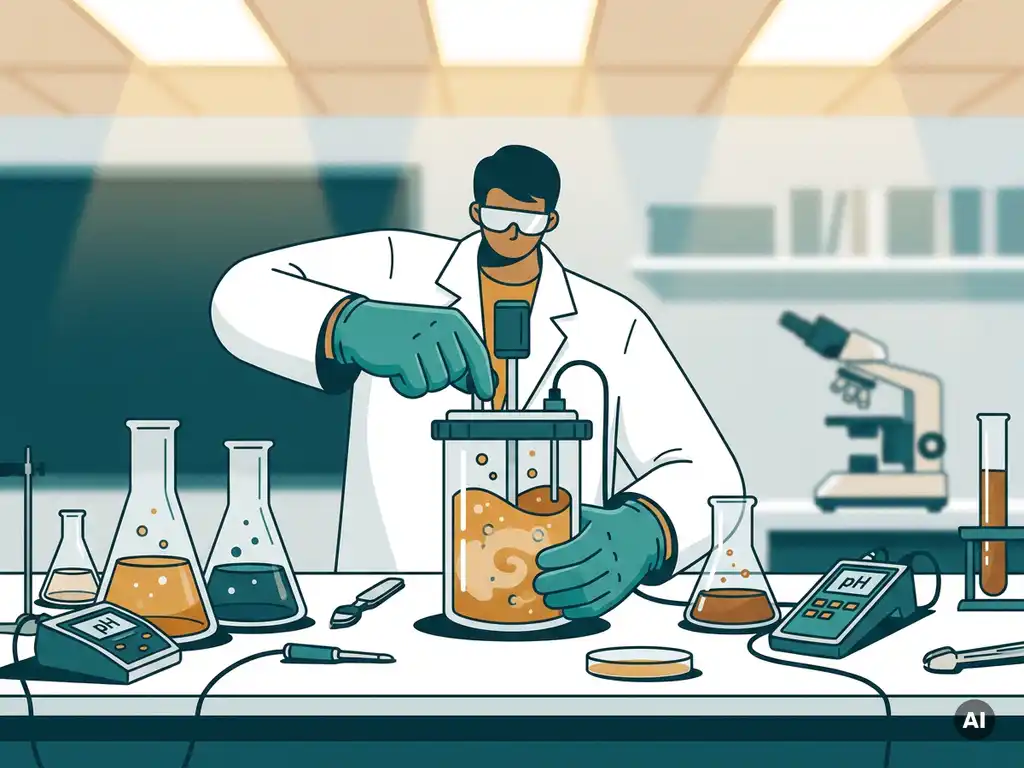
Lab-scale fermentation testing is the process of running a fermentation reaction in a controlled, small-volume environment, typically between one and twenty liters, to evaluate whether a microbial process is technically feasible before committing to larger infrastructure. It is the first structured step in validating a fermentation concept, allowing researchers and engineers to understand how a microbial system behaves under defined conditions. The sections below address the most common questions companies ask before starting a fermentation feasibility study.
What happens during a lab-scale fermentation test?
During a lab-scale fermentation test, a microbial culture is introduced into a controlled bioreactor where temperature, pH, aeration, and nutrient supply are carefully managed. The goal is to observe how the microorganisms grow, consume substrate, and produce target compounds under reproducible conditions. This generates the process data needed to determine whether a concept is worth developing further.
A typical lab fermentation process starts with inoculum preparation, cultivating the relevant microbial community or strain to an appropriate density before transferring it to the bioreactor. From there, the fermentation runs through defined phases: lag, exponential growth, and stationary. Samples are taken at regular intervals to track biomass accumulation, substrate consumption, and product formation.
For processes involving complex microbial communities rather than pure cultures, additional molecular analysis tools such as amplicon sequencing or qPCR are used to monitor community composition throughout the run. This level of monitoring is particularly important when working with mixed cultures, where shifts in microbial populations can significantly affect process performance and reproducibility.
What parameters are measured and controlled during fermentation?
The core parameters measured and controlled during microbial fermentation testing include temperature, pH, dissolved oxygen, agitation speed, and nutrient feed rates. These variables directly influence microbial metabolism, and maintaining them within defined ranges is what makes a lab-scale result reproducible and meaningful for scale-up decisions.
Beyond the physical and chemical control parameters, analytical measurements track the biological response of the culture:
- Biomass concentration – measured by optical density or dry weight to track growth
- Substrate consumption – monitoring how quickly the culture depletes carbon and nitrogen sources
- Product formation – quantifying the target compound (protein, enzyme, metabolite) over time
- Off-gas composition – CO2 and O2 levels in the exhaust gas indicate metabolic activity
- Microbial community structure – relevant for mixed culture systems, tracked via molecular tools
The precision of this monitoring is what distinguishes a proper fermentation feasibility study from a simple shake-flask experiment. Instrumented bioreactors generate continuous data streams that reveal how the process responds to disturbances, information that is essential before attempting any scale-up.
{div style=”box-sizing: border-box !important; margin: 32px 0 !important; padding: 28px 32px !important; background-color: #004070 !important; background-image: linear-gradient(135deg, #004070 0%, #003057 100%) !important; border: none !important; border-left: 4px solid #36a9e1 !important; font-family: ‘Exo’, sans-serif !important; text-align: center !important; line-height: normal !important;”}
{p style=”margin: 0 0 6px 0 !important; padding: 0 !important; font-family: ‘Exo’, sans-serif !important; font-size: 12px !important; font-weight: 500 !important; color: #36a9e1 !important; text-transform: uppercase !important; letter-spacing: 1.5px !important; line-height: 16px !important;”}Get in Touch{/p}
{p style=”margin: 0 0 8px 0 !important; padding: 0 !important; font-family: ‘Exo’, sans-serif !important; font-size: 20px !important; font-weight: 500 !important; color: #ffffff !important; line-height: 26px !important;”}Let’s Talk Microbial Solutions{/p}
{p style=”margin: 0 0 20px 0 !important; padding: 0 !important; font-family: ‘Exo’, sans-serif !important; font-size: 14px !important; font-weight: 300 !important; color: #ffffff !important; line-height: 20px !important;”}Book a conversation with Stijn, our CEO, or send us your request.{/p}
{table style=”border-collapse: collapse !important; border-spacing: 0 !important; margin: 0 auto !important; padding: 0 !important; width: auto !important;” cellpadding=”0″ cellspacing=”0″ role=”presentation”}
{tr style=”margin: 0 !important; padding: 0 !important;”}
{td style=”margin: 0 !important; padding: 0 6px 0 0 !important; white-space: nowrap !important;”}
{a href=”https://avecom.be/contact-2/” style=”display: inline-block !important; box-sizing: border-box !important; margin: 0 !important; padding: 11px 24px !important; background-color: #95c11f !important; color: #ffffff !important; font-family: ‘Exo’, sans-serif !important; font-size: 14px !important; font-weight: 500 !important; text-transform: uppercase !important; text-decoration: none !important; border: none !important; line-height: 18px !important; letter-spacing: 0.3px !important; white-space: nowrap !important;”}Book an Appointment{/a}
{/td}
{td style=”margin: 0 !important; padding: 0 !important; white-space: nowrap !important;”}
{a href=”https://avecom.callista.be/contactus” style=”display: inline-block !important; box-sizing: border-box !important; margin: 0 !important; padding: 9px 24px !important; background-color: transparent !important; color: #ffffff !important; font-family: ‘Exo’, sans-serif !important; font-size: 14px !important; font-weight: 500 !important; text-transform: uppercase !important; text-decoration: none !important; border: 2px solid #ffffff !important; line-height: 18px !important; letter-spacing: 0.3px !important; white-space: nowrap !important;”}Request Information{/a}
{/td}
{/tr}
{/table}
{/div}
How long does a lab-scale fermentation study take?
A lab-scale fermentation study typically takes between four and twelve weeks from project start to final reporting, depending on the complexity of the microbial system and the number of conditions being tested. Simple batch fermentations with known organisms can yield initial results in two to three weeks, while studies involving mixed cultures, process optimization, or multiple substrate conditions take considerably longer.
The timeline breaks down roughly as follows: one to two weeks for inoculum development and system setup, one to four weeks for the fermentation runs themselves (which may be repeated across different conditions), and one to two weeks for data analysis and reporting. If the study includes downstream processing steps, such as centrifugation or drying to characterize the end product, additional time is required.
For companies facing investor timelines or internal proof-of-concept deadlines, working with an established contract fermentation R&D partner rather than building internal capacity is often the fastest path to a credible dataset. Avecom’s fermentation R&D infrastructure is set up to run studies without the lead time of equipment procurement or staff training.
What’s the difference between lab-scale and pilot-scale fermentation?
Lab-scale fermentation operates in reactors typically ranging from one to twenty liters and is primarily used for feasibility testing, parameter screening, and process development. Pilot-scale fermentation uses reactors in the range of fifty to two thousand liters and is used to validate that a process developed at lab scale behaves predictably at larger volumes before committing to full production.
The distinction is not just about volume. At lab scale, the priority is generating reliable process understanding: identifying optimal temperature, pH, and feeding strategies, and confirming that the microbial system produces the target compound at acceptable yields. At pilot scale, the focus shifts to engineering challenges: how mixing dynamics change with volume, how heat transfer behaves differently in larger vessels, and whether the process remains stable over longer run times.
A well-executed lab-scale study is what makes pilot-scale fermentation efficient. Without solid process data from the lab, pilot runs become expensive trial-and-error exercises. The two scales are sequential steps in a development pathway, not alternatives to each other.
Why do fermentation processes fail when scaling up from lab to pilot?
Fermentation processes most commonly fail during scale-up because physical parameters that are easy to control at small volume become difficult to maintain at larger scale. Mixing uniformity, oxygen transfer rates, and heat distribution all change significantly as reactor volume increases, and a process optimized for a two-liter vessel does not automatically translate to a two-hundred-liter vessel.
Several specific failure modes appear repeatedly in fermentation scale-up:
- Oxygen limitation – aerobic cultures that received adequate oxygen at lab scale become oxygen-starved in larger reactors where gas transfer efficiency is lower
- Gradient formation – pH and substrate gradients develop in large vessels where mixing is imperfect, creating zones that are hostile to microbial activity
- Contamination sensitivity – processes that ran cleanly in small, tightly controlled lab reactors become vulnerable to contamination when handling volumes are larger
- Inoculum quality – scaling up the seed culture itself introduces variability that was not present at lab scale
- Underdetermined process parameters – if the lab study did not systematically explore the sensitivity of the process to key variables, the pilot run encounters conditions outside the validated range
The underlying cause of most scale-up failures is insufficient process understanding at the lab stage. A thorough fermentation feasibility study that deliberately stresses the process across a range of conditions produces the mechanistic insight needed to anticipate and manage these engineering challenges.
When should a company outsource fermentation testing to a contract lab?
A company should outsource fermentation testing to a contract lab when it lacks the specialized bioreactor infrastructure, instrumentation, or microbial expertise to run a controlled study internally, or when the time and capital required to build that capacity internally would delay the project beyond acceptable limits. Outsourcing is particularly appropriate at the feasibility and early development stages, before it is clear whether a process warrants internal investment.
The decision is straightforward in several common situations:
- The internal lab can run shake-flask experiments but has no instrumented bioreactors for controlled fermentation
- The process involves complex mixed microbial cultures that require molecular monitoring tools not available in-house
- A proof-of-concept result is needed within six to twelve months for an investor or regulatory milestone
- The company wants to test multiple process conditions in parallel without the overhead of running each internally
- Scientific documentation is needed to support a patent application or subsidy file
Working with a specialized contract fermentation partner also provides access to expertise that goes beyond equipment. Understanding how to design a meaningful feasibility study, interpret microbial community data, and translate lab results into pilot-scale process parameters requires experience that is difficult to build quickly in-house. For companies at the scale-up stage, that expertise is often the most valuable part of the engagement.