

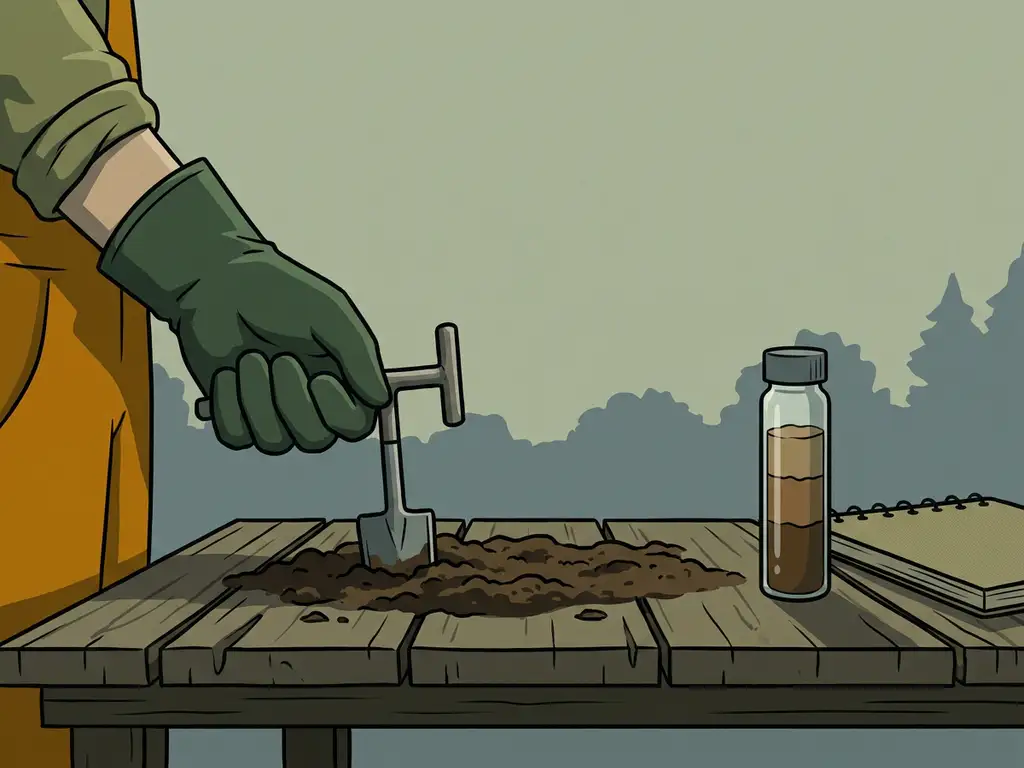
To test if soil is contaminated, you collect soil and groundwater samples from the suspected area and send them to an accredited laboratory for chemical analysis. The lab screens for a defined set of pollutants – solvents, heavy metals, petroleum hydrocarbons, or other substances – and compares the results against regulatory threshold values. If concentrations exceed those limits, the soil is legally classified as contaminated, and further investigation or remediation is required.
The right approach depends on what contaminants you suspect, the history of the site, and the regulatory framework that applies. In Belgium, for example, OVAM and VLAREBO set the reference values that determine whether a site requires action. Understanding the full testing process – from initial sampling to remediation feasibility – helps project managers and site owners make faster, better-informed decisions when dealing with contaminated soil.
What methods are used to detect soil contamination?
Soil contamination is detected through a combination of field screening and laboratory analysis. Field methods such as portable gas detectors, X-ray fluorescence (XRF) scanners, and direct-push soil probes give rapid on-site indications. Laboratory analysis of collected samples then provides legally defensible, quantified results that can be compared against regulatory standards.
The choice of method depends on the type of contamination suspected. Volatile organic compounds (VOCs), including chlorinated solvents, require headspace gas chromatography or purge-and-trap analysis. Heavy metals are typically measured by inductively coupled plasma mass spectrometry (ICP-MS). Petroleum hydrocarbons are screened using total petroleum hydrocarbon (TPH) analysis.
Field screening is useful for guiding where to take samples, but it cannot replace accredited laboratory analysis. Regulatory bodies require certified laboratory results before any legal classification or remediation decision is made. For complex sites with a history of industrial use, a phased investigation approach is standard: a preliminary desk study first, followed by exploratory sampling, and then a detailed characterisation if contamination is confirmed.
Get in Touch
Let’s Talk Microbial Solutions
Book a conversation with Stijn, our CEO, or send us your request.
| Book an Appointment | Request Information |
What contaminants are most commonly found in soil?
The most commonly found contaminants in soil are petroleum hydrocarbons (from fuel storage and spills), heavy metals (lead, cadmium, zinc, arsenic), chlorinated solvents such as tetrachloroethylene (PCE) and trichloroethylene (TCE), polycyclic aromatic hydrocarbons (PAHs), and pesticides. The specific mix depends heavily on the historical land use of the site.
Industrial and brownfield sites frequently carry legacy contamination from decades of manufacturing, dry cleaning, metalworking, or chemical processing. Chlorinated solvents – collectively known as volatile organochlorine compounds (VOCl) – are among the most persistent and problematic. They sink through the soil profile into groundwater, spread laterally, and resist conventional treatment. This makes them particularly relevant for site owners facing blocked development plans or stalled remediation programmes.
Agricultural land tends to show elevated nitrate, phosphate, and pesticide residues. Urban soils often contain lead from historical paint and fuel additives. Understanding which contaminants are likely present before sampling allows investigators to select the right analytical suite and avoid missing critical pollutants.
How is a soil sample collected and analysed?
Soil samples are collected by drilling or driving a probe into the ground at defined depths and locations, transferring material into sealed containers to prevent contamination or off-gassing, and delivering them to an accredited laboratory within a specified holding time. The laboratory then extracts and analyses the target compounds using validated chemical methods.
A sampling plan defines the number, location, and depth of samples based on site history and the suspected contamination pattern. Samples are typically taken from multiple depths to capture both the unsaturated zone and the saturated zone near the water table. For volatile compounds, special low-disturbance sampling techniques are used to prevent losses before the sample reaches the lab.
Groundwater sampling through monitoring wells is often conducted alongside soil sampling, since many contaminants migrate into the aquifer. Laboratory turnaround typically takes one to three weeks depending on the analytical methods required. Results are reported in milligrams per kilogram (mg/kg) for soil and micrograms per litre (µg/L) for groundwater, and are then compared directly to the threshold values set by the relevant authority.
What does a microcosm test reveal about contaminated soil?
A microcosm test reveals whether the native microbial community in a contaminated soil is capable of breaking down specific pollutants under controlled laboratory conditions. It is a small-scale feasibility study that simulates the actual soil environment and measures whether biodegradation occurs, at what rate, and whether it proceeds to safe end products – all before committing to a full-scale remediation programme.
For chlorinated solvents specifically, a microcosm test determines whether the right degrading microorganisms are already present in the soil, whether they are active or dormant, and whether adding nutrients, electron donors, or specialised microbial cultures would accelerate the process. This is critical information: biological remediation of VOCl only works when the complete degradation pathway is functional. Incomplete degradation can temporarily produce more toxic intermediate compounds, so confirming the full pathway in the lab before field application is essential.
Avecom uses microcosm tests as a standard first step in evaluating sites for biological soil remediation. The test is relatively fast and cost-efficient compared to a full pilot, and it gives site owners concrete, site-specific data rather than a general assumption that biology will work. If the microcosm shows degradation is feasible, the results directly inform the design of the remediation strategy.
When should you consider biological soil remediation?
You should consider biological soil remediation when excavation is not technically feasible or economically viable, when contamination is deep or spread across a large area, or when conventional techniques have already been applied without achieving the required clean-up targets. It is particularly well-suited to chlorinated solvent contamination, petroleum hydrocarbons, and other organic pollutants that microorganisms can degrade.
Biological remediation becomes the logical alternative in several common scenarios:
- The site has existing structures that make excavation impossible without demolition
- Groundwater contamination has spread beyond the source zone
- Previous pump-and-treat or soil vapour extraction has reduced concentrations but cannot reach the final target values
- The volume of contaminated material makes excavation disproportionately expensive
- The site timeline allows for an in-situ approach over months rather than weeks
One concern project managers often raise is certainty: will it actually work on this specific site? That is precisely what a microcosm feasibility test is designed to answer before any significant investment is made. A science-based partner like Avecom, with over 27 years of experience in microbial process engineering, can quickly determine whether the biological conditions at a given site support this approach.
Knowing what to do with contaminated soil also means understanding the regulatory dimension. In Flanders, OVAM requires that any chosen remediation technique be demonstrably effective for the specific contamination present. A microcosm test provides exactly the kind of documented, site-specific evidence that supports a remediation plan submission.
How do you monitor whether soil remediation is working?
You monitor soil remediation by taking periodic soil and groundwater samples and tracking whether contaminant concentrations are declining toward the target values. For biological remediation, molecular monitoring tools go further by measuring the presence and activity of the specific microorganisms responsible for degradation – giving direct evidence that the biological process is functioning, not just that concentrations have changed.
Chemical monitoring
Standard chemical monitoring tracks pollutant concentrations over time through a network of monitoring wells. Results are plotted against a remediation timeline and compared to interim and final target values. While this confirms whether concentrations are falling, it does not explain why, and it may take months before a trend is statistically clear.
Molecular biological monitoring
Molecular tools such as quantitative PCR (qPCR) and amplicon sequencing detect and quantify specific microbial groups directly in soil and groundwater samples. For chlorinated solvent remediation, this means tracking the bacteria responsible for reductive dechlorination and confirming that the complete degradation pathway is active. This approach provides earlier, more actionable signals than chemical monitoring alone.
Combining both methods gives project managers the most complete picture: chemical data confirms the regulatory outcome, while molecular data explains the mechanism and allows the remediation approach to be adjusted if needed. This dual approach also strengthens reporting to OVAM, since it demonstrates not just that concentrations are changing but that the intended biological process is driving that change.
For sites where monitoring costs are a concern, molecular tools can actually reduce overall expenditure by enabling more targeted sampling – fewer wells, tested less frequently, but with higher diagnostic value per sample. Avecom’s molecular monitoring services are designed to integrate directly with OVAM-compliant reporting, making them a practical tool for both technical teams and project managers who need clear, defensible progress data throughout the remediation process.
Related Articles
- What is anaerobic fermentation used for in industry?
- Can high nitrogen loads cause sludge problems in wastewater treatment?
- How does temperature affect sludge behavior in biological treatment?
- How do you improve a wastewater system without shutting it down?
- What happens when industrial wastewater treatment stops working?