

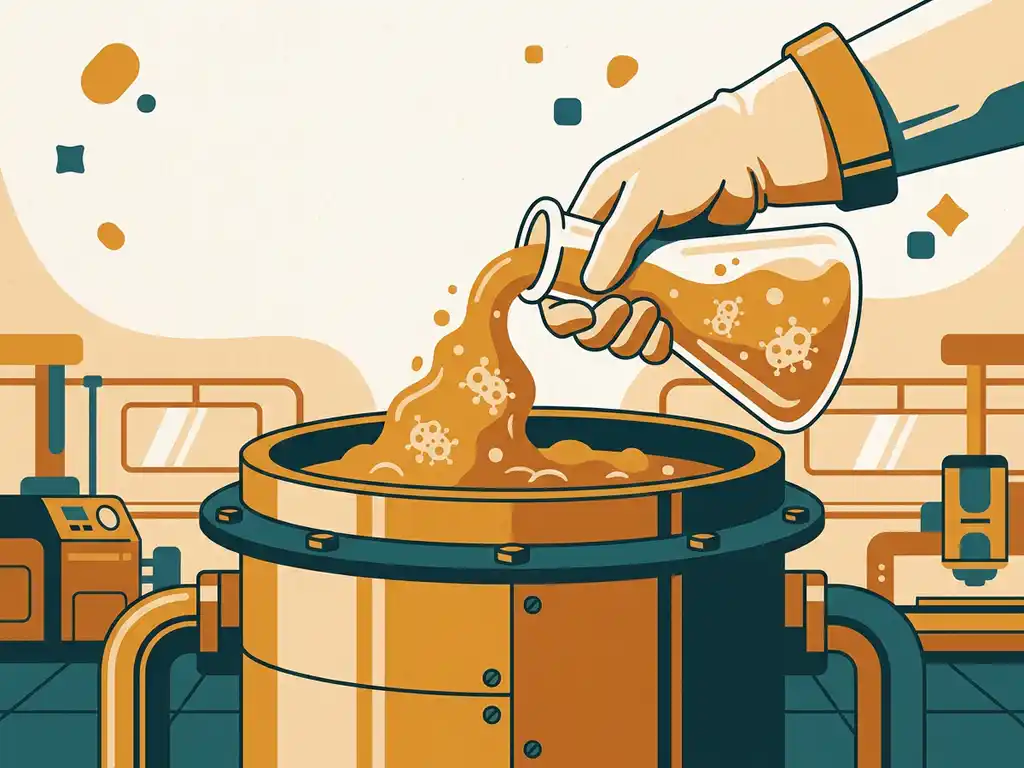
To seed a biological wastewater plant, you introduce a concentrated population of active microorganisms into the treatment system before or during startup. This gives the system a working microbial community from day one rather than waiting for bacteria to establish themselves naturally from the incoming wastewater alone. The sections below cover where that seed material comes from, how long it takes to become effective, and what can derail the process.
What bacteria are actually doing the work in a biological wastewater plant?
In a biological wastewater plant, the work is done by mixed microbial communities that break down dissolved organic compounds, convert nitrogen species, and remove phosphorus. These are not single strains but complex consortia of bacteria, archaea, and, in some systems, protozoa, each occupying a functional role in the treatment chain. The specific composition depends on the wastewater type, temperature, oxygen regime, and operating conditions.
In aerobic systems, heterotrophic bacteria oxidize carbon compounds and convert them into carbon dioxide, water, and new biomass. Autotrophic nitrifiers such as Nitrosomonas and Nitrobacter convert ammonium first to nitrite and then to nitrate. In anoxic zones, denitrifying bacteria reduce nitrate to nitrogen gas, completing the nitrogen cycle within the plant. Anaerobic systems rely on a layered consortium of fermenters, acetogens, and methanogenic archaea working in strict sequence to convert organic matter into biogas.
What makes biological treatment both powerful and sensitive is the interdependence of these groups. Disrupt one functional guild and the downstream steps stall. This is why the microbial community that populates a plant is not incidental; it is the process. Understanding which organisms are present and whether they are active in sufficient numbers is the starting point for any diagnosis of sludge problems in wastewater treatment.
Get in Touch
Let’s Talk Microbial Solutions
Book a conversation with Stijn, our CEO, or send us your request.
| Book an Appointment | Request Information |
What does ‘seeding’ a biological wastewater plant actually mean?
Seeding a biological wastewater plant means deliberately introducing a pre-established microbial community into a new or restarted treatment system to accelerate the development of a functional biofilm or activated sludge. Without seeding, a plant must wait for bacteria to colonize naturally from the incoming wastewater, a process that can take weeks to months before treatment performance reaches compliance levels.
In practice, seeding shortens the startup curve significantly. Instead of building a microbial community from scratch, the system begins with an active, diverse population already adapted to degrading organic matter, nitrifying ammonium, or performing whatever function the process requires. The seed material provides both the organisms and, to some extent, the ecological structure those organisms need to function: the microbial relationships, the extracellular matrix, and the population ratios that stable sludge depends on.
Seeding is also used during process correction. When an existing plant loses biological activity due to a toxic shock, an operational upset, or prolonged downtime, reintroducing active biomass can restore function faster than waiting for natural recovery. In this context, seeding is less about startup and more about resilience.
Where does the seed sludge come from?
Seed sludge typically comes from one of three sources: a well-performing municipal wastewater treatment plant, a similar industrial installation treating comparable wastewater, or a purpose-produced microbial inoculum developed for a specific application. The best choice depends on the target wastewater composition and the treatment objectives.
Municipal activated sludge is widely available and contains a broad community of heterotrophs and nitrifiers. It works well as a general starter culture for plants treating mixed organic loads. However, for industrial wastewater with unusual substrates, high concentrations of specific compounds, or extreme pH or temperature conditions, municipal sludge may lack the specialized degraders needed to achieve performance targets quickly.
A more targeted approach uses seed material from a plant treating similar wastewater. If a food processor is starting a new treatment system, sludge from another food-sector installation will already contain organisms adapted to fats, proteins, or sugars relevant to that stream. This narrows the adaptation period considerably.
For demanding or niche applications, purpose-produced inocula offer the most precision. These are developed through controlled enrichment, selecting for the functional guilds the process specifically requires. biological water treatment at this level of specificity is where microbial expertise rather than off-the-shelf sludge makes a measurable difference in startup time and treatment reliability.
How long does it take for seeded bacteria to become fully active?
After seeding, a biological wastewater plant typically reaches stable, compliant operation within two to eight weeks, depending on the process type, the quality of the seed material, and operating conditions during startup. Nitrification systems generally take longer than pure carbon removal systems because nitrifying bacteria grow slowly and are sensitive to disturbance.
In the first days after seeding, the introduced organisms are adapting to their new environment: the substrate composition, temperature, hydraulic loading, and oxygen regime. During this period, treatment efficiency is partial and variable. The system should be loaded gradually rather than at full design capacity to avoid overwhelming the developing community before it has established itself.
By weeks two to four, carbon removal typically stabilizes in well-seeded aerobic systems. Nitrification lags behind, often not reaching consistent performance until week four to six or beyond. Anaerobic systems, particularly those targeting methane production, can take six to twelve weeks to reach stable biogas yields because methanogenic archaea grow especially slowly and are highly sensitive to overloading in the early phase.
The quality of the seed sludge matters as much as the quantity. A large volume of stressed or poorly active sludge will underperform compared to a smaller volume of healthy, concentrated biomass. This is why the origin and condition of the inoculum are as important as the seeding strategy itself.
What can go wrong during the seeding phase and how is it fixed?
The most common problems during the seeding phase are sludge bulking, washout of biomass, inhibition by toxic compounds in the incoming wastewater, and failure of nitrification to establish. Each has a distinct cause and a corresponding correction strategy. Recognizing which problem is occurring is the first step toward fixing it.
Sludge bulking and excess sludge problems
Sludge bulking in biological treatment occurs when filamentous bacteria outcompete floc-forming organisms, producing a light, poorly settling sludge that is difficult to retain in the system. During seeding, bulking is often triggered by low dissolved oxygen, high carbohydrate loading, or nutrient imbalance. The sludge volume index rises, and the secondary clarifier struggles to separate treated water from biomass.
Fixing sludge bulking requires addressing the root cause rather than treating symptoms. Increasing aeration, adjusting the food-to-microorganism ratio, and correcting nitrogen or phosphorus deficiencies in the feed are the primary interventions. In persistent cases, a targeted addition of floc-forming inoculum can help shift the microbial balance. Excess sludge in a wastewater plant during startup is a related issue: overloading the system before the community has stabilized produces more biomass than the clarifier can handle, compounding settling problems.
Inhibition and toxic shocks
Industrial wastewater occasionally contains compounds that are inhibitory to specific microbial groups, particularly nitrifiers. Heavy metals, biocides, cleaning agents, and high salt concentrations can suppress biological activity even at low concentrations. If nitrification fails to establish or collapses after initial progress, a toxic event in the feed is a likely cause.
The response is to identify and buffer the inhibitory input, reduce loading while the community recovers, and, if necessary, reseed the nitrification fraction. Molecular monitoring of the microbial community, using techniques such as quantitative PCR or 16S rRNA sequencing, can confirm whether nitrifier populations have declined and guide the decision to reinoculate.
When should you re-seed an existing biological wastewater plant?
An existing biological wastewater plant should be reseeded when the active microbial community has been severely depleted or functionally compromised and natural recovery is too slow to meet discharge standards. This happens after toxic shocks, prolonged shutdown, major operational upsets, or repeated overloading events that have eroded the biological population below functional thresholds.
The decision to reseed should be based on evidence rather than assumption. Signs that reseeding is warranted include a sustained rise in effluent COD or ammonium despite correct operating conditions, a collapse in sludge settleability that does not respond to standard corrective measures, or microbiological analysis showing the near-absence of key functional groups. Waiting and adjusting operating parameters is appropriate when the community is stressed but still present; reseeding is the response when it is effectively gone.
Reseeding an operating plant requires more care than seeding a new one. The existing sludge may be competing with or inhibiting the introduced organisms, and the hydraulic and loading conditions must be managed to give the new biomass time to establish. A partial replacement strategy, where a fraction of the existing sludge is removed and replaced with active inoculum, often works better than attempting a full restart.
For plants treating complex industrial streams, the question of how to fix sludge bulking in biological treatment or recover from a community collapse is rarely straightforward. The answer depends on the specific microbiology of the system, the wastewater composition, and the operational history. Avecom’s applied microbiology team works with industrial operators across the food, chemical, and pharmaceutical sectors to diagnose these situations and design targeted reseeding strategies, including microbiological audits and molecular community analysis to identify exactly what is missing before any inoculum is introduced.
Getting the microbial foundation right at the start, or restoring it effectively after a setback, is the difference between a treatment system that consistently meets discharge limits and one that is perpetually managed reactively. If your plant is struggling with sludge problems or you are planning a new biological treatment installation, contact Avecom for a no-obligation intake assessment.
Related Articles
- What fermentation applications exist in the agrochemical industry?
- Can contaminated soil be cleaned without digging it up?
- Can you fix sludge bulking without replacing the biomass?
- Why does sludge bulking happen in activated sludge systems?
- What causes sludge problems in biological wastewater treatment?