

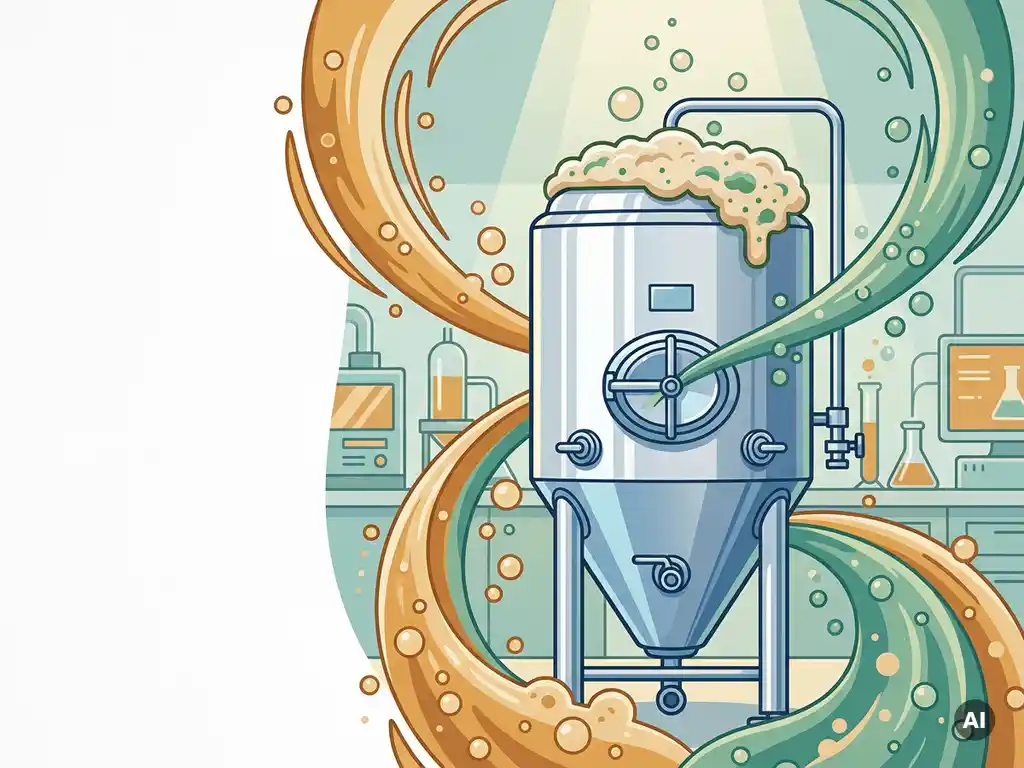
Aerobic fermentation is a microbial process in which microorganisms break down organic substrates in the presence of oxygen to produce biomass, enzymes, organic acids, or other target compounds. Unlike anaerobic fermentation, which operates without oxygen and prioritizes metabolite production, aerobic fermentation channels most of the available energy into cell growth and biosynthesis. It is the preferred approach when your process goal is high biomass yield, efficient substrate conversion, or the production of aerobically synthesized compounds such as single-cell protein or certain enzymes. The sections below unpack the key questions that industrial R&D teams face when evaluating aerobic fermentation for a new process.
How does aerobic fermentation actually work?
In aerobic fermentation, microorganisms use oxygen as the terminal electron acceptor in their metabolic pathways. Organic substrates, sugars, organic acids, waste streams, or complex feedstocks, are oxidized through cellular respiration, generating ATP, carbon dioxide, water, and new biomass. Because oxygen enables complete substrate oxidation, aerobic processes are significantly more energy-efficient for the microorganism than anaerobic alternatives, which translates into higher biomass yields per gram of substrate consumed.
The practical implication for process design is that oxygen transfer becomes a critical control variable. In a bioreactor, dissolved oxygen must be maintained above a threshold that keeps the microbial community in fully aerobic metabolism. This is achieved through aeration (sparging air or pure oxygen into the vessel), agitation to break up gas bubbles and improve transfer rates, and real-time monitoring of dissolved oxygen sensors. When oxygen transfer lags behind microbial demand, a common problem during scale-up, the culture can shift toward mixed or anaerobic metabolism, producing unwanted byproducts and reducing yield.
Temperature, pH, nutrient supply, and inoculum quality are equally important parameters. In a well-controlled aerobic fermentation, all of these variables are continuously monitored and adjusted to keep the microbial community performing at its optimum. This level of process control is precisely what distinguishes a validated pilot-scale process from a laboratory observation.
What are the main products of aerobic fermentation?
The main products of aerobic fermentation are microbial biomass, enzymes, organic acids, biosurfactants, and specialty biochemicals. Because aerobic metabolism favors growth over metabolite overflow, biomass itself is often the primary product, most notably in the production of single-cell protein, baker’s yeast, and probiotic cultures. Enzymes such as proteases, amylases, and lipases are also predominantly produced under aerobic conditions, as their biosynthesis requires the energy surplus that only oxidative metabolism can supply.
Beyond biomass and enzymes, aerobic fermentation is used to produce:
- Organic acids such as citric acid and gluconic acid, where specific aerobic organisms are selected for their metabolic overflow under oxygen-rich conditions
- Biosurfactants and biopolymers, which many aerobic bacteria produce as secondary metabolites
- Microbial protein from industrial side streams, an application area where mixed aerobic cultures can convert nutrient-rich wastewater into high-protein biomass
- Vitamins and cofactors, including riboflavin and coenzyme Q10, which are synthesized aerobically by specific microbial strains
The choice of product fundamentally shapes the process design. A biomass-focused process optimizes for growth rate and substrate conversion efficiency, while an enzyme production process may introduce specific induction steps or substrate shifts to trigger secretion. Understanding which product you are targeting is the first decision that determines whether aerobic fermentation is the right platform.
{div style=”box-sizing: border-box !important; margin: 32px 0 !important; padding: 28px 32px !important; background-color: #004070 !important; background-image: linear-gradient(135deg, #004070 0%, #003057 100%) !important; border: none !important; border-left: 4px solid #36a9e1 !important; font-family: ‘Exo’, sans-serif !important; text-align: center !important; line-height: normal !important;”}
{p style=”margin: 0 0 6px 0 !important; padding: 0 !important; font-family: ‘Exo’, sans-serif !important; font-size: 12px !important; font-weight: 500 !important; color: #36a9e1 !important; text-transform: uppercase !important; letter-spacing: 1.5px !important; line-height: 16px !important;”}Get in Touch{/p}
{p style=”margin: 0 0 8px 0 !important; padding: 0 !important; font-family: ‘Exo’, sans-serif !important; font-size: 20px !important; font-weight: 500 !important; color: #ffffff !important; line-height: 26px !important;”}Let’s Talk Microbial Solutions{/p}
{p style=”margin: 0 0 20px 0 !important; padding: 0 !important; font-family: ‘Exo’, sans-serif !important; font-size: 14px !important; font-weight: 300 !important; color: #ffffff !important; line-height: 20px !important;”}Book a conversation with Stijn, our CEO, or send us your request.{/p}
{table style=”border-collapse: collapse !important; border-spacing: 0 !important; margin: 0 auto !important; padding: 0 !important; width: auto !important;” cellpadding=”0″ cellspacing=”0″ role=”presentation”}
{tr style=”margin: 0 !important; padding: 0 !important;”}
{td style=”margin: 0 !important; padding: 0 6px 0 0 !important; white-space: nowrap !important;”}
{a href=”https://avecom.be/contact-2/” style=”display: inline-block !important; box-sizing: border-box !important; margin: 0 !important; padding: 11px 24px !important; background-color: #95c11f !important; color: #ffffff !important; font-family: ‘Exo’, sans-serif !important; font-size: 14px !important; font-weight: 500 !important; text-transform: uppercase !important; text-decoration: none !important; border: none !important; line-height: 18px !important; letter-spacing: 0.3px !important; white-space: nowrap !important;”}Book an Appointment{/a}
{/td}
{td style=”margin: 0 !important; padding: 0 !important; white-space: nowrap !important;”}
{a href=”https://avecom.callista.be/contactus” style=”display: inline-block !important; box-sizing: border-box !important; margin: 0 !important; padding: 9px 24px !important; background-color: transparent !important; color: #ffffff !important; font-family: ‘Exo’, sans-serif !important; font-size: 14px !important; font-weight: 500 !important; text-transform: uppercase !important; text-decoration: none !important; border: 2px solid #ffffff !important; line-height: 18px !important; letter-spacing: 0.3px !important; white-space: nowrap !important;”}Request Information{/a}
{/td}
{/tr}
{/table}
{/div}
What is the difference between aerobic and anaerobic fermentation?
The core difference between aerobic and anaerobic fermentation is the role of oxygen. Aerobic fermentation requires oxygen as the final electron acceptor, producing high biomass yields and carbon dioxide as the main byproduct. Anaerobic fermentation occurs without oxygen, generating metabolites such as ethanol, lactic acid, or biogas as the primary outputs, with significantly lower biomass yield per unit of substrate.
Energy efficiency and yield
Aerobic metabolism generates far more ATP per mole of glucose than anaerobic pathways. This energy surplus is invested in cell growth, which is why aerobic processes consistently produce more biomass. Anaerobic processes, by contrast, produce less biomass but accumulate metabolites, making them the preferred route when the target product is ethanol, lactic acid, acetic acid, or methane.
Process infrastructure and operational complexity
Aerobic fermentation demands active oxygen supply, which adds engineering complexity: aeration systems, agitators, and dissolved oxygen control loops are non-negotiable. Anaerobic fermentation avoids this cost but requires sealed, oxygen-free systems and often longer retention times. Operating costs differ accordingly: aerobic processes carry higher energy costs for aeration and mixing, while anaerobic systems invest more in gas handling and longer process cycles. Neither is inherently superior; the right choice depends entirely on the target product and feedstock.
When should you choose aerobic over anaerobic fermentation?
Choose aerobic fermentation when your target product is biomass, an aerobically synthesized enzyme, or a compound that requires oxidative biosynthesis pathways. Aerobic fermentation is also the better choice when you need fast process cycles, high substrate conversion efficiency, or when your feedstock is a dilute aqueous waste stream where maximizing biomass yield per unit of organic matter is economically important.
Specific situations that favor aerobic fermentation include:
- Single-cell protein production from food processing water, brewery effluent, or other organic side streams
- Enzyme manufacturing where the target protein requires aerobic cellular machinery for correct folding or secretion
- Biosurfactant or biopolymer production by aerobic bacterial strains
- Rapid proof-of-concept timelines where shorter fermentation cycles reduce experimental iteration time
- Applications where downstream processing is simplified by a dense, well-defined biomass rather than a complex metabolite mixture
Anaerobic fermentation remains preferable when the target is a reduced metabolite (ethanol, lactate, biogas), when energy input must be minimized, or when the substrate is better suited to anaerobic microbial communities. In practice, the decision often comes down to a structured feasibility assessment that maps the target product, feedstock chemistry, and process economics against both options before committing to infrastructure or scale-up investment.
What are the biggest challenges in scaling up aerobic fermentation?
The biggest challenges in scaling up aerobic fermentation are maintaining adequate oxygen transfer at larger volumes, managing heat generated by microbial metabolism, and preserving the process conditions that were established at lab scale. Each of these factors behaves differently as reactor volume increases, and failure to account for them is the most common reason that aerobic fermentation processes that work cleanly at bench scale underperform at pilot or production scale.
Oxygen transfer and mixing
At lab scale, oxygen transfer is relatively straightforward because the ratio of surface area to volume is favorable and mixing is rapid. At pilot scale, this ratio decreases sharply. The volumetric oxygen transfer coefficient (kLa) must be actively engineered through impeller design, sparger geometry, and airflow rates. If kLa is insufficient, dissolved oxygen drops below the critical threshold and the culture shifts metabolism, reducing yield and potentially accumulating unwanted byproducts. Characterizing kLa across scales before committing to a scale-up step is a non-negotiable part of sound aerobic fermentation process development.
Heat management and process consistency
Aerobic microbial metabolism generates substantial heat, particularly at high cell densities. At small scale, temperature control is straightforward. At pilot and production scale, heat removal requires properly sized cooling jackets or internal coils, and temperature gradients within the vessel can create zones where cells experience different conditions. Similarly, pH gradients can develop in large reactors if base or acid addition is localized. These heterogeneities are invisible at lab scale but become significant contributors to batch-to-batch variability at larger volumes. Addressing them requires careful bioreactor engineering and, ideally, computational fluid dynamics modeling before scale-up decisions are finalized.
Who should consider aerobic fermentation for industrial applications?
Industrial companies and R&D teams should consider aerobic fermentation when they are working with biomass-derived products, aerobically produced enzymes, or when they need to valorize organic side streams into high-value microbial products. It is particularly relevant for food ingredient producers, biotech scale-ups developing protein or enzyme platforms, and companies in the circular economy space looking to convert waste streams into marketable outputs.
The profile of organizations that benefit most from aerobic microbial fermentation typically includes:
- Food and feed ingredient companies exploring single-cell protein or fermentation-derived additives as alternatives to conventional protein sources
- Biotech scale-ups with a validated lab concept that need pilot-scale proof before approaching investors or industrial partners
- Agrochemical and specialty chemical producers evaluating biosurfactants, biostimulants, or enzyme-based products as sustainable alternatives to synthetic inputs
- Industrial companies with organic side streams, brewery waste, food processing water, starch effluent, that represent an underutilized resource rather than a disposal cost
For organizations without in-house fermentation infrastructure, the practical path to validating an aerobic fermentation concept is partnering with a specialized contract R&D provider. Avecom’s biomass fermentation services cover the full development arc from lab-scale feasibility through pilot-scale validation, with aerobic and anaerobic bioreactors up to 2,000 liters and the molecular monitoring tools needed to understand and control mixed microbial communities throughout the process. For teams under time pressure to deliver proof of concept, this kind of external infrastructure removes the capital barrier and compresses the timeline significantly.
Related Articles
- What is anaerobic fermentation used for in industry?
- How do you compare fermentation partners before signing a contract?
- What causes poor sludge settling in a food industry wastewater plant?
- How do you restart a biological wastewater plant after sludge failure?
- How do filamentous bacteria cause sludge bulking?